
Verification of Competency (Magnetic Drill) Template
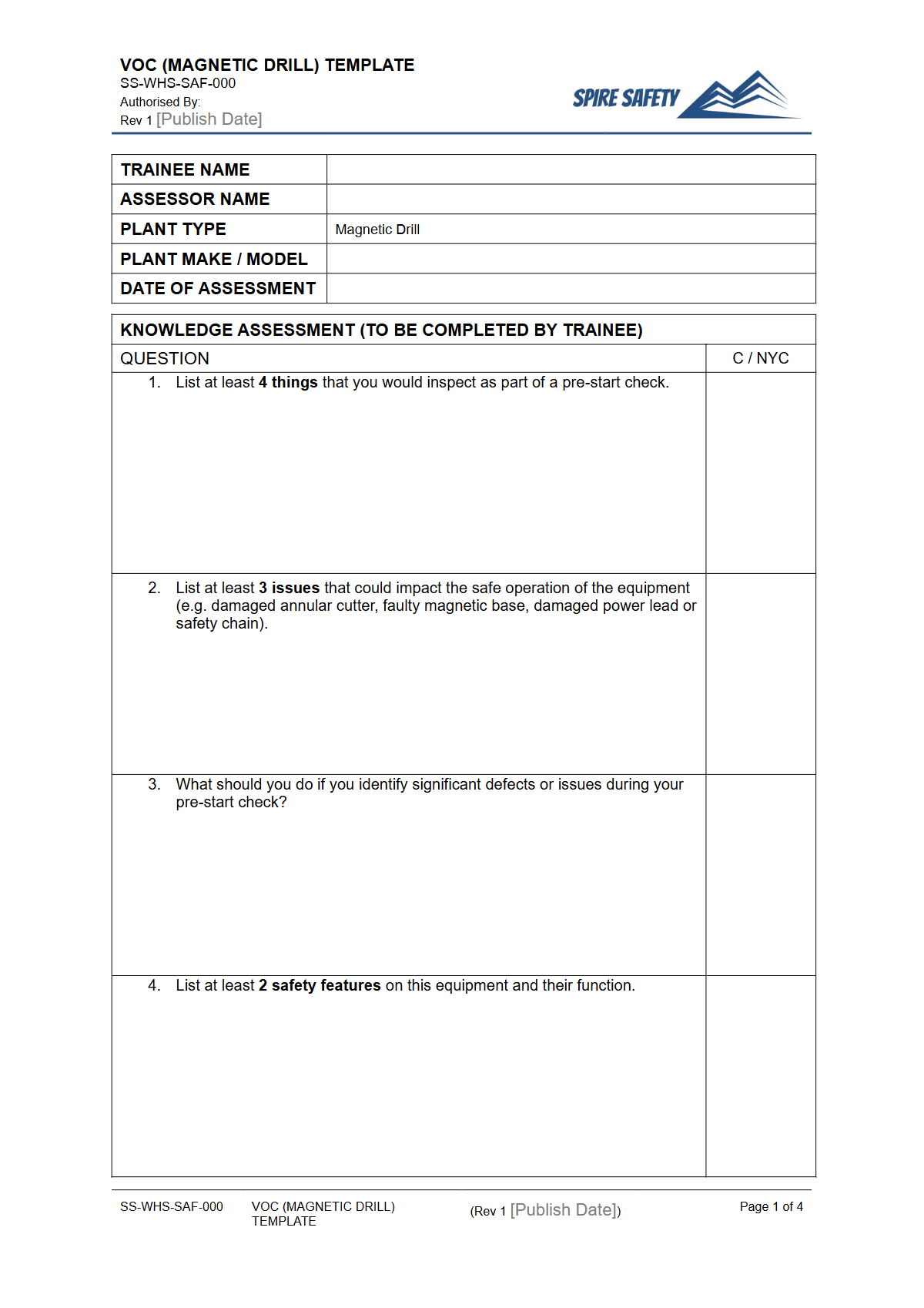
Download our free Magnetic Drill Verification of Competency (VOC) template. A critical tool for ensuring safe operations. Get your copy today!
Verification of Competency (Magnetic Drill) Template
DOCX • 138 KB + PDF
Updated Oct 2026
No signup required
Purpose of the Verification of Competency (Magnetic Drill) Template
Our free Verification of Competency (Magnetic Drill) Template is designed to help Australian businesses formally assess and document the skills and knowledge of workers operating magnetic drills. Recognising that the safe operation of plant and equipment, like a magnetic drill, is paramount in any workplace, this template provides a structured framework for evaluating competence in line with Australian WHS practices.
It supports organisations in upholding their primary duty of care by ensuring workers possess the necessary capabilities to perform tasks safely, thereby mitigating risks associated with powerful drilling machinery.
Using a free WHS resource like this Verification of Competency template is a proactive step in managing workplace safety. It aids in demonstrating due diligence by providing tangible evidence of competency assessments.
This magnetic drill VOC template focuses on key operational aspects, safety procedures, and relevant compliance requirements specific to this type of equipment, ensuring a thorough evaluation process.
Video walkthrough
How to use the Verification of Competency (Magnetic Drill) Template
To effectively use this free Verification of Competency (Magnetic Drill) Template, download it in either DOCX or PDF format. The DOCX version is fully editable, allowing you to tailor it precisely to your organisation's specific needs, equipment models, and internal safety procedures. Please note: This template is a starting point and must be customised to your specific workplace before use. I recommend reviewing all sections and adapting them to reflect your unique operational environment.
The template outlines various competencies, including pre-operational checks, safe operating techniques, emergency procedures, and correct power isolation methods. It functions as a checklist and assessment record for a qualified supervisor or assessor to complete.
Documenting the assessment findings helps in identifying any gaps in a worker's knowledge or skill set, prompting further training or supervision where necessary. For comprehensive safety management, consider integrating this with your broader WHS management systems.
What is a Magnetic Drill?
A magnetic drill, often called a mag drill, is a portable drilling machine equipped with an electromagnetic base. This base allows it to adhere powerfully to ferromagnetic materials, like steel, enabling it to drill accurately and safely in various orientations, including horizontal, vertical, and overhead positions.
They are predominantly used in construction, fabrication, and structural engineering for creating holes in heavy-duty materials, offering superior stability and precision compared to conventional hand drills. Due to their power and application, proper training and competency verification are essential to prevent accidents and injuries.
Understanding the specific operating principles and safety considerations of plant like magnetic drills is crucial for effective risk management. Similar to other complex machinery, such as a hammer drill or drill press, magnetic drills require operators to be fully aware of potential hazards, including electrical risks, pinch points, and entanglement.
When to use it
This Verification of Competency (Magnetic Drill) Template should be used in several critical situations to ensure ongoing workplace safety:
- New Employees: Before a new worker operates a magnetic drill for the first time, even if they claim prior experience.
- New Equipment: When new models of magnetic drills are introduced to the workplace, requiring familiarisation.
- Refresher Training: Periodically, as part of scheduled refresher training, to reinforce safe operating procedures and update workers on any new safety protocols or equipment modifications.
- Incident Follow-up: After an incident or near-miss involving a magnetic drill, to re-assess the operator's competency and identify any contributing factors.
- Workplace Changes: When there are significant changes to tasks, work environments, or WHS procedures that might impact the safe operation of the drill.
- Performance Management: If concerns arise about a worker's ability to safely operate the magnetic drill.
Who should use it
This template is primarily intended for:
- WHS Managers and Officers: To implement and oversee the competency assessment program for plant operators.
- Supervisors and Team Leaders: To conduct the actual assessments, as they are often closest to the daily operations and can observe practical application.
- Trainers and Assessors: Individuals responsible for delivering WHS training and evaluating worker competence within an organisation.
- Business Owners and Directors: To ensure their organisation has robust systems in place for verifying worker competency, fulfilling their WHS obligations.
Ensuring that the right people are using these tools consistently is vital for maintaining a strong safety culture. For expert guidance on implementing such frameworks, consider engaging in WHS consulting services.
Related Verifications of Competency
Beyond magnetic drills, Spire Safety offers a range of free VOC templates for various plant and equipment. These resources are designed to help businesses manage competency across a wide spectrum of machinery.
Explore other relevant templates such as the Mitre Saw VOC, the Lathe VOC, or the Reciprocating Saw VOC. Each template provides a tailored assessment framework to address the specific risks and operational requirements of the equipment, helping to cultivate a safer working environment across your operations. Proper VOCs are crucial for reducing the likelihood of incidents and fostering a proactive approach to safety.
Common mistakes
Common mistakes to avoid
- Not verifying current competence, leading to untrained operators.
- Using a generic VOC template without customising it to specific equipment or workplace conditions.
- Failing to conduct periodic re-assessments or refresher training for operators.
- Not documenting VOC outcomes, leaving no auditable trail of competency verification.
Legal references
Legal considerations
The following legal requirements may be relevant to this type of work.
- Work Health and Safety Act (Harmonised) — Provides the primary duties for protecting workers and other people from work health and safety risks.
- Work Health and Safety Regulations (Harmonised) — Sets out requirements supporting the management of workplace hazards and risks.
The following codes may be relevant to this type of work.
- Managing WHS Risks Code of Practice — Provides practical guidance on identifying hazards, assessing risks and applying effective controls.
- Work Health and Safety Consultation, Cooperation and Coordination Code of Practice — Provides practical guidance on consulting workers and coordinating with other duty holders.
- Managing the Work Environment and Facilities Code of Practice — Provides practical guidance on safe work environments, workplace facilities and related controls.
Did you know
Magnetic Drill Power
Magnetic drills can exert thousands of pounds of holding force, making them incredibly stable but also requiring careful handling during setup and operation to prevent injury from unexpected releases or shifts.
Coolant Importance
Using cutting fluid or coolant with a magnetic drill significantly extends the life of drill bits and improves cutting efficiency by reducing heat and friction, which are critical for precision and safety.
FAQ
Frequently asked questions
01What is the primary benefit of using a Magnetic Drill VOC template?
02How often should magnetic drill operators undergo VOC assessment?
03Can I modify this VOC template to suit my specific magnetic drill model?
04Who should conduct the competency assessment for a magnetic drill?
Share this resource
Verification of Competency (Magnetic Drill) Template
Browse Categories
How To Use It
- 1Download and open in Word or PDF.
- 2Replace the placeholders with your business details.
- 3Get it reviewed by a WHS specialist before rollout.
Need it customised?
Our WHS consultants can adapt this template to your site, run a gap analysis, or audit what you already have in place.
Book a Free Consultation WHS consulting servicesor call 1300 156 382
Related templates
- Verification of Competency (Metal Cut-Off Saw) Template
- Verification of Competency (MIG Welder) Template
- Verification of Competency (Mini Excavator) Template
- Verification of Competency (Mortar Mixer) Template
- Verification of Competency (Multi-Tool (Oscillating Tool)) Template
- Verification of Competency (Orbital Sander) Template