
Verification of Competency (Orbital Sander) Template
Download our free Verification of Competency (Orbital Sander) Template. Ensure worker competency and safety with this essential WHS document. Get started today!
Verification of Competency (Orbital Sander) Template
DOCX • 138 KB + PDF
Updated Oct 2026
No signup required
Purpose of the Verification of Competency (Orbital Sander) Template
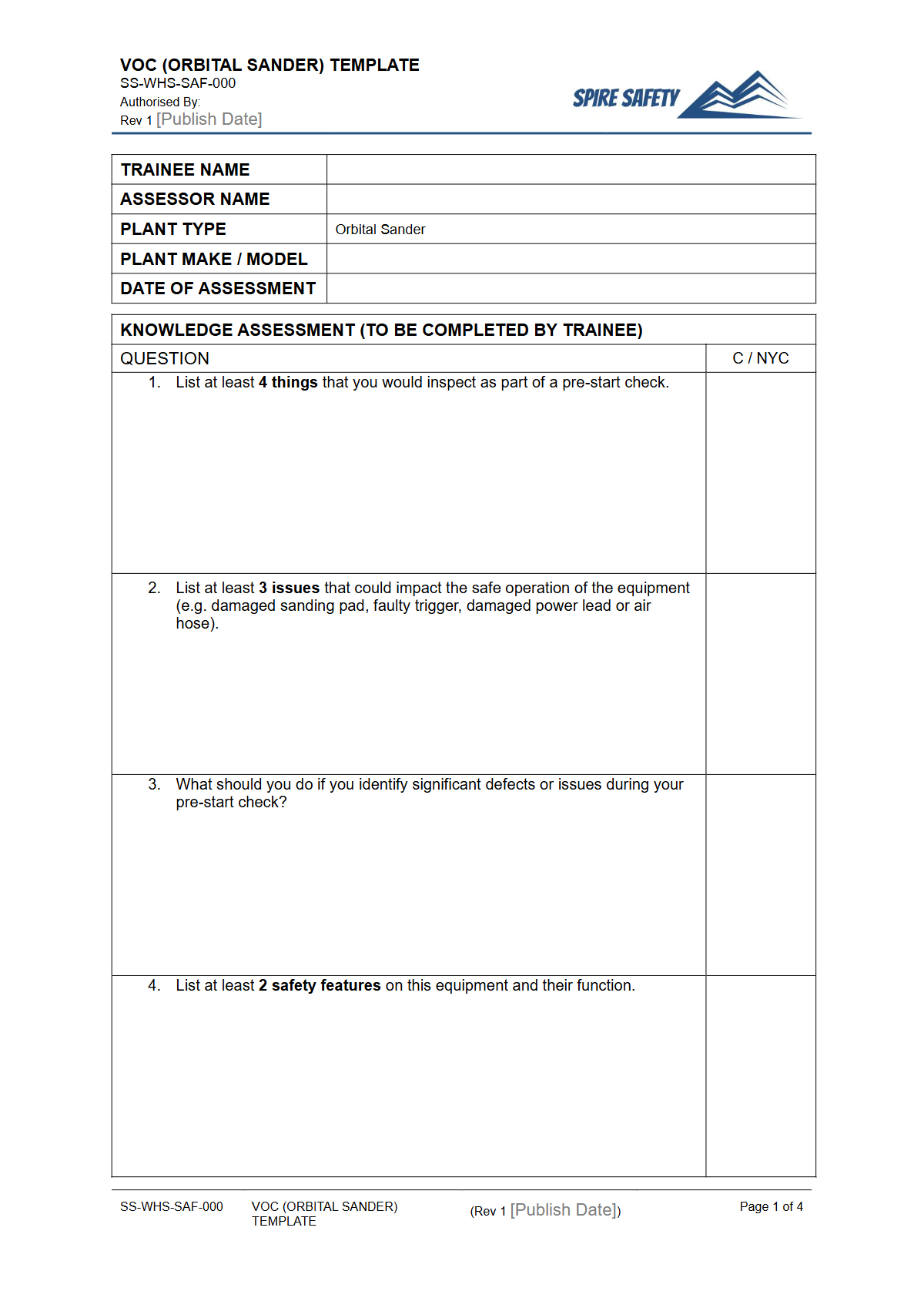
Our free Verification of Competency (Orbital Sander) Template provides a structured framework for assessing and documenting a worker's ability to safely and competently operate an orbital sander. This template assists Australian businesses in meeting their obligations to ensure workers have the necessary skills and knowledge for tasks involving plant and equipment.
Utilising a robust competency verification process is crucial for managing WHS risks associated with plant operation, helping to prevent incidents and injuries.
An orbital sander, while a common tool, presents inherent hazards such as entanglement, dust inhalation, vibration exposure, and electrical risks. Effective training and verification ensure workers understand these risks and can implement appropriate control measures.
This template is designed to guide supervisors through observing critical operational aspects, safety checks, and emergency procedures specific to orbital sander use, contributing to a safer work environment.
Video walkthrough
How to use the Verification of Competency (Orbital Sander) Template
This Verification of Competency (Orbital Sander) Template is a downloadable, editable document offered in both DOCX and PDF formats, providing flexibility for your organisation's needs. To effectively use it, first, download the template and customise it to reflect the specific orbital sander models used in your workplace, your organisational policies, and any unique workplace hazards.
Remember, this is a starting point; it must be customised to your workplace and its specific equipment and procedures to be effective and aligned with Australian WHS practice.
The template outlines a series of tasks and knowledge areas relevant to orbital sander operation. A competent assessor, typically a supervisor or an experienced operator with formal assessment training, should observe the worker performing these tasks.
Each criterion should be marked off as either competent or requiring further training. Detailed comments sections are provided to document observations, areas for improvement, and any specific safety concerns.
This process should be undertaken in a controlled environment, free from distractions, to ensure an accurate assessment of skill and safety behaviour.
When to use it
A Verification of Competency for an orbital sander should be completed in several key scenarios. This includes new employees who will be operating the equipment, existing employees whose competency needs to be re-verified due to a change in equipment, a change in work procedures, or following an incident or near-miss.
Regular periodic re-verification, as determined by your WHS management system, is also good practice to ensure skills remain current and safe work habits are maintained. Furthermore, if a worker returns to operating an orbital sander after an extended period away from the task, a VOC can help confirm their continued proficiency and understanding of current safety protocols.
This proactive approach helps to mitigate risks and ensures workers are always operating safely.
Who should use it
This Verification of Competency (Orbital Sander) Template is ideal for WHS officers, supervisors, team leaders, and trainers responsible for ensuring worker competence and safety in Australian workplaces. Business owners and managers also benefit from using such templates to fulfil their primary duty of care obligations to provide a safe working environment.
Any individual tasked with assessing the operational capabilities and safety awareness of workers using orbital sanders should utilise this tool. It establishes a clear, consistent, and documented process for competency verification, which is a vital component of any robust WHS program.
For plant like a mitre saw or even a skid-steer loader, similar VOC processes apply.
Benefits of competency verification
Implementing a rigorous competency verification process for tools like orbital sanders offers numerous benefits beyond basic compliance. It proactively identifies skill gaps, allowing for targeted training interventions before incidents occur.
This reduces the likelihood of workplace injuries, property damage, and costly production delays. A well-documented VOC process also demonstrates an organisation's commitment to WHS, fostering a culture of safety and professionalism among workers.
It provides robust evidence for internal audits and external regulatory inquiries, showcasing due diligence in worker competency. For comprehensive support in managing WHS obligations, consider engaging in general WHS consulting to ensure your systems are robust.
Common mistakes
Common mistakes to avoid
- Not customising the template to specific workplace equipment and procedures.
- Failing to conduct practical observation alongside theoretical knowledge assessment.
- Skipping regular re-verification processes, especially after incidents or equipment changes.
- Allowing untrained or unverified workers to operate equipment.
Legal references
Legal considerations
The following legal requirements may be relevant to this type of work.
- Work Health and Safety Act (Harmonised) — Provides the primary duties for protecting workers and other people from work health and safety risks.
- Work Health and Safety Regulations (Harmonised) — Sets out requirements supporting the management of workplace hazards and risks.
The following codes may be relevant to this type of work.
- Managing WHS Risks Code of Practice — Provides practical guidance on identifying hazards, assessing risks and applying effective controls.
- Work Health and Safety Consultation, Cooperation and Coordination Code of Practice — Provides practical guidance on consulting workers and coordinating with other duty holders.
- Managing the Work Environment and Facilities Code of Practice — Provides practical guidance on safe work environments, workplace facilities and related controls.
Did you know
Dust Exposure Risks
Operating an orbital sander can generate significant fine dust, which, if not properly controlled, can lead to respiratory issues. Always use appropriate dust extraction and respiratory protective equipment.
FAQ
Frequently asked questions
01What is a Verification of Competency (VOC) for an orbital sander?
02Why is it important to verify competency for orbital sander use?
03Who can perform a VOC assessment for an orbital sander?
04How often should orbital sander competency be re-verified?
Share this resource
Verification of Competency (Orbital Sander) Template
Browse Categories
How To Use It
- 1Download and open in Word or PDF.
- 2Replace the placeholders with your business details.
- 3Get it reviewed by a WHS specialist before rollout.
Need it customised?
Our WHS consultants can adapt this template to your site, run a gap analysis, or audit what you already have in place.
Book a Free Consultation WHS consulting servicesor call 1300 156 382
Related templates
- Verification of Competency (Overhead Bridge Crane) Template
- Verification of Competency (Oxy-Acetylene Welding Equipment) Template
- Verification of Competency (Pallet Jack (Electric)) Template
- Verification of Competency (Pipe Cutter) Template
- Verification of Competency (Pipe Threader) Template
- Verification of Competency (Plasma Cutter)