
Verification of Competency (Pipe Cutter) Template
Download our free Verification of Competency (Pipe Cutter) Template to help assess worker competence. A structured starting point for your WHS needs.
Verification of Competency (Pipe Cutter) Template
DOCX • 138 KB + PDF
Updated Oct 2026
No signup required
Purpose of the Verification of Competency (Pipe Cutter) Template
Our free Verification of Competency (Pipe Cutter) Template is designed to assist Australian businesses in formally assessing and documenting the competence of workers operating pipe cutting equipment. Utilising a pipe cutter requires specific skills and knowledge to ensure both efficiency and safety.
This template provides a structured framework, enabling you to verify that operators possess the necessary abilities to perform tasks safely and effectively, reducing risks associated with incorrect operation or lack of proficiency. It’s an essential tool for maintaining high safety standards and ensuring compliance within your workplace.
A robust WHS management system incorporates such verification processes to proactively manage risks. By consistently verifying competency, organisations can enhance their overall safety culture and minimise incidents.
Video walkthrough
How to use the Verification of Competency (Pipe Cutter) Template
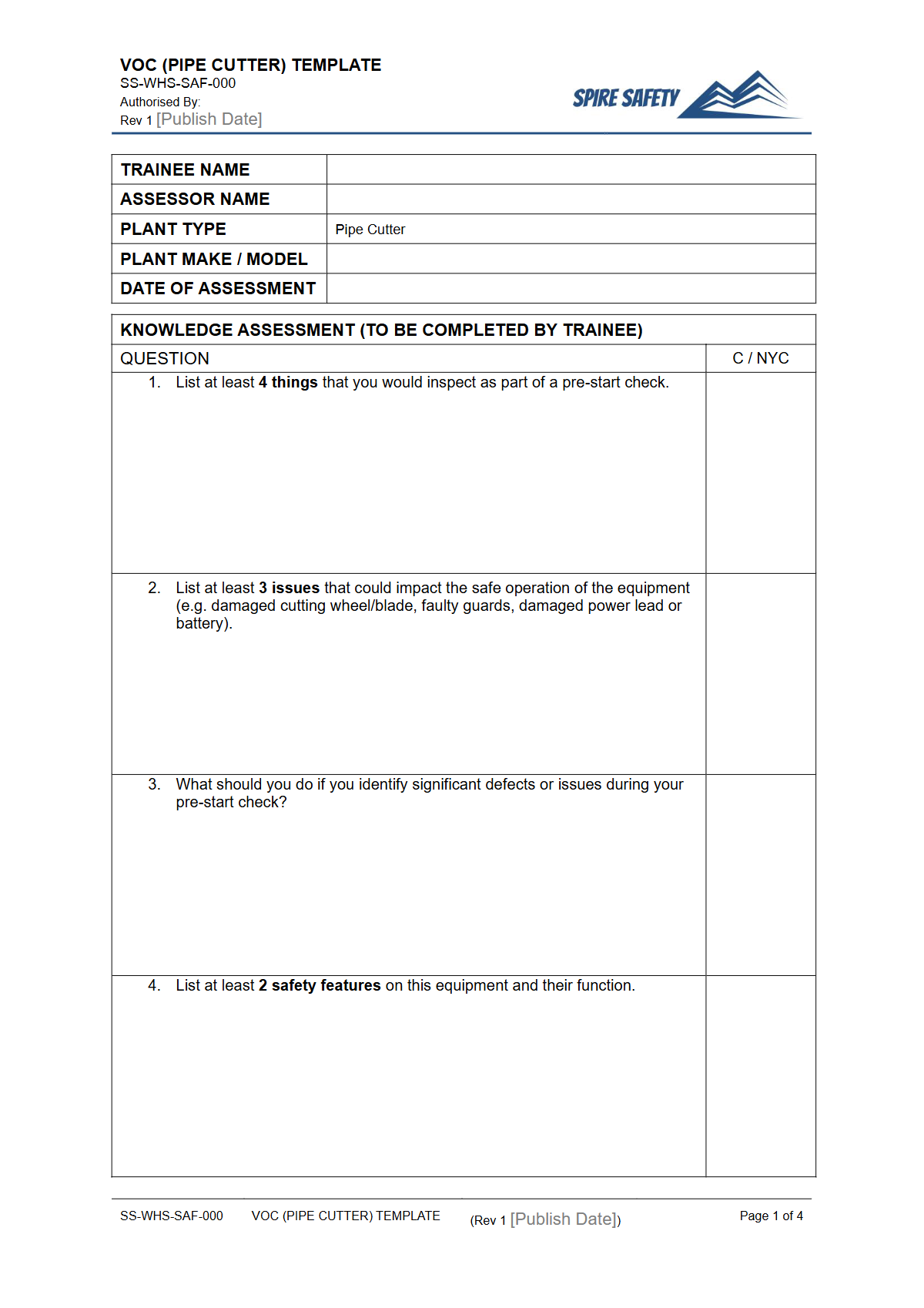
This Verification of Competency (Pipe Cutter) Template offers a comprehensive checklist for assessing an individual's knowledge and practical skills related to operating pipe cutting machinery. It covers key areas such as pre-operational checks, safe operating procedures, identification of hazards, emergency protocols, and post-operation maintenance.
The template prompts assessors to observe performance, ask targeted questions, and review relevant documentation, ensuring a thorough evaluation.
To effectively use this resource, download it in your preferred format (DOCX or PDF) and familiarise yourself with its sections. Conduct the assessment in a controlled environment, following all manufacturer guidelines for the specific pipe cutter model in use.
Remember, this template is a starting point; it must be customised to your specific workplace conditions, the particular pipe cutting equipment being used, and the unique risks present in your operational environment. After completion, ensure all parties sign off on the assessment, and maintain a record as part of your WHS documentation. For other equipment, consider our Mitre Saw VOC Template or a Brush Cutter VOC Template.
When to use it
Implementing a Verification of Competency (VOC) for pipe cutter operators is crucial in several scenarios. It should be used for all new employees required to operate pipe cutting equipment, even if they possess prior certifications.
Regular reassessments are vital, particularly if there are changes to equipment models, operating procedures, or WHS regulations. After an incident or near-miss involving a pipe cutter, a VOC can help identify potential skill gaps or areas for retraining.
Furthermore, if an operator has been absent from pipe cutting duties for an extended period, a refresher VOC is highly recommended to ensure their skills remain current and sharp. Including VOCs as part of routine WHS consulting can significantly enhance workplace safety.
Who should use it
This template is ideal for WHS managers, supervisors, team leaders, and trainers responsible for overseeing work activities involving pipe cutting equipment. Operators themselves can also use it as a self-assessment tool to understand expected competencies.
Employers, particularly those in manufacturing, construction, plumbing, or any industry where pipe installation or modification occurs, will find this a valuable asset. Anyone tasked with ensuring worker competency and compliance with WHS duties will benefit from this structured approach to verifying skills and knowledge.
Explore our Vac Truck VOC or Skid-Steer Loader VOC templates for other specific machinery.
Common mistakes
Common mistakes to avoid
- Failing to customise the VOC template for specific pipe cutter models or workplace conditions.
- Not conducting practical assessments under realistic operating conditions.
- Overlooking regular re-verification, especially after incidents or operational changes.
- Assuming prior certification automatically equates to current competency without verification.
- Inadequate record-keeping of completed VOC assessments.
Legal references
Legal considerations
The following legal requirements may be relevant to this type of work.
- Work Health and Safety Act (Harmonised) — Provides the primary duties for protecting workers and other people from work health and safety risks.
- Work Health and Safety Regulations (Harmonised) — Sets out requirements supporting the management of workplace hazards and risks.
The following codes may be relevant to this type of work.
- Managing WHS Risks Code of Practice — Provides practical guidance on identifying hazards, assessing risks and applying effective controls.
- Work Health and Safety Consultation, Cooperation and Coordination Code of Practice — Provides practical guidance on consulting workers and coordinating with other duty holders.
- Managing the Work Environment and Facilities Code of Practice — Provides practical guidance on safe work environments, workplace facilities and related controls.
Did you know
Precision Matters
Even a slight misalignment in pipe cutting can lead to serious structural integrity issues or leaks, highlighting the importance of precise and competent operation.
Diverse Applications
Pipe cutters are used across a vast range of industries, from plumbing and HVAC to heavy construction and mining, demonstrating the widespread need for skilled operators.
FAQ
Frequently asked questions
01What is a Verification of Competency (VOC)?
02Why is verifying competency for pipe cutter operators important?
03How often should pipe cutter operator competency be re-verified?
04Can this template be used for all types of pipe cutters?
Share this resource
Verification of Competency (Pipe Cutter) Template
Browse Categories
How To Use It
- 1Download and open in Word or PDF.
- 2Replace the placeholders with your business details.
- 3Get it reviewed by a WHS specialist before rollout.
Need it customised?
Our WHS consultants can adapt this template to your site, run a gap analysis, or audit what you already have in place.
Book a Free Consultation WHS consulting servicesor call 1300 156 382