
Verification of Competency (Portable Welding Machine)
Ensure your operators are competent with our Verification of Competency (Portable Welding Machine) template. Aligned with Australian WHS practice. Download now.
Verification of Competency (Portable Welding Machine)
DOCX • 138 KB + PDF
Updated Oct 2026
No signup required
Purpose of the Verification of Competency (Portable Welding Machine)
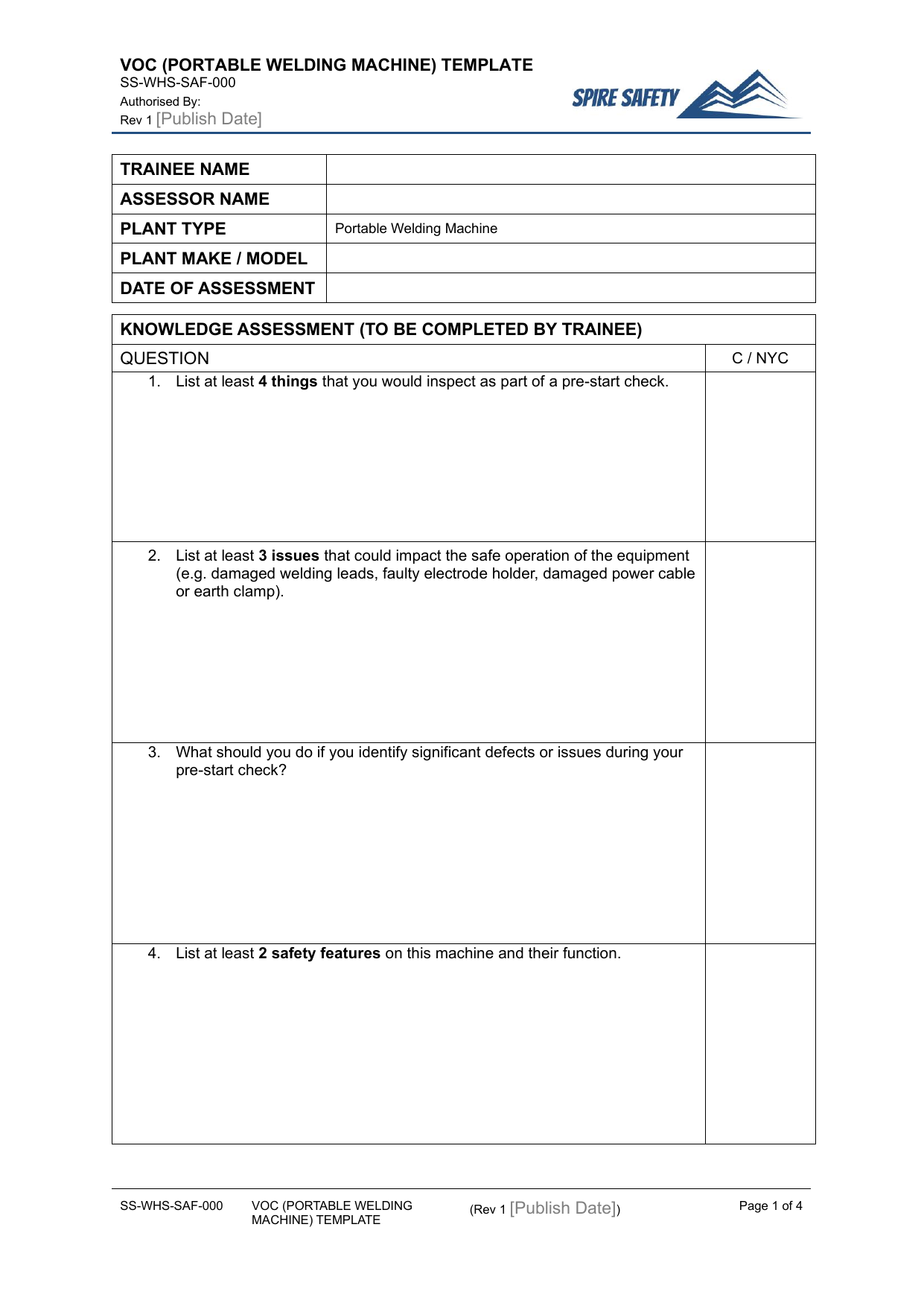
A Verification of Competency (VOC) is a practical assessment used to confirm that a worker has the current skills, knowledge, and experience to operate a piece of plant safely and competently. This Verification of Competency (Portable Welding Machine) template provides a structured method for an organisation to assess an operator's ability to use portable welding equipment according to established procedures and WHS standards.
It is not a substitute for formal training but serves to verify that previously acquired skills are maintained and applied correctly in the workplace.
Using this VOC helps a Person Conducting a Business or Undertaking (PCBU) meet their primary duty of care under WHS law. It creates a formal record demonstrating that steps have been taken to ensure plant is used by competent individuals, which is a critical component of a comprehensive WHS management system. The assessment covers pre-start checks, operational techniques, hazard identification, and shutdown procedures specific to portable welders.
Video walkthrough
How to use the Verification of Competency (Portable Welding Machine)
To effectively use this Verification of Competency (Portable Welding Machine) document, a competent and experienced person (the assessor) should observe the worker (the participant) as they perform tasks with the equipment in a controlled environment. The assessor should use the checklist to record observations against each competency criteria, noting where the participant meets or does not meet the required standard.
The process should include both a theory component (questioning) and a practical demonstration.
Important: It is crucial to customise this template. We've provided a structured starting point, but you must adapt it to reflect your specific portable welding machine models (e.g., MIG, TIG, Stick), unique site conditions, and organisational procedures.
For example, the hazards associated with oxy-fuel processes differ from arc welding, just as our Verification of Competency for plasma cutters addresses risks unique to that equipment.
When to use it
Conducting a VOC is an ongoing process, not a one-time event. It should be performed at key points in a worker's employment lifecycle and as part of regular safety assurance activities. Key triggers for using this VOC include:
- Pre-employment: To verify the claimed experience of a new hire before they commence work.
- New Equipment: Before a worker uses a new make or model of portable welder for the first time.
- Post-Incident: As part of a corrective action following a safety incident or near-miss involving a welding machine.
- Refresher Assessment: Periodically (e.g., every 2-3 years) to ensure skills have not diminished over time.
- Observed Behaviour: If a supervisor observes unsafe or non-compliant operation of the equipment.
These verifications form an essential part of your safety processes, similar to assessments for other hot work equipment like the process outlined in our Oxy-Acetylene Welding Equipment VOC. The records from these assessments are valuable evidence of your safety management practices and may be reviewed during independent WHS compliance audits.
Who should use it
Several key roles are involved in the VOC process. The primary user of this template is the assessor, who must be competent and experienced not only in operating portable welders but also in conducting assessments.
This could be a supervisor, a leading hand, an internal trainer, or a dedicated WHS advisor.
The participant—the worker being assessed—is also a key user, as the process provides them with clear feedback on their performance. For a VOC to be effective, it must be a transparent and constructive process, focused on safety and improvement, not just compliance.
This consistent approach to competency can be applied across a range of workshop equipment, such as when conducting a bench grinder VOC to ensure operator safety.
Key Hazards to Assess
When customising this template, ensure it prompts the assessor to look for evidence that the operator can manage the specific hazards associated with portable welding. These include, but are not limited to:
- Electrical Hazards: Correct inspection of leads, plugs, and connections; understanding of risks in damp environments; and proper earthing.
- Fumes and Gases: Awareness of the need for local exhaust ventilation (LEV) or appropriate respiratory protective equipment (RPE) to control exposure to hazardous fumes.
- Fire and Explosion: Competence in conducting pre-work inspections for flammable materials, ensuring fire extinguishers are present, and complying with any hot work permit systems.
- Radiation: Correct use of personal protective equipment (PPE) like welding helmets with appropriate filter lenses, gloves, and protective clothing to prevent arc eye and skin burns from UV and IR radiation.
- Manual Tasks: Safe techniques for lifting and moving the portable welding unit to prevent musculoskeletal injury.
Documenting competency across these hazard controls is vital. This structured approach is transferable to other plant assessments, such as our pipe threader VOC. You can find more templates and checklists in our free WHS resources library to build out your site's competency framework.
Common mistakes
Common mistakes to avoid
- Using a generic VOC template without customising it for the specific welding machine and workplace hazards.
- Treating the VOC as a 'tick-and-flick' exercise without genuine observation and interaction.
- Confusing a VOC with initial training or formal qualifications; it is a verification of existing skills, not a training session.
- Failing to document the assessment outcome, feedback provided, and any required follow-up actions like gap training.
Legal references
Legal considerations
The following legal requirements may be relevant to this type of work.
- Work Health and Safety Act (Harmonised) — Provides the primary duties for protecting workers and other people from work health and safety risks.
- Work Health and Safety Regulations (Harmonised) — Sets out requirements supporting the management of workplace hazards and risks.
The following codes may be relevant to this type of work.
- Managing WHS Risks Code of Practice — Provides practical guidance on identifying hazards, assessing risks and applying effective controls.
- Work Health and Safety Consultation, Cooperation and Coordination Code of Practice — Provides practical guidance on consulting workers and coordinating with other duty holders.
- Managing the Work Environment and Facilities Code of Practice — Provides practical guidance on safe work environments, workplace facilities and related controls.
Did you know
Welding Fumes Are Carcinogenic
In 2017, the International Agency for Research on Cancer (IARC) reclassified welding fumes as a 'Group 1' carcinogen, meaning there is sufficient evidence they cause cancer in humans.
Arc Eye Risk
The UV radiation from a welding arc can cause a painful condition called photokeratitis or 'arc eye' in seconds. It is a burn to the cornea that feels like sand in the eyes and can cause temporary vision loss.
FAQ
Frequently asked questions
01Is a Verification of Competency the same as a welding ticket or licence?
02How often should I conduct a VOC for a portable welder?
03Can this VOC template be used for all portable welders (e.g., MIG, TIG, Stick)?
04What happens if a worker is found 'not yet competent'?
Share this resource
Verification of Competency (Portable Welding Machine)
Browse Categories
How To Use It
- 1Download and open in Word or PDF.
- 2Replace the placeholders with your business details.
- 3Get it reviewed by a WHS specialist before rollout.
Need it customised?
Our WHS consultants can adapt this template to your site, run a gap analysis, or audit what you already have in place.
Book a Free Consultation WHS consulting servicesor call 1300 156 382