
Verification of Competency (Ride-On Sweeper)
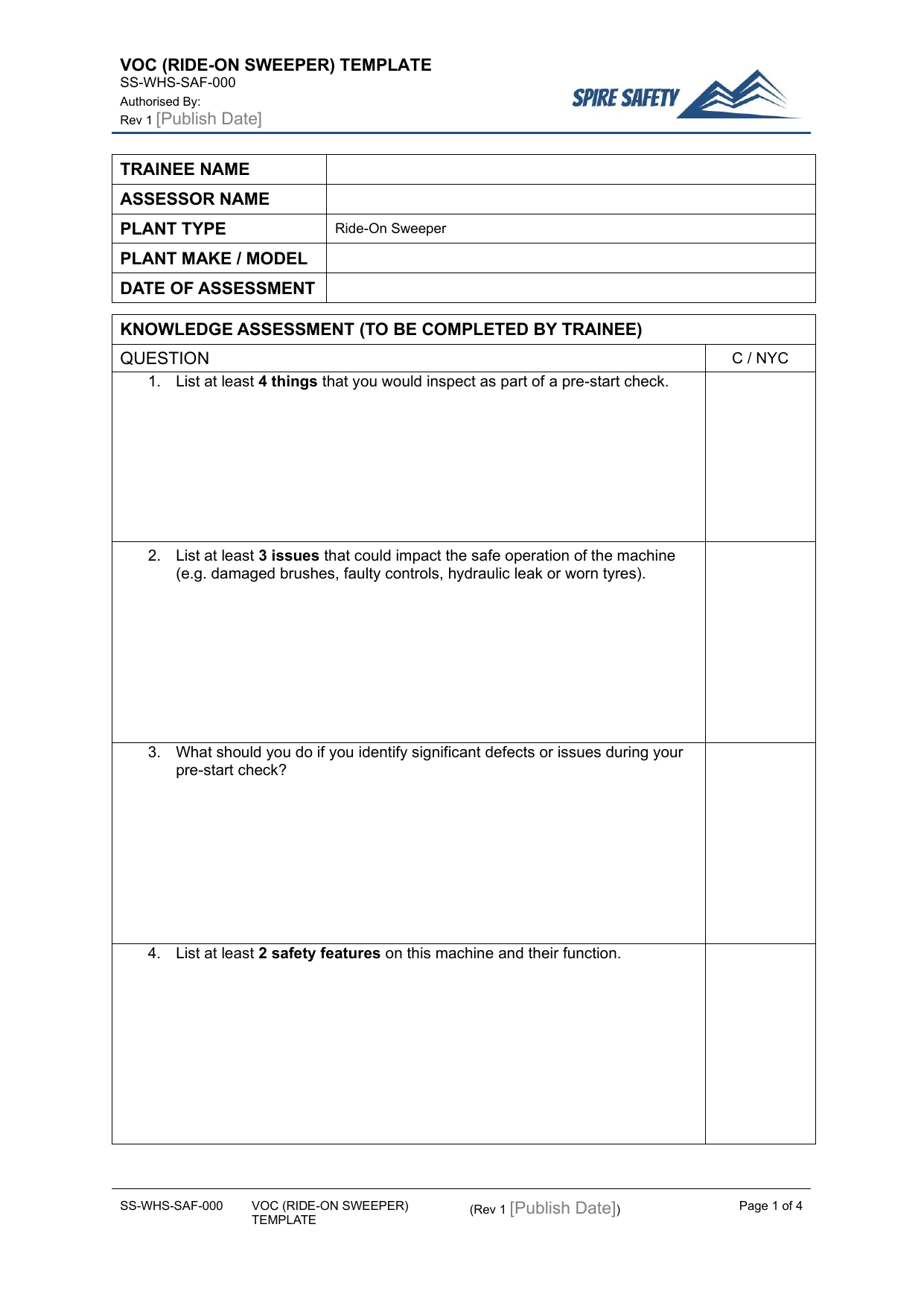
Download our free Verification of Competency (Ride-On Sweeper) template. A structured starting point for assessing operator skill. Available in DOCX and PDF.
Verification of Competency (Ride-On Sweeper)
DOCX • 138 KB + PDF
Updated Oct 2026
No signup required
Purpose of the Verification of Competency (Ride-On Sweeper)
This Verification of Competency (Ride-On Sweeper) template provides a structured method for employers and Persons Conducting a Business or Undertaking (PCBUs) to assess and confirm that an operator has the required skills and knowledge to operate a ride-on sweeper safely. Completing a VOC is a practical way to meet your primary duty of care under WHS legislation, ensuring workers are competent for the tasks they perform.
It goes beyond initial training or licensing, providing a point-in-time confirmation of a worker's ability to operate the equipment according to current site rules and safe work procedures.
Using a formal verification process helps identify any gaps in an operator's knowledge or changes in their behaviour, allowing for targeted retraining before an incident occurs. It forms a critical part of managing risks associated with powered mobile plant in the workplace.
This document serves as a record that a PCBU has taken proactive steps to verify operator competence, which is a key component of a robust safety management system.
Video walkthrough
How to use the Verification of Competency (Ride-On Sweeper)
This template is designed to be used by a competent person, such as a supervisor, trainer, or experienced operator, to assess another worker. The assessment should include a combination of theoretical questions and a practical observation of the operator using the ride-on sweeper in their typical work environment.
The assessor should observe the operator performing pre-start checks, demonstrating safe operating techniques (e.g., managing speed, blind spots, and interaction with pedestrians), and completing correct shutdown procedures.
After the assessment, the document should be completed to record the outcome, detailing any areas where the operator excelled or requires further training. Both the operator and the assessor should sign the form.
For tasks with similar machinery, you may find our Verification of Competency (Floor Scrubber) Template useful as a comparative resource.
Please note: This document is a template and must be customised to suit your specific workplace. This includes referencing the make and model of your ride-on sweeper, the unique hazards of the operating environment (e.g., slopes, shared traffic areas, hazardous dust), and your organisation’s specific safe work procedures.
We cannot guarantee its suitability for your specific circumstances without this customisation.
When to use it
A Verification of Competency should be conducted at several key points to ensure ongoing safety and competence. It is not a one-time event. Consider using this VOC process in the following situations:
- Pre-employment or prior to assignment: To verify the skills and claims of a new or transferring employee before they begin work on the equipment.
- Introduction of new equipment: When a new make or model of ride-on sweeper is introduced to the workplace, even for experienced operators.
- Post-incident: After an incident or a near miss involving a ride-on sweeper to identify and correct any unsafe behaviours or knowledge gaps.
- Scheduled intervals: As part of a regular competency review program (e.g., annually or biennially) to ensure skills have not diminished over time.
Regularly scheduled assessments for all types of site equipment, similar to what you might use our Free Ride-on-Mower VOC (Verification of Competency) Template for, create a consistent culture of safety and skill maintenance.
Who should use it
This resource is intended for any person with responsibility for ensuring workplace safety and operator competency. This includes:
- WHS Managers and Safety Advisors
- Supervisors and Team Leaders
- Operations and Facilities Managers
- Internal Trainers and Assessors
Integrating VOCs into your safety framework demonstrates a commitment to proactive risk management. These documented assessments are a vital part of a comprehensive WHS management system, providing clear evidence that the organisation is actively verifying worker capabilities.
Records of completed VOCs are important documents that prove due diligence. They show that you have a system in place for checking that workers can do their jobs safely, a key requirement that is often examined during WHS compliance auditing.
The principles of verifying competency are scalable across different types of powered mobile plant. For more complex machinery, such as that covered in our Verification of Competency (Boom Lift or Knuckle Boom) Template, the process becomes even more critical in preventing serious incidents.
This document is one of many tools available to help you build a safer workplace. You can explore our complete free WHS resources library for a wide range of templates, checklists, and guides to support your safety objectives.
Common mistakes
Common mistakes to avoid
- Using a generic checklist that doesn't account for site-specific hazards.
- Treating the VOC as a 'tick and flick' exercise without meaningful observation.
- Failing to formally document the assessment outcome and any required actions.
- Assessing only theoretical knowledge without a thorough practical demonstration of skill.
Legal references
Legal considerations
The following legal requirements may be relevant to this type of work.
- Work Health and Safety Act (Harmonised) — Provides the primary duties for protecting workers and other people from work health and safety risks.
- Work Health and Safety Regulations (Harmonised) — Sets out requirements supporting the management of workplace hazards and risks.
The following codes may be relevant to this type of work.
- Managing WHS Risks Code of Practice — Provides practical guidance on identifying hazards, assessing risks and applying effective controls.
- Work Health and Safety Consultation, Cooperation and Coordination Code of Practice — Provides practical guidance on consulting workers and coordinating with other duty holders.
- Managing the Work Environment and Facilities Code of Practice — Provides practical guidance on safe work environments, workplace facilities and related controls.
Did you know
Air Quality Risk
Ride-on sweepers can generate significant airborne dust. If operating in areas with crystalline silica, operators may be at risk of exposure, requiring specific controls like water suppression systems and appropriate respiratory protective equipment (RPE).
Carbon Monoxide Hazard
Internal combustion (LPG, petrol, diesel) sweepers produce carbon monoxide, a toxic gas. Using them in poorly ventilated indoor areas can be fatal, making electric models a safer choice for many indoor applications.
FAQ
Frequently asked questions
01What is a Verification of Competency (VOC) for a ride-on sweeper?
02Is a special licence required to operate a ride-on sweeper in Australia?
03How often should a ride-on sweeper VOC be conducted?
04Can I use this template for a walk-behind floor sweeper?
Share this resource
Verification of Competency (Ride-On Sweeper)
Browse Categories
How To Use It
- 1Download and open in Word or PDF.
- 2Replace the placeholders with your business details.
- 3Get it reviewed by a WHS specialist before rollout.
Need it customised?
Our WHS consultants can adapt this template to your site, run a gap analysis, or audit what you already have in place.
Book a Free Consultation WHS consulting servicesor call 1300 156 382