
Verification of Competency (Rough Terrain Forklift)
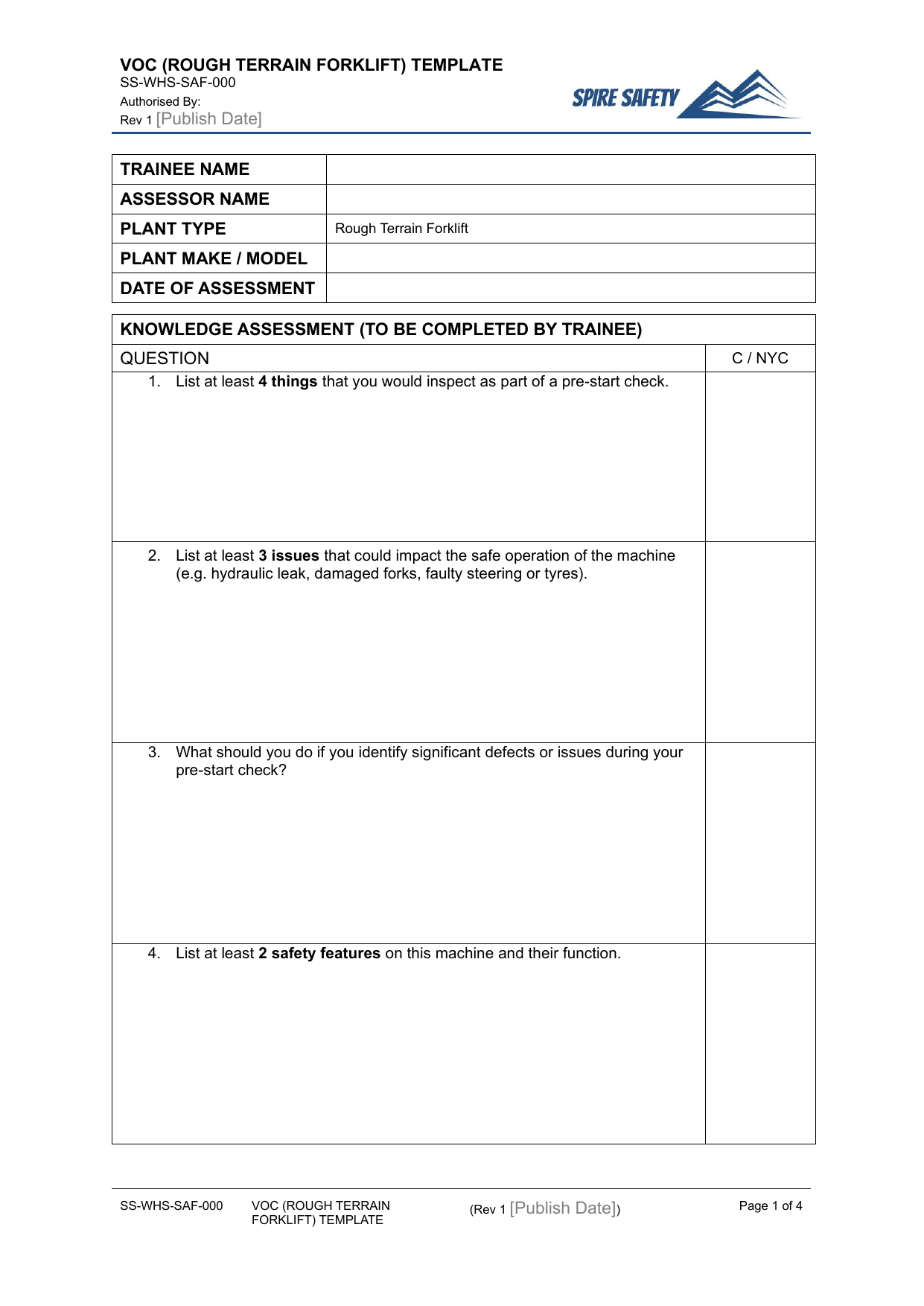
Download our Verification of Competency (Rough Terrain Forklift) template. This structured DOCX & PDF resource helps assess operator skills on uneven ground.
Verification of Competency (Rough Terrain Forklift )
DOCX • 138 KB + PDF
Updated Oct 2026
No signup required
Purpose of the Verification of Competency (Rough Terrain Forklift)
A Verification of Competency (VOC) is a critical process used by employers to confirm that their workers have the current skills and knowledge to operate equipment safely and competently. This Verification of Competency (Rough Terrain Forklift) template provides a structured method to assess an operator’s ability to handle this specific type of plant, which presents unique risks due to its operation on uneven, sloping, and often unstable surfaces.
Fulfilling your duty of care under WHS law involves not just providing initial training or licences, but also ensuring ongoing competence. This document serves as a practical tool for gathering evidence of an operator’s current capabilities.
While it shares principles with assessments for other plant, the focus here is distinct from that of a standard forklift VOC, which is tailored for warehouse environments.
Video walkthrough
How to use the Verification of Competency (Rough Terrain Forklift)
This document is designed as a user-friendly starting point for assessing your operators. The process typically involves a competent person (the assessor) observing an operator perform a series of tasks representative of their day-to-day work.
The assessor uses the checklist to record observations against specific performance criteria, noting either satisfactory performance or areas needing improvement. This process of verification and documentation is a critical component of robust WHS management systems.
To use the template effectively:
- Download the DOCX file and open it in a word processor.
- Customise the checklist with details specific to your site, including the make and model of the rough terrain forklift, common attachments used, and site-specific hazards (e.g., steep gradients, trenches, overhead powerlines).
- Brief the operator on the assessment process and the tasks they will be asked to perform.
- Conduct the observation in a controlled but realistic work environment.
- Complete the form, provide feedback to the operator, and document the outcome, including any recommendations for further training.
Please note: We have designed this document as a starting point. You must customise it to reflect the specific rough terrain forklift models, attachments, site conditions, and operational risks at your workplace.
Key Assessment Areas
A thorough VOC for a rough terrain forklift should cover more than just basic driving. Our template prompts assessment across several key domains to build a complete picture of competence.
These include pre-start inspections, hazard identification and risk control, spatial awareness, navigating slopes and rough ground, lifting and placing loads at height, and correct shutdown and parking procedures. This provides a comprehensive assessment framework, similar to what you might find in our asphalt paver VOC template.
When to use it
A Verification of Competency is not a one-time event. It should be integrated into your safety management procedures and conducted at key moments.
Common triggers for conducting a VOC include: prior to employment or commencement on a new site, when introducing a new make or model of rough terrain forklift, following an incident or near miss involving the equipment, or if an unsafe work practice is observed. Many organisations also schedule periodic VOCs (e.g., every one to two years) as a proactive measure to ensure skills have not diminished over time. The same logic applies to other high-risk mobile plant, as outlined in our Verification of Competency for boom lifts.
Who should use it
This template is intended for use by individuals responsible for workplace safety and operator supervision. This includes Site Supervisors, Project Managers, WHS Advisors, and internal Trainers and Assessors.
The most critical requirement is that the person conducting the VOC must be competent themselves. This means they should possess deep knowledge and significant practical experience with the specific type of rough terrain forklift being assessed, as well as a solid understanding of the relevant WHS regulations and safe operating procedures.
Regular reviews of your VOC process, often conducted as part of WHS compliance auditing, can ensure the program remains effective.
Developing internal assessors with the right combination of technical expertise and assessment skills is a valuable investment for any organisation that relies on high-risk plant. If you require assistance in developing these internal capabilities, our WHS consulting services can provide expert guidance. For more tools to support your safety framework, explore our complete free WHS resources library.
Common mistakes
Common mistakes to avoid
- Using a generic forklift checklist that ignores specific rough terrain hazards (e.g., slopes, soft ground).
- The assessor not being competent or experienced with the specific make and model of the rough terrain forklift.
- Treating the VOC as a 'tick-and-flick' exercise instead of a genuine observation of skill.
- Failing to document the VOC outcome and any required corrective actions, like retraining.
Legal references
Legal considerations
The following legal requirements may be relevant to this type of work.
- Work Health and Safety Act (Harmonised) — Provides the primary duties for protecting workers and other people from work health and safety risks.
- Work Health and Safety Regulations (Harmonised) — Sets out requirements supporting the management of workplace hazards and risks.
The following codes may be relevant to this type of work.
- Managing WHS Risks Code of Practice — Provides practical guidance on identifying hazards, assessing risks and applying effective controls.
- Work Health and Safety Consultation, Cooperation and Coordination Code of Practice — Provides practical guidance on consulting workers and coordinating with other duty holders.
- Managing the Work Environment and Facilities Code of Practice — Provides practical guidance on safe work environments, workplace facilities and related controls.
Did you know
Tip-Over Risk
Rough terrain forklifts are specifically designed for unstable surfaces, but tip-overs remain one of the most common and fatal incidents, often due to a combination of speed, slope, and an improperly secured load.
Operator's 'Cone of Vision'
The large tyres, mast, and load on a rough terrain forklift create significant blind spots. A key part of a VOC is assessing how an operator manages this restricted 'cone of vision' to work safely around pedestrians and obstacles.
FAQ
Frequently asked questions
01Is a Verification of Competency the same as a forklift licence?
02How often should we conduct a rough terrain forklift VOC?
03What happens if an operator fails the VOC?
04Can this template be used for a standard warehouse forklift?
Share this resource
Verification of Competency (Rough Terrain Forklift)
Browse Categories
How To Use It
- 1Download and open in Word or PDF.
- 2Replace the placeholders with your business details.
- 3Get it reviewed by a WHS specialist before rollout.
Need it customised?
Our WHS consultants can adapt this template to your site, run a gap analysis, or audit what you already have in place.
Book a Free Consultation WHS consulting servicesor call 1300 156 382
Related templates
- Verification of Competency (Sand Blaster)
- Verification of Competency (SDS Max Rotary Hammer)
- Verification of Competency (SDS Plus Rotary Hammer)
- Verification of Competency (Semi-Trailer or Prime Mover)
- Verification of Competency (Side Tipper Truck)
- Verification of Competency (Skid Steer Auger Attachment)