
Verification of Competency (Sand Blaster)
Download our free Verification of Competency (Sand Blaster) template. This DOCX and PDF resource helps you assess and confirm operator skills. Get started now.
Verification of Competency (Sand Blaster)
DOCX • 138 KB + PDF
Updated Oct 2026
No signup required
Purpose of the Verification of Competency (Sand Blaster)
The primary purpose of this Verification of Competency for sand blasters is to ensure workers have the current skills and knowledge to operate the equipment safely in your specific environment. Sand blasting presents severe risks, including exposure to hazardous dust (like respirable crystalline silica), high-pressure injection injuries, noise-induced hearing loss, and hazards from the plant itself.
A VOC goes beyond a simple training certificate; it's a practical confirmation of ability. It helps a PCBU fulfil their primary duty of care by verifying that training has been understood and can be applied in real-world conditions. Documenting this process is a key component of demonstrating due diligence within your overall WHS management systems.
Video walkthrough
How to use the Verification of Competency (Sand Blaster)
This template should be used by a competent person—typically a supervisor, experienced operator, or safety advisor with extensive knowledge of sand blasting operations. The assessment should involve a combination of direct observation, verbal questioning, and a review of the operator's understanding of procedures.
The process generally includes:
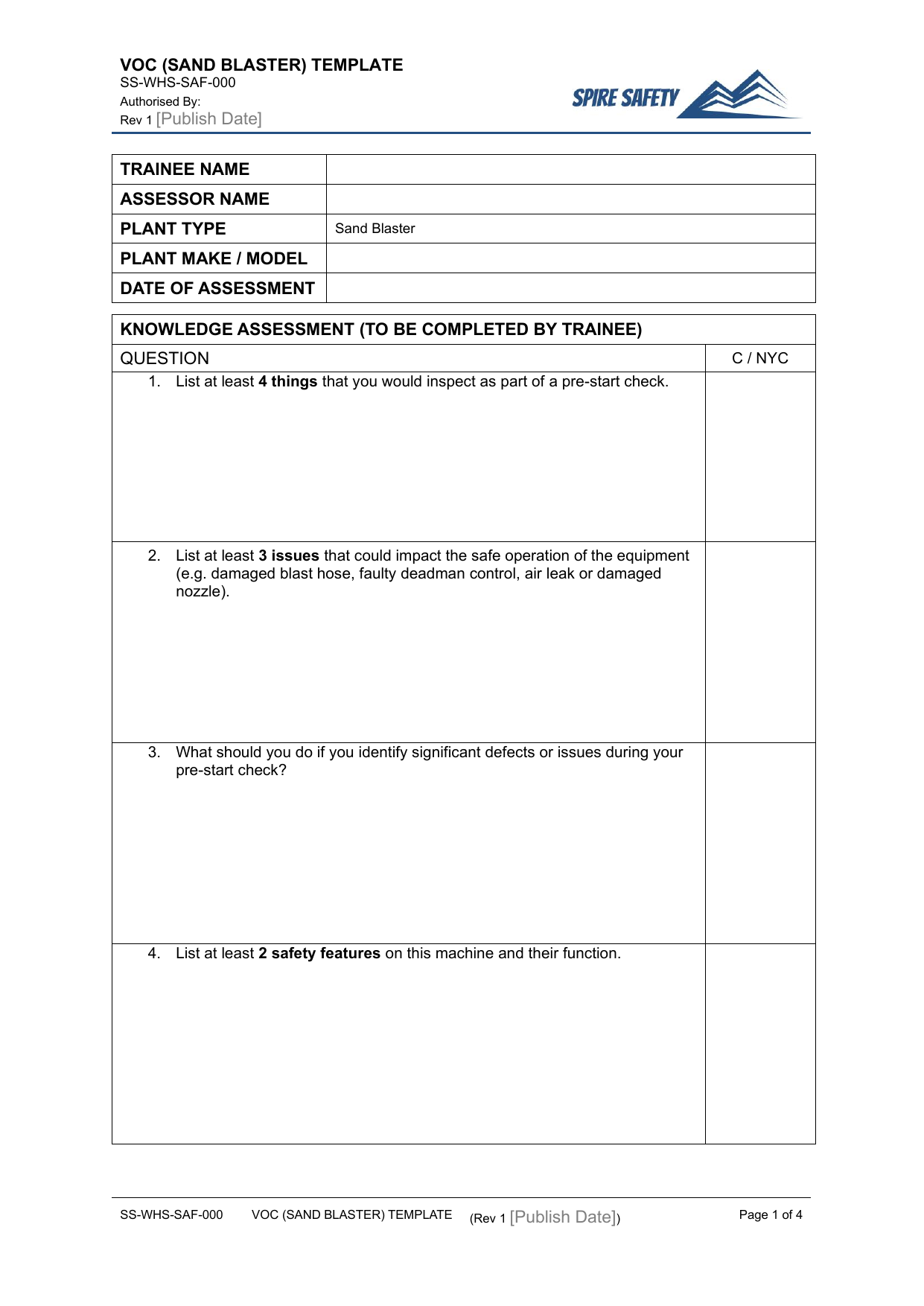
- Theory and Knowledge: Asking questions about pre-start checks, hazard identification, emergency procedures, and the function of safety features like the dead-man switch.
- Practical Observation: Watching the operator carry out the entire task, from setting up the blast pot and hoses to performing the blasting and shutting down the equipment safely.
- Documentation: Recording the observations and outcomes on the checklist. If gaps in competency are identified, a plan for further training or supervision should be put in place and documented.
Please note: This document is a template and must be customised to your specific workplace. We have included common criteria, but you must assess your unique sand blasting equipment, abrasive media, work environment, and internal procedures.
Regular checks of your documented processes, such as those performed during WHS compliance auditing, ensure they remain effective and relevant to your operations.
When to use it
A VOC for sand blasting is not a one-time event. It should be conducted at various points to ensure skills remain current and relevant. Key triggers for conducting a VOC include:
- As part of a pre-employment or pre-contract engagement process.
- When a worker is assigned to use a new or different model of sand blaster.
- If a worker has not operated the equipment for a significant period.
- When observation or performance data suggests a worker may require refresher training.
- Following an incident or near-miss involving the equipment.
- As part of a scheduled periodic review, for example, every two years, to ensure ongoing competency.
Who should use it
This template is designed for use by PCBUs, managers, supervisors, and WHS professionals responsible for ensuring plant and operator safety. The person conducting the assessment must be deemed competent themselves.
This means they possess detailed knowledge of the sand blaster's operation, the associated hazards, and the control measures required. They must be able to make a valid and reliable judgement about another person's competency.
For high-risk tasks like this, it is not enough for the assessor to have simply read the manual; they need practical, hands-on experience.
Key Assessment Criteria for Sand Blaster Operators
A comprehensive VOC should cover all phases of the sand blasting task. While our template provides a detailed list, key areas for assessment must include the operator's ability to:
- Conduct thorough pre-start inspections of the blast pot, hoses, connections, nozzle, and safety devices.
- Select, inspect, and correctly don all required Personal Protective Equipment (PPE), including blast helmet, air supply, hearing protection, and protective clothing.
- Demonstrate correct setup of the work area, including barricading, signage, and containment measures if required.
- Safely load the abrasive media and pressurise the system.
- Maintain correct blasting technique, posture, and control of the dead-man switch at all times.
- Recognise and respond to equipment malfunctions or emergencies.
- Follow correct shutdown, depressurisation, and clean-up procedures.
The principles of verifying practical skill are transferable across various types of workplace plant. For example, our Verification of Competency (Plasma Cutter) template also focuses heavily on pre-start checks and the correct use of safety features specific to that equipment.
Similarly, assessing competency on equipment that generates dust and noise, like that covered in our Free Bench Grinder VOC (Verification of Competency) Template, shares a common focus on PPE and hazard control. Sandblasting often requires working at height or in awkward positions, making it crucial to assess the operator's awareness of their surroundings. In situations where access equipment is used, you may also need to complete a separate Verification of Competency (Boom Lift or Knuckle Boom) Template.
For a wider range of checklists and templates covering other plant and equipment, feel free to browse our free WHS resources library.
Common mistakes
Common mistakes to avoid
- Treating the VOC as a 'tick and flick' paper exercise without proper practical observation.
- Using an assessor who is not familiar with the specific model of sand blasting equipment.
- Failing to check the operator's knowledge of the specific abrasive media being used and its associated hazards.
- Neglecting to review the effectiveness of PPE, especially respiratory and hearing protection, during the assessment.
Legal references
Legal considerations
The following legal requirements may be relevant to this type of work.
- Work Health and Safety Act (Harmonised) — Provides the primary duties for protecting workers and other people from work health and safety risks.
- Work Health and Safety Regulations (Harmonised) — Sets out requirements supporting the management of workplace hazards and risks.
The following codes may be relevant to this type of work.
- Managing WHS Risks Code of Practice — Provides practical guidance on identifying hazards, assessing risks and applying effective controls.
- Work Health and Safety Consultation, Cooperation and Coordination Code of Practice — Provides practical guidance on consulting workers and coordinating with other duty holders.
- Managing the Work Environment and Facilities Code of Practice — Provides practical guidance on safe work environments, workplace facilities and related controls.
Did you know
Silica Ban
Abrasive blasting with materials containing more than 1% crystalline silica has been banned in Australian workplaces due to the severe and irreversible risk of silicosis.
Noise Levels
Sand blasting operations can easily exceed 115 decibels (dBA), causing permanent hearing damage in minutes without appropriate, correctly fitted hearing protection.
FAQ
Frequently asked questions
01What is the difference between a Verification of Competency and a license?
02Is a VOC mandatory for sand blaster operators in Australia?
03How often should a sand blaster VOC be conducted?
04Who can conduct a Verification of Competency for a sand blaster?
Share this resource
Verification of Competency (Sand Blaster)
Browse Categories
How To Use It
- 1Download and open in Word or PDF.
- 2Replace the placeholders with your business details.
- 3Get it reviewed by a WHS specialist before rollout.
Need it customised?
Our WHS consultants can adapt this template to your site, run a gap analysis, or audit what you already have in place.
Book a Free Consultation WHS consulting servicesor call 1300 156 382