
Verification of Competency (Spider Lift)
Download our free Verification of Competency (Spider Lift) template to assess operator skills and support WHS compliance. Get your DOCX and PDF now.
Verification of Competency (Spider Lift)
DOCX • 139 KB + PDF
Updated Oct 2026
No signup required
Purpose of the Verification of Competency (Spider Lift)
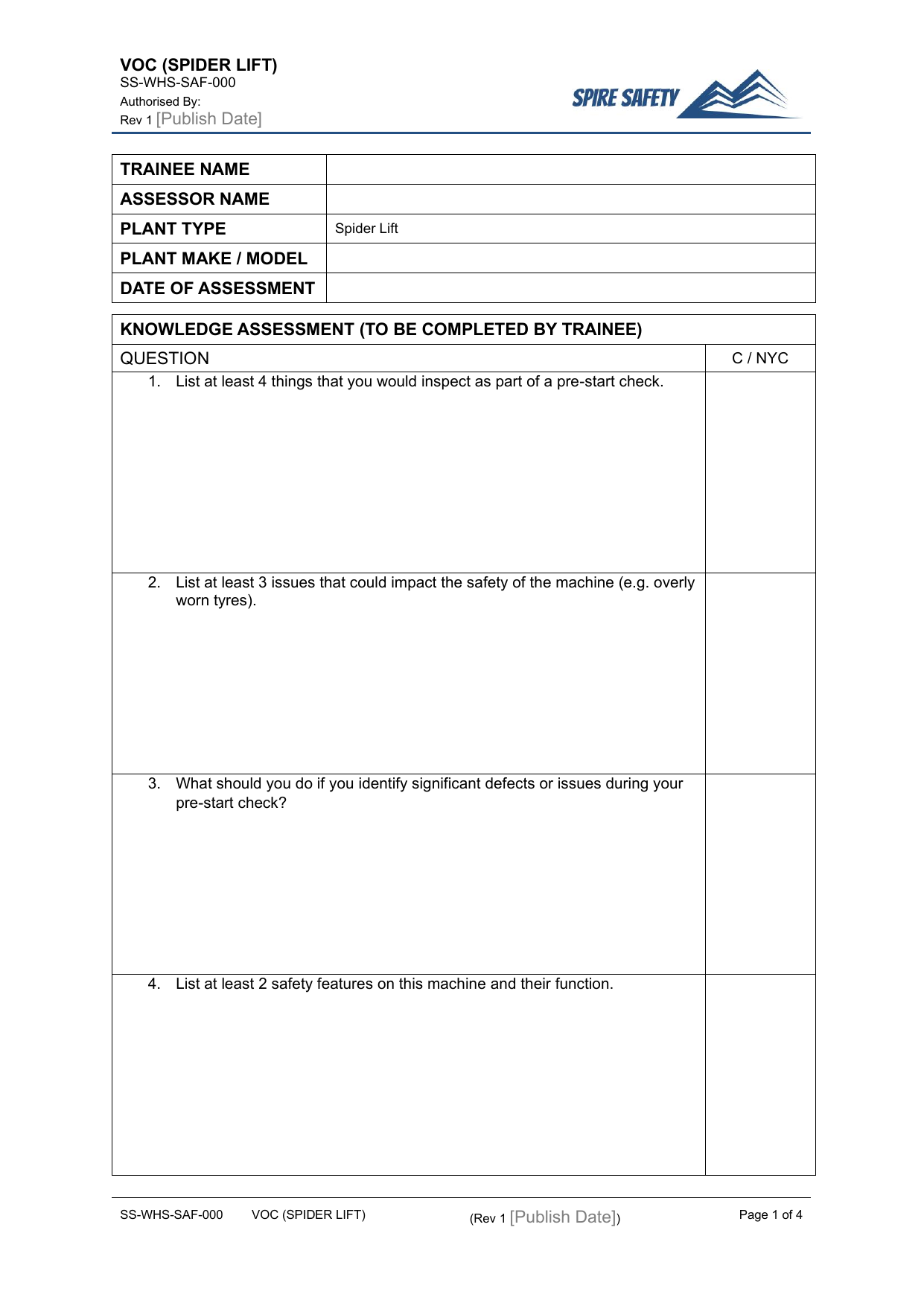
A Verification of Competency (VOC) is a formal process used by an employer or PCBU (Person Conducting a Business or Undertaking) to confirm that an individual possesses the current skills, knowledge, and experience to operate specific equipment safely in their workplace. This Verification of Competency (Spider Lift) template provides a structured framework for assessing an operator's ability to safely handle a spider lift, from pre-start checks through to shutdown procedures.
It moves beyond simply holding a licence, focusing on demonstrated competence in the context of your specific site and tasks.
While a High Risk Work Licence (class WP) is required for boom-type EWPs with a capacity of 11 metres or more, a VOC is best practice for all plant, regardless of licencing requirements. It ensures that skills remain current and are applied correctly according to site-specific rules.
For operators who may also use other types of elevated work platforms, our Verification of Competency for a Boom Lift or Knuckle Boom provides a relevant alternative assessment structure.
Video walkthrough
How to use the Verification of Competency (Spider Lift)
This document should be used by a competent person—such as a supervisor or an experienced operator—to observe and evaluate another worker operating a spider lift. The process involves a combination of theoretical questions and practical observation, covering critical safety and operational aspects.
These include understanding the machine's capabilities and limitations, conducting pre-start and operational checks, identifying hazards, and demonstrating safe travel, setup, and use of the platform.
The assessor uses the checklist to record the operator's performance, providing a clear record of the assessment outcome. Both the assessor and the operator should sign the completed document.
This process forms a vital part of your overall safety framework, integrating seamlessly with comprehensive WHS management systems to ensure ongoing worker safety and risk control.
Important: This is a template that provides a structured starting point. We have designed it to be customised to reflect your specific site, machinery, and operational procedures.
You must adapt it to cover the unique hazards and control measures relevant to your workplace.
When to use it
A Verification of Competency should be conducted at various points in an operator's employment lifecycle to ensure skills remain sharp and relevant. Key triggers for conducting a spider lift VOC include:
- Pre-employment: To validate the skills and claims of a new hire before they begin work.
- Introduction of new equipment: When a new make or model of spider lift is introduced to the workplace.
- Post-incident: Following any incident or near-miss involving a spider lift to identify any competency gaps.
- Performance concerns: If a supervisor observes unsafe or inefficient operating practices.
- Regular intervals: As part of a scheduled assessment program (e.g., annually or biennially) to ensure skills have not diminished over time.
On a busy construction site, operators often use multiple pieces of equipment. Standardising your competency verification across different plant is essential for maintaining safety standards.
You can adapt this process for other common machinery, such as that covered in our Concrete Saw or Floor Saw VOC template.
Who should use it
This resource is designed for any person responsible for ensuring the safe operation of plant and equipment. This typically includes:
- WHS Managers and Advisors: To implement and manage a consistent competency verification program across the organisation.
- Site Supervisors and Forepersons: To conduct on-the-ground assessments of their team members before assigning tasks.
- Project Managers: To ensure all contractors and workers on a project are competent to use the equipment required.
- Internal Trainers and Assessors: As a formal tool for evaluating operators as part of internal training programs.
The individual conducting the assessment must be competent themselves. This means they should have extensive theoretical knowledge and practical experience with spider lifts and be familiar with the relevant safe work procedures and WHS legislation.
Periodically reviewing these processes through WHS compliance audits helps confirm that your verification procedures are being applied correctly and consistently.
Maintaining a library of standardised assessment tools helps create a robust safety culture. Alongside this document, you might find our Free Circular Saw VOC (Verification of Competency) Template useful for assessing operators of common handheld power tools.
Common mistakes
Common mistakes to avoid
- Using a generic EWP template that doesn't account for the specific risks of spider lifts, such as stabiliser setup.
- Failing to conduct a practical assessment and relying only on an operator's stated experience or licence.
- Neglecting to document the VOC assessment, leaving no formal record of the operator's demonstrated competency.
- Treating the VOC as a 'tick and flick' exercise instead of a genuine opportunity to observe and correct unsafe behaviours.
Legal references
Legal considerations
The following legal requirements may be relevant to this type of work.
- Work Health and Safety Act (Harmonised) — Provides the primary duties for protecting workers and other people from work health and safety risks.
- Work Health and Safety Regulations (Harmonised) — Sets out requirements supporting the management of workplace hazards and risks.
The following codes may be relevant to this type of work.
- Managing WHS Risks Code of Practice — Provides practical guidance on identifying hazards, assessing risks and applying effective controls.
- Work Health and Safety Consultation, Cooperation and Coordination Code of Practice — Provides practical guidance on consulting workers and coordinating with other duty holders.
- Managing the Work Environment and Facilities Code of Practice — Provides practical guidance on safe work environments, workplace facilities and related controls.
Did you know
Nickname Origin
Spider lifts get their name from their distinctive, multi-legged stabiliser system that resembles a spider's legs. This design allows them to be set up securely on uneven or sloping ground where traditional boom lifts cannot operate.
Compact and Capable
Despite their impressive reach, many spider lifts are designed to be narrow enough to fit through standard single or double doorways. This makes them ideal for maintenance, cleaning, and construction tasks inside atriums, shopping centres, and factories.
FAQ
Frequently asked questions
01What is a Verification of Competency (VOC) for a spider lift?
02Is a High Risk Work Licence required to operate a spider lift?
03Who can conduct a spider lift VOC assessment?
04How often should a spider lift VOC be renewed?
Share this resource
Verification of Competency (Spider Lift)
Browse Categories
How To Use It
- 1Download and open in Word or PDF.
- 2Replace the placeholders with your business details.
- 3Get it reviewed by a WHS specialist before rollout.
Need it customised?
Our WHS consultants can adapt this template to your site, run a gap analysis, or audit what you already have in place.
Book a Free Consultation WHS consulting servicesor call 1300 156 382