
Verification of Competency (Stick Welder)
Assess operator skill for manual metal arc welding with our Verification of Competency (Stick Welder) template. Aligned with Australian WHS standards.
Verification of Competency (Stick Welder)
DOCX • 138 KB + PDF
Updated Oct 2026
No signup required
Purpose of the Verification of Competency (Stick Welder)
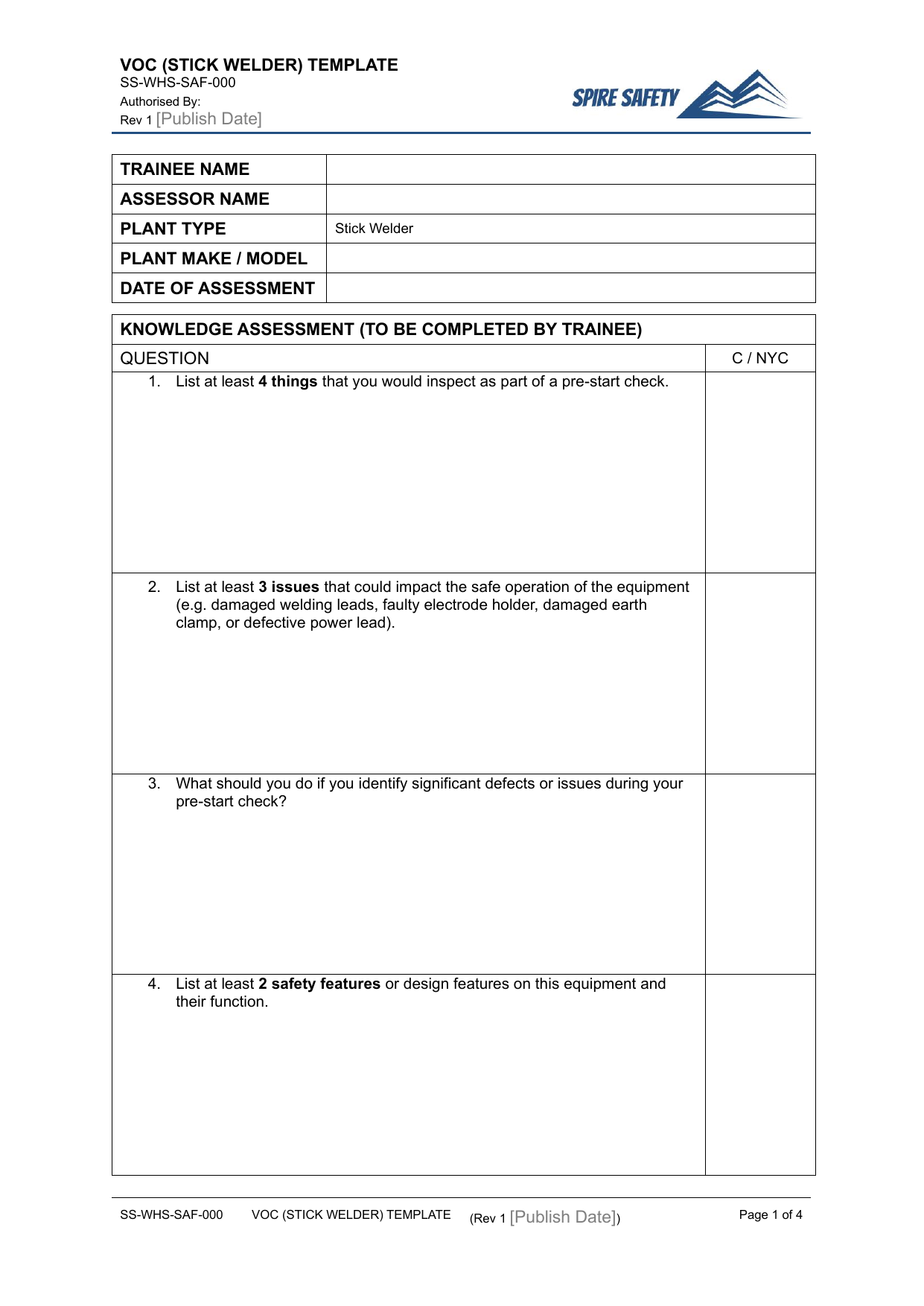
This Verification of Competency (Stick Welder) template provides a structured method for a Person Conducting a Business or Undertaking (PCBU) to confirm that workers have the required skills and knowledge to operate manual metal arc welding (MMAW) equipment safely. It goes beyond formal qualifications by assessing a worker's current, practical ability to perform the task competently in their specific work environment, fulfilling a key part of the primary duty of care.
Using a formal VOC process helps create a clear record of due diligence, demonstrating that the organisation has taken proactive steps to manage risks associated with welding. It is an essential tool for identifying any gaps in worker knowledge or performance, which can then be addressed through targeted training and supervision. While this document is specific to stick welding, the same principles apply to other welding processes, as shown in our MIG Welder Verification of Competency template.
Video walkthrough
How to use the Verification of Competency (Stick Welder)
To effectively use this Verification of Competency (Stick Welder) resource, a competent assessor—such as an experienced supervisor or a qualified trainer—should observe the worker performing a range of typical stick welding tasks. The template acts as a checklist, guiding the assessor through key areas including pre-operational checks, safe startup, operational technique, hazard control, and correct shutdown procedures.
The assessor documents their observations, noting whether the worker's performance is satisfactory or requires further development.
Please note: This document is a template designed as a starting point. We strongly recommend you customise it to reflect your specific workplace, the models of stick welders in use, the materials being welded, and your organisation's unique safe work procedures and policies.
Key Assessment Criteria
When customising your VOC, consider breaking the assessment into three core areas to ensure a thorough evaluation:
- Theoretical Knowledge: Does the operator understand the specific electrical hazards of MMAW, the risks from welding fumes and arc flash, and the correct selection and use of Personal Protective Equipment (PPE)? Can they interpret welding procedure specifications (WPS)?
- Practical Skills: Can the operator correctly set up the welder, select the appropriate electrode and amperage for the job, strike and maintain a stable arc, and execute common weld types (e.g., fillet, butt) to the required standard? This also includes pre-weld preparation, such as cleaning or grinding materials, which can be assessed with a supplementary tool like a bench grinder VOC template.
- Safe Work Behaviour: Does the worker consistently wear appropriate PPE, manage electrical leads safely, ensure adequate ventilation, and maintain awareness of their surroundings to protect others from arc flash and fumes? Safe behaviour is a critical component of overall competence. For other hot work processes, you may find our Verification of Competency for plasma cutters a useful reference.
When to use it
A Verification of Competency should be conducted at several key points to ensure ongoing safety and skill retention. It is essential before a new or existing worker operates a stick welder for the first time on your site, regardless of their prior experience or qualifications.
A VOC is also prudent when a worker returns to the task after a long absence, when a new type or model of stick welder is introduced, or as a follow-up action after an incident or near miss involving welding operations.
Many organisations integrate VOCs into their safety management system, scheduling them at regular intervals (e.g., annually or biennially) as part of a proactive competency assurance program. These assessments can form part of broader safety initiatives, such as regular WHS compliance audits, to ensure standards are being consistently met across the board.
Who should use it
This template is designed for use by employers, site managers, supervisors, and WHS personnel in industries where stick welding is performed, including construction, manufacturing, engineering, and maintenance. The responsibility for ensuring competence lies with the PCBU, making this a vital tool for those in leadership positions.
The assessment itself must be carried out by a person who has the technical expertise in stick welding and the ability to assess another person's skill objectively. The completed document serves as a critical record for both the operations and WHS/HR departments.
Documenting competency is a fundamental part of a comprehensive WHS management system, providing tangible evidence of risk management actions.
Similar assessment processes are vital for other related hot-work tasks, and you can adapt the principles from this template or use our specific oxy-acetylene welding VOC for gas welding and cutting activities. If you require further guidance on implementing competency programs, consider engaging specialist WHS consulting to tailor a solution for your business.
Common mistakes
Common mistakes to avoid
- Treating the VOC as a "tick and flick" exercise without genuine observation of the worker's skills.
- Using a generic template without customising it for the specific stick welder models and tasks at the workplace.
- Failing to provide refresher training and a re-assessment plan for workers found "not yet competent".
- Forgetting to document the VOC outcome and store it as a training record for due diligence.
Legal references
Legal considerations
The following legal requirements may be relevant to this type of work.
- Work Health and Safety Act (Harmonised) — Provides the primary duties for protecting workers and other people from work health and safety risks.
- Work Health and Safety Regulations (Harmonised) — Sets out requirements supporting the management of workplace hazards and risks.
The following codes may be relevant to this type of work.
- Managing WHS Risks Code of Practice — Provides practical guidance on identifying hazards, assessing risks and applying effective controls.
- Work Health and Safety Consultation, Cooperation and Coordination Code of Practice — Provides practical guidance on consulting workers and coordinating with other duty holders.
- Managing the Work Environment and Facilities Code of Practice — Provides practical guidance on safe work environments, workplace facilities and related controls.
Did you know
Arc Eye Lag
The painful effects of "arc eye" (photokeratitis) from UV radiation often don't appear until 6-12 hours after exposure. This delay can lead welders to underestimate the initial risk.
Fume Hazards
In 2017, the International Agency for Research on Cancer (IARC) reclassified welding fumes as a 'Group 1' carcinogen, meaning they are carcinogenic to humans.
FAQ
Frequently asked questions
01Is a Verification of Competency the same as a welding ticket?
02Who is considered a 'competent person' to conduct a stick welder VOC?
03How often should a Verification of Competency for a stick welder be redone?
04What happens if a worker is found 'not yet competent'?
Share this resource
Verification of Competency (Stick Welder)
Browse Categories
How To Use It
- 1Download and open in Word or PDF.
- 2Replace the placeholders with your business details.
- 3Get it reviewed by a WHS specialist before rollout.
Need it customised?
Our WHS consultants can adapt this template to your site, run a gap analysis, or audit what you already have in place.
Book a Free Consultation WHS consulting servicesor call 1300 156 382