
Verification of Competency (Spray Painter (Airless))
Download our free Verification of Competency (Spray Painter (Airless)) template. Assess operator skills and support your WHS duties. Get your DOCX & PDF now.
Verification of Competency (Spray Painter (Airless))
DOCX • 138 KB + PDF
Updated Oct 2026
No signup required
Purpose of the Verification of Competency (Spray Painter (Airless))
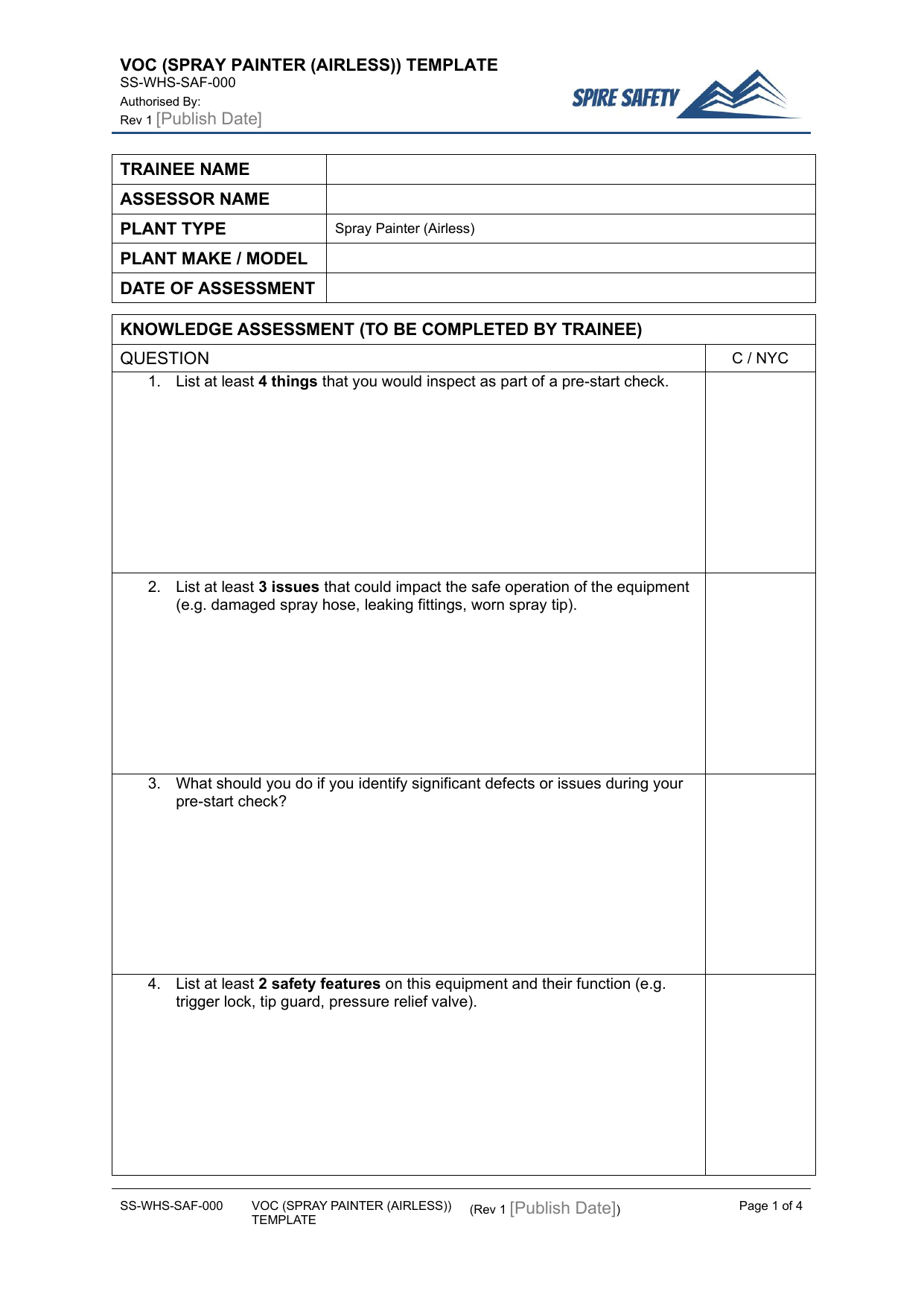
Operating an airless spray painter requires specific skills to manage high pressures, hazardous chemicals, and electrical risks safely. This Verification of Competency (Spray Painter (Airless)) template provides a structured method for an employer or Person Conducting a Business or Undertaking (PCBU) to confirm that an individual has the necessary skills and knowledge to perform this task safely and effectively.
It is a practical assessment tool that formalises the process of checking a worker's abilities against established safety criteria.
A VOC is not a substitute for formal training or licensing. Instead, it serves as a confirmation of competence after training has been completed, or for experienced workers joining a new team or using new equipment.
Using this document helps a PCBU meet its primary duty of care under WHS law by ensuring tasks are performed by competent personnel. Integrating such processes into comprehensive WHS management systems demonstrates a proactive approach to risk management and workplace safety.
What this Verifications of Competency covers:
This template is aligned with the model WHS framework and covers key areas essential for the safe operation of an airless spray painter, including:
- Pre-operational checks (inspecting hoses, nozzles, guards, and power supply).
- Knowledge of equipment setup, pressure settings, and shutdown procedures.
- Correct use of personal protective equipment (PPE), including respiratory protection, eye protection, and gloves.
- Safe handling and mixing of paints and solvents.
- Spraying techniques that minimise overspray and ensure operator safety.
- Hazard identification and emergency procedures, such as responding to an injection injury.
Video walkthrough
How to use the Verification of Competency (Spray Painter (Airless))
This document should be used by a competent assessor to observe a worker operating an airless spray painter in a practical setting. The assessor, typically a supervisor or experienced operator, will use the checklist to evaluate the worker's performance against each criterion.
The form includes sections for the assessor to record observations, confirm satisfactory performance, or note any identified gaps in skill or knowledge that may require further training.
Please note: We've designed this template as a comprehensive starting point. You must customise it to reflect your specific workplace environment, the exact model of airless sprayer used, the types of materials being sprayed (e.g., water-based vs.
solvent-based), and your organisation's safe work procedures. For assistance tailoring safety documents to your specific needs, consider engaging expert WHS consulting services.
When to use it
A Verification of Competency is a versatile tool that should be used at several key points in the worker lifecycle. It is not a one-off event but part of an ongoing safety assurance process. Key times to conduct a VOC for an airless spray painter include:
- Pre-employment or prior to starting a role: To verify the claimed skills of a new hire.
- Post-training: To confirm that a worker can apply newly learned skills in a practical environment.
- Introduction of new equipment: When the workplace acquires a new make or model of airless sprayer.
- Following an incident or near miss: To assess if operator error was a contributing factor and identify retraining needs.
- At regular intervals: As part of a scheduled competency review program (e.g., every 2-3 years) to ensure skills remain current.
- For specific tasks: Sometimes, surface preparation involves other tools. You might also use a Verification of Competency for an orbital sander to assess related skills.
Who should use it
This VOC template is designed for use by specific roles within an organisation. The primary user is the Assessor, who must be a competent person with in-depth technical knowledge of airless spray painters, experience in their safe operation, and the ability to assess others effectively.
This could be a site supervisor, a leading hand, or a dedicated WHS advisor or trainer. The assessor must have the authority and expertise to make a fair and accurate judgement of the operator's skills.
The Operator is the individual being assessed. This could be any worker required to use an airless spray painter as part of their job, from apprentices who have recently completed training to experienced painters.
Documenting competence for all tool use is a key part of a robust safety system. You may also find our circular saw VOC template useful for assessing other common construction tasks.
Finally, the completed record should be managed by Supervisors, Project Managers, and WHS/HR Managers. These records serve as crucial evidence of due diligence during WHS compliance audits and help managers make informed decisions about work allocation and training plans. Maintaining a library of completed VOCs, such as this one and our bench grinder VOC, helps build a strong safety culture. You can find more templates like these in our free WHS resources library.
Common mistakes
Common mistakes to avoid
- Using the template without customising it for the specific sprayer and materials used.
- Assigning an assessor who isn't experienced with the specific hazards of airless sprayers.
- Treating the VOC as a 'tick and flick' exercise instead of a genuine skills assessment.
- Failing to document and follow up on identified competency gaps with further training.
Legal references
Legal considerations
The following legal requirements may be relevant to this type of work.
- Work Health and Safety Act (Harmonised) — Provides the primary duties for protecting workers and other people from work health and safety risks.
- Work Health and Safety Regulations (Harmonised) — Sets out requirements supporting the management of workplace hazards and risks.
The following codes may be relevant to this type of work.
- Managing WHS Risks Code of Practice — Provides practical guidance on identifying hazards, assessing risks and applying effective controls.
- Work Health and Safety Consultation, Cooperation and Coordination Code of Practice — Provides practical guidance on consulting workers and coordinating with other duty holders.
- Managing the Work Environment and Facilities Code of Practice — Provides practical guidance on safe work environments, workplace facilities and related controls.
Did you know
High-Pressure Hazard
Airless sprayers can generate pressures over 3,000 PSI, enough to inject paint or solvent directly into the skin. This can cause severe injury that may require specialist surgery or even amputation.
Atomisation Risk
The fine mist (atomisation) created by airless sprayers can be easily inhaled, making correct respiratory protection essential, especially when using paints containing hazardous chemicals like isocyanates.
FAQ
Frequently asked questions
01Is a Verification of Competency (VOC) the same as a licence?
02How often should we conduct a VOC for an airless spray painter?
03What are the primary hazards of using an airless spray painter?
04Can this VOC template be used as a training document?
Share this resource
Verification of Competency (Spray Painter (Airless))
Browse Categories
How To Use It
- 1Download and open in Word or PDF.
- 2Replace the placeholders with your business details.
- 3Get it reviewed by a WHS specialist before rollout.
Need it customised?
Our WHS consultants can adapt this template to your site, run a gap analysis, or audit what you already have in place.
Book a Free Consultation WHS consulting servicesor call 1300 156 382