
Verification of Competency (Skid Steer Auger Attachment)
Assess operator competence for skid steer auger attachments. Our Verification of Competency template is aligned with Australian WHS practice.
Verification of Competency (Skid Steer Auger Attachment)
DOCX • 138 KB + PDF
Updated Oct 2026
No signup required
Purpose of the Verification of Competency (Skid Steer Auger Attachment)
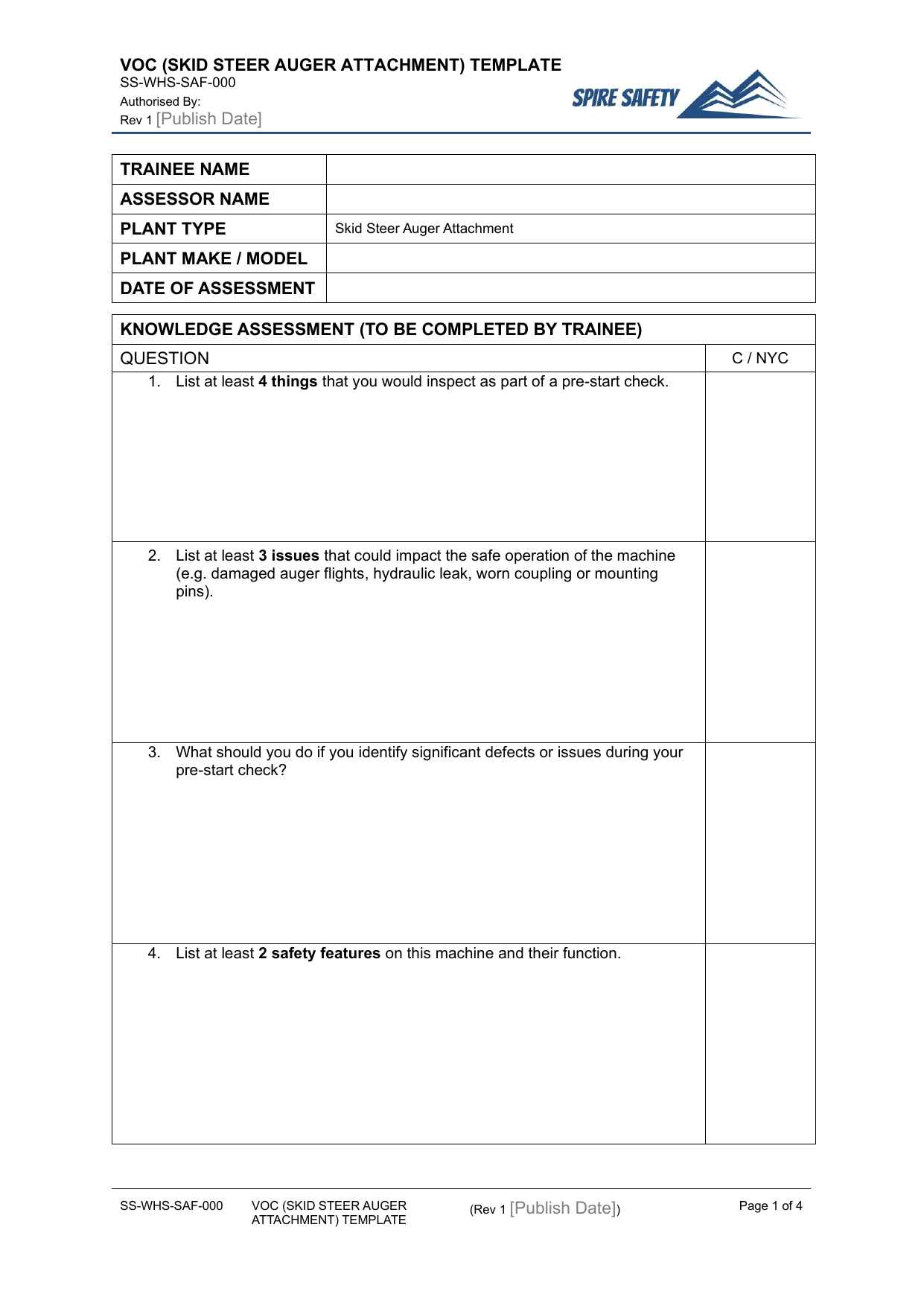
A Verification of Competency (VOC) is a formal process used to confirm that an individual possesses the current skills, knowledge, and practical ability to operate specific plant and equipment safely. This Verification of Competency (Skid Steer Auger Attachment) template provides a structured framework for assessing an operator's ability to safely use a skid steer loader fitted with a drilling auger.
It is not a replacement for formal training or licensing but serves as a practical check to ensure competence is current and aligned with workplace-specific procedures.
Operating a skid steer with an auger attachment introduces significant risks, including entanglement with the rotating flight, being struck by moving parts, machine instability on uneven ground, and the serious danger of striking underground services like electrical cables or gas lines. This document helps a PCBU (Person Conducting a Business or Undertaking) meet their primary duty of care by documenting the steps taken to verify an operator can manage these specific hazards.
This process complements our free Skid-Steer Loader VOC by focusing specifically on the high-risk auger attachment.
Video walkthrough
How to use the Verification of Competency (Skid Steer Auger Attachment)
Using this Verification of Competency (Skid Steer Auger Attachment) involves more than just filling out a form. It is an interactive assessment process that combines theoretical checks with practical observation.
The goal is to gain confidence that the operator can perform the task safely and competently in their actual work environment.
IMPORTANT: This is a template resource. We have designed it to be a starting point, but it must be customised to reflect the specific make and model of the equipment, the work environment, and the unique risks present in your workplace.
A generic assessment that does not account for your site-specific conditions will not be effective.
The process generally involves these steps:
- Preparation: The assessor reviews the operator's formal qualifications (e.g., RIIMPO318F Skid Steer Operations licence) and any previous training records related to attachments.
- Theory and Knowledge Assessment: The assessor discusses key safety elements with the operator, such as their understanding of the machine's load chart, stability factors, exclusion zone requirements, and procedures for identifying underground services. The principles are similar to those in a Verification of Competency for a standalone post hole digger or auger, focusing on specific operational hazards.
- Practical Observation: The assessor observes the operator performing all phases of the task. This includes pre-start checks, correctly attaching and securing the auger, travelling with the attachment, setting up for drilling, operating the auger controls, managing spoil, and safely shutting down and detaching the equipment.
- Documentation: The assessor completes the VOC checklist, recording observations and noting any areas where the operator demonstrates strength or requires further training. Both the operator and assessor sign the completed document.
When to use it
A Verification of Competency should be conducted at several key points to ensure ongoing safety and competence. It is a critical tool for risk management and should be triggered in the following situations:
- Pre-employment or Engagement: Before a new employee or contractor is permitted to operate the equipment.
- New Equipment Introduction: When a worker is required to use a different make, model, or type of skid steer or auger attachment.
- Post-Incident: Following any incident or near miss involving the equipment to identify and correct any unsafe behaviours or knowledge gaps.
- Lapse in Use: If an operator has not used the equipment for an extended period.
- Scheduled Refresher: As part of a regular assessment cycle (e.g., annually or biennially) to ensure skills have been maintained. Regular assessments are a key component of comprehensive WHS management systems.
Who should use it
This resource is intended for use by individuals responsible for workplace safety and operator supervision. This includes Site Supervisors, Project Managers, WHS Advisors, and other personnel tasked with confirming worker competence.
The most crucial factor is that the person conducting the assessment must be competent themselves.
An assessor must have a deep understanding and significant practical experience with the specific plant being assessed. They must be able to identify correct and incorrect operational techniques, recognise potential hazards, and understand the control measures required. The records produced from these VOCs are important documents that may be reviewed during internal or external WHS compliance auditing.
If an organisation does not have a suitably qualified person in-house to conduct the assessment, it is essential to engage an external expert. For organisations without an appropriately experienced internal assessor, engaging specialist WHS consulting services can provide the necessary expertise and an objective evaluation of operator skills.
Common mistakes
Common mistakes to avoid
- Treating the VOC as a 'tick and flick' paperwork exercise without proper observation.
- Failing to customise the template for the specific make/model of the skid steer and auger.
- Using an assessor who lacks direct, hands-on experience with auger attachments.
- Neglecting to check for underground services before commencing any drilling.
Legal references
Legal considerations
The following legal requirements may be relevant to this type of work.
- Work Health and Safety Act (Harmonised) — Provides the primary duties for protecting workers and other people from work health and safety risks.
- Work Health and Safety Regulations (Harmonised) — Sets out requirements supporting the management of workplace hazards and risks.
The following codes may be relevant to this type of work.
- Managing WHS Risks Code of Practice — Provides practical guidance on identifying hazards, assessing risks and applying effective controls.
- Work Health and Safety Consultation, Cooperation and Coordination Code of Practice — Provides practical guidance on consulting workers and coordinating with other duty holders.
- Managing the Work Environment and Facilities Code of Practice — Provides practical guidance on safe work environments, workplace facilities and related controls.
Did you know
Underground Dangers
Before any drilling or excavation, Dial Before You Dig (DBYD) must be consulted. Striking underground assets like electrical cables, gas lines, or fibre optic cables can cause serious injury, widespread service disruptions, and significant financial penalties.
Auger Entanglement
The rotating motion of an auger flight can easily snag loose clothing, gloves, or hair, leading to horrific entanglement injuries. Maintaining safe distances and wearing close-fitting clothing are critical controls.
FAQ
Frequently asked questions
01Is a Verification of Competency the same as a licence for a skid steer?
02How often should a VOC for a skid steer auger be done?
03Who can conduct a Verification of Competency for this equipment?
04What happens if an operator fails the VOC?
Share this resource
Verification of Competency (Skid Steer Auger Attachment)
Browse Categories
How To Use It
- 1Download and open in Word or PDF.
- 2Replace the placeholders with your business details.
- 3Get it reviewed by a WHS specialist before rollout.
Need it customised?
Our WHS consultants can adapt this template to your site, run a gap analysis, or audit what you already have in place.
Book a Free Consultation WHS consulting servicesor call 1300 156 382