
Verification of Competency (Post Hole Digger or Auger)
Assess and confirm operator competence for post hole diggers and augers with our structured VOC template. Download your free DOCX and PDF resource today.
Verification of Competency (Post Hole Digger or Auger)
DOCX • 138 KB + PDF
Updated Oct 2026
No signup required
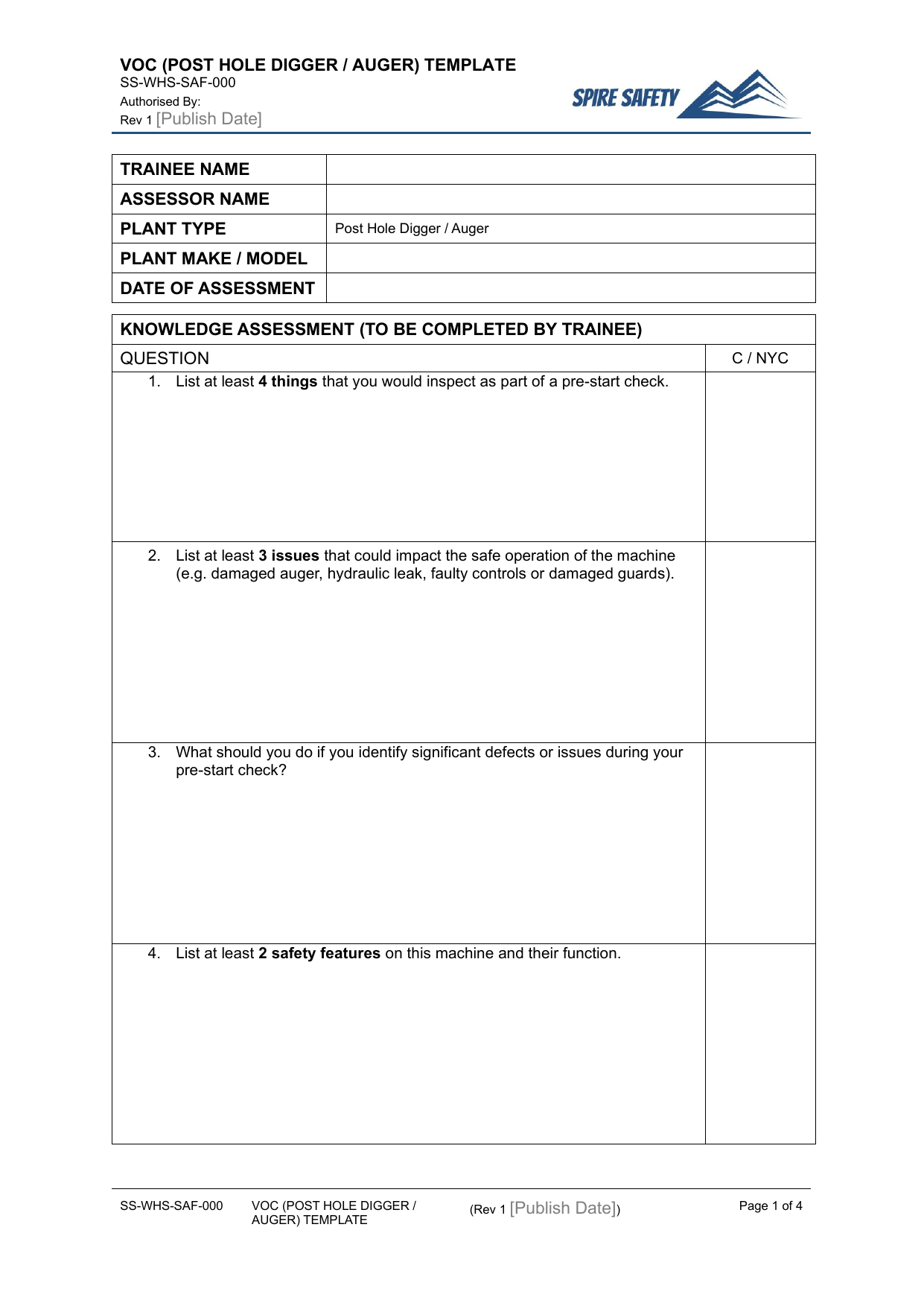
Purpose of the Verification of Competency (Post Hole Digger or Auger)
A Verification of Competency (VOC) is a formal process used to confirm that an individual possesses the required skills, knowledge, and experience to operate specific plant and equipment safely. This Verification of Competency (Post Hole Digger or Auger) template provides a structured method to assess an operator’s ability beyond simply holding a ticket or licence.
Its primary purpose is to ensure that workers can safely handle the unique risks associated with augers, such as managing rotational torque and kickback, identifying and avoiding underground services, and understanding the specific operational controls of the machine being used.
By systematically observing and questioning an operator, a Person Conducting a Business or Undertaking (PCBU) can verify their current competence, identify any knowledge gaps, and determine if further training is needed. This process is a critical control measure for managing risks associated with high-risk plant, helping to prevent incidents, injuries, and damage to property or essential services.
Proper verification helps build a safer work environment by ensuring that only skilled and aware personnel operate potentially dangerous machinery.
Video walkthrough
How to use the Verification of Competency (Post Hole Digger or Auger)
This document serves as a starting point for developing a workplace-specific assessment. First, download the template in your preferred format (DOCX for easy editing or PDF for reference).
The next critical step is customisation. You must adapt the criteria to reflect the specific make and model of the post hole digger or auger used at your site, as controls and safety features can vary significantly.
You should also incorporate site-specific hazards, such as soil conditions, slopes, proximity to structures, and local procedures for identifying underground utilities.
The assessment should be conducted by a person who is not only familiar with WHS principles but also highly competent and experienced in the operation of the specific auger. The process involves direct observation of the operator performing tasks, from pre-start checks to operation and shutdown, alongside a theory component to test their understanding of safety procedures and hazard management.
Much like our Free Dingo Digger VOC (Verification of Competency) Template, this resource is a framework to build upon, not a final product. We have not included every possible hazard or control measure; you must tailor this document to your unique operational context to ensure its effectiveness.
When to use it
A VOC for a post hole digger or auger should be conducted at several key points to ensure ongoing safety and competence. It is commonly used during the recruitment and onboarding process to verify the skills claimed by a new employee before they are authorised to operate equipment.
It should also be triggered when a new type or model of auger is introduced to the workplace, as operational differences may present new risks. Following a near-miss or an incident involving the equipment, a VOC is essential to identify if operator error or a competency gap was a contributing factor.
Furthermore, regular, scheduled VOCs are a cornerstone of proactive safety management. Many organisations incorporate them into their periodic review cycle, often every one to two years, to ensure skills have not diminished over time.
This continuous verification is a vital part of maintaining robust WHS management systems, demonstrating a commitment to worker safety and regulatory alignment.
Who should use it
This VOC template is designed for use by individuals with responsibility for workplace health and safety and personnel competence. This includes site supervisors, project managers, WHS advisors, and equipment trainers.
The person conducting the assessment must be suitably qualified and experienced with post hole diggers to make a valid judgement on the operator's skills. They act as the assessor, using the template to guide their observation and questioning, ultimately making a determination of 'Competent' or 'Not Yet Competent'.
The subject of the assessment is the plant operator—any worker tasked with using a one-person, two-person, or machine-mounted auger. On a busy construction or landscaping site, a worker might need to demonstrate competence on a wide range of equipment.
For instance, after verifying auger skills, you may need to assess their ability with other tools using our Verification of Competency (Concrete Saw or Floor Saw) Template. For more complex plant, like elevated work platforms, a separate assessment such as our Verification of Competency (Boom Lift or Knuckle Boom) Template would be required.
Ultimately, this document helps PCBUs fulfil their duty of care by providing a clear and documented process for competency verification. If you need assistance developing or implementing a comprehensive competency program, engaging external WHS consulting services can provide valuable expertise.
You can also explore our free WHS resources library for other useful templates and guides.
Common mistakes
Common mistakes to avoid
- Using a generic 'auger' VOC template without tailoring it to the specific make, model, and condition of the machine.
- The assessor not being competent or experienced enough with the auger to identify unsafe practices or subtle operational errors.
- Treating the VOC as a paperwork exercise ('tick and flick') instead of a practical, observational assessment of real-world skills.
- Failing to include a check that the operator knows how and when to locate underground services before starting any work.
Legal references
Legal considerations
The following legal requirements may be relevant to this type of work.
- Work Health and Safety Act (Harmonised) — Provides the primary duties for protecting workers and other people from work health and safety risks.
- Work Health and Safety Regulations (Harmonised) — Sets out requirements supporting the management of workplace hazards and risks.
The following codes may be relevant to this type of work.
- Managing WHS Risks Code of Practice — Provides practical guidance on identifying hazards, assessing risks and applying effective controls.
- Work Health and Safety Consultation, Cooperation and Coordination Code of Practice — Provides practical guidance on consulting workers and coordinating with other duty holders.
- Managing the Work Environment and Facilities Code of Practice — Provides practical guidance on safe work environments, workplace facilities and related controls.
Did you know
Underground Dangers
Striking underground utilities like electrical cables or gas pipes is a primary hazard of using an auger. Always using a service like Dial Before You Dig (or your state's equivalent) is a non-negotiable first step before any excavation.
The Power of Torque
The sudden, powerful kickback from an auger, especially when it hits a rock or root, can cause severe injuries, including fractures, sprains, and facial trauma. Modern augers often include safety clutches or reverse functions to help manage this risk.
FAQ
Frequently asked questions
01Is a VOC for a post hole digger the same as a training course?
02What should happen if a worker is found 'Not Yet Competent' on an auger?
03How often should we conduct a VOC for a post hole digger?
04Do I need a VOC for a small, one-person handheld auger?
Share this resource
Verification of Competency (Post Hole Digger or Auger)
Browse Categories
How To Use It
- 1Download and open in Word or PDF.
- 2Replace the placeholders with your business details.
- 3Get it reviewed by a WHS specialist before rollout.
Need it customised?
Our WHS consultants can adapt this template to your site, run a gap analysis, or audit what you already have in place.
Book a Free Consultation WHS consulting servicesor call 1300 156 382