
Verification of Competency (Rivet Gun)
Ensure safe operation of rivet guns with our Verification of Competency (Rivet Gun) template. This structured resource helps assess operator skills.
Verification of Competency (Rivet Gun)
DOCX • 138 KB + PDF
Updated Oct 2026
No signup required
Purpose of the Verification of Competency (Rivet Gun)
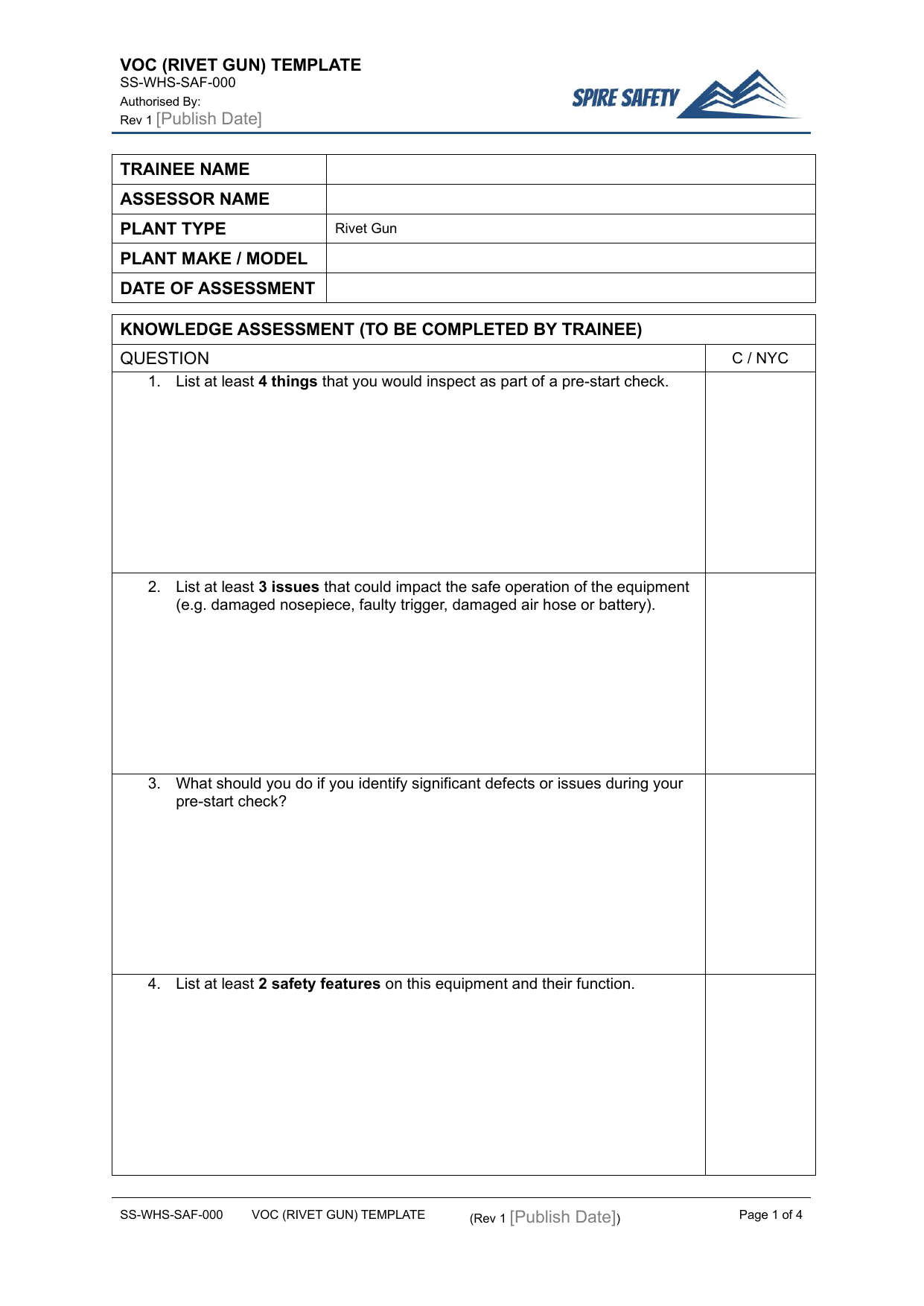
A Verification of Competency (VOC) is a practical assessment used to confirm that a worker has the current skills and knowledge to operate equipment safely and proficiently. This Verification of Competency (Rivet Gun) template provides a structured method to evaluate an operator’s ability to use a rivet gun, whether pneumatic, hydraulic, or battery-powered, according to your workplace’s specific procedures and safety standards.
It goes beyond initial training, serving as a crucial tool for ongoing risk management and confirming that skills have been retained over time.
Using a formal VOC process helps a Person Conducting a Business or Undertaking (PCBU) meet their primary duty of care under WHS legislation. It creates a verifiable record that demonstrates proactive steps have been taken to ensure worker competence with specific high-risk plant.
In a workshop environment, where multiple tools are in use, maintaining consistent competency records is vital. For example, similar verification processes are essential for tools like drills, and our free Drill Press VOC template offers another example of equipment-specific assessment.
Video walkthrough
How to use the Verification of Competency (Rivet Gun)
This document provides a comprehensive starting point for assessing operators of rivet guns. It is designed to be adapted to the unique context of your workplace, including the specific models of rivet guns used, the types of rivets, and the materials being fastened.
The assessment includes a combination of theory questions to test knowledge and a practical observation checklist to evaluate hands-on skills.
To implement this VOC effectively:
- Download the template in your preferred format (DOCX for easy editing or PDF).
- Customise the checklist to align with your Safe Work Procedures (SWPs), the manufacturer’s instructions for your specific rivet gun, and the hazards identified in your risk assessments.
- Have a competent and authorised person (the assessor) conduct the verification. This person must have in-depth knowledge of the equipment and assessment procedures.
- The assessor observes the operator performing tasks, asks relevant questions, and records the outcomes directly on the form.
- Both the operator and the assessor sign the completed document. A copy should be provided to the operator and the original stored as a training record.
Please note: This resource is a template. We are not there in your workplace, so you must customise it to reflect your specific rivet gun models, tasks, materials, and workplace environment.
Integrating such customised documents into your overall safety framework is a key component of effective WHS management systems, ensuring all safety processes are connected and robust.
When to use it
A Verification of Competency should not be a one-off event. It is an ongoing process that should be triggered by specific circumstances to ensure skills remain current and safety standards are upheld. Consider conducting a rivet gun VOC in the following situations:
- Pre-employment: To verify the claimed skills and experience of a new hire.
- Introduction of new equipment: When a new model or type of rivet gun is introduced to the workplace. This is distinct from tools like pop rivet guns, which may require their own assessment using a specific Verification of Competency (Pop Rivet Gun).
- Post-incident: After an incident, accident, or near miss involving a rivet gun to identify any competency gaps.
- Identified performance issues: If a supervisor observes unsafe or incorrect operation.
- Extended absence: For workers returning to their role after a long period away from using the equipment.
- Scheduled reassessment: As part of a regular schedule (e.g., annually or every two years) to ensure skills have not degraded over time.
This proactive approach helps manage risks associated with hazardous manual tasks and the use of plant. The same principles apply to other powered hand tools, such as those covered in our Verification of Competency (Orbital Sander) Template.
Who should use it
This resource is designed for use by several key personnel within an organisation to ensure a comprehensive and effective competency management process:
- WHS Managers and Advisors: To implement a standardised and documented process for verifying competency across the workforce, forming part of the broader safety management system.
- Supervisors and Team Leaders: As the individuals responsible for the day-to-day safety of their teams, they can use this tool to conduct assessments and ensure their workers are operating equipment safely. These records are often reviewed as part of routine WHS compliance auditing.
- Internal Trainers and Assessors: To formally verify that skills taught during training have been understood and can be applied competently in a practical setting.
- Operators: While they are the subject of the assessment, understanding the criteria gives them a clear picture of performance expectations and safety standards.
Ultimately, the PCBU holds the responsibility for ensuring systems are in place to manage WHS risks. This template provides a practical tool to help meet those obligations, similar to how our Free Bench Grinder VOC helps manage risks for another common piece of workshop equipment.
Common mistakes
Common mistakes to avoid
- Using a generic checklist without customising it for the specific rivet gun model and tasks.
- Treating the VOC as a 'tick and flick' exercise instead of a genuine assessment of skill.
- Failing to document corrective actions or provide further training when competency gaps are identified.
- Allowing an assessor who lacks deep technical knowledge of the equipment to conduct the verification.
Legal references
Legal considerations
The following legal requirements may be relevant to this type of work.
- Work Health and Safety Act (Harmonised) — Provides the primary duties for protecting workers and other people from work health and safety risks.
- Work Health and Safety Regulations (Harmonised) — Sets out requirements supporting the management of workplace hazards and risks.
The following codes may be relevant to this type of work.
- Managing WHS Risks Code of Practice — Provides practical guidance on identifying hazards, assessing risks and applying effective controls.
- Work Health and Safety Consultation, Cooperation and Coordination Code of Practice — Provides practical guidance on consulting workers and coordinating with other duty holders.
- Managing the Work Environment and Facilities Code of Practice — Provides practical guidance on safe work environments, workplace facilities and related controls.
Did you know
Aviation History
Rivet guns were a revolutionary tool in the 20th century, particularly for the aviation industry. The duralumin fuselage of aircraft like the Douglas DC-3 was held together by hundreds of thousands of rivets, each installed manually.
Noise Hazard
Pneumatic rivet guns can generate noise levels well over 100 decibels (dB), far exceeding the 85 dB exposure standard where hearing protection becomes mandatory. This makes hearing risk management a critical control for operators.
FAQ
Frequently asked questions
01What is the difference between training and a Verification of Competency (VOC)?
02Is a VOC legally required for using a rivet gun in Australia?
03How often should a rivet gun VOC be performed?
04Can a supervisor conduct the VOC for their team member?
Share this resource
Verification of Competency (Rivet Gun)
Browse Categories
How To Use It
- 1Download and open in Word or PDF.
- 2Replace the placeholders with your business details.
- 3Get it reviewed by a WHS specialist before rollout.
Need it customised?
Our WHS consultants can adapt this template to your site, run a gap analysis, or audit what you already have in place.
Book a Free Consultation WHS consulting servicesor call 1300 156 382