
Verification of Competency (Road Saw or Diamond Blade Saw)
Assess and confirm worker skill in operating road or diamond blade saws. Our Verification of Competency template is aligned with Australian WHS standards.
Verification of Competency (Road Saw or Diamond Blade Saw)
DOCX • 138 KB + PDF
Updated Oct 2026
No signup required
Purpose of the Verification of Competency (Road Saw or Diamond Blade Saw)
Operating a road saw, also known as a diamond blade saw or floor saw, presents significant risks to health and safety. This equipment generates high levels of noise, vibration, and hazardous dust like respirable crystalline silica.
A formal process to confirm that workers are competent to operate this machinery safely is a critical part of a PCBU's duty of care. This Verification of Competency (Road Saw or Diamond Blade Saw) template provides a structured method for assessing and documenting an operator's ability to use the equipment correctly and manage associated hazards.
Implementing formal verification processes is a key component of robust WHS management systems. It helps demonstrate that all reasonably practicable steps have been taken to ensure worker safety. This document is not just about ticking a box; it's a practical tool for risk management, helping to prevent incidents, injuries, and long-term occupational illnesses linked to plant operation.
A VOC complements initial training and licensing. It confirms that the theoretical knowledge and practical skills can be applied effectively in the specific context of your workplace, using the models of equipment you own.
This process is similar for other high-risk cutting equipment, and you may also find our Verification of Competency for a concrete or floor saw useful.
Video walkthrough
How to use the Verification of Competency (Road Saw or Diamond Blade Saw)
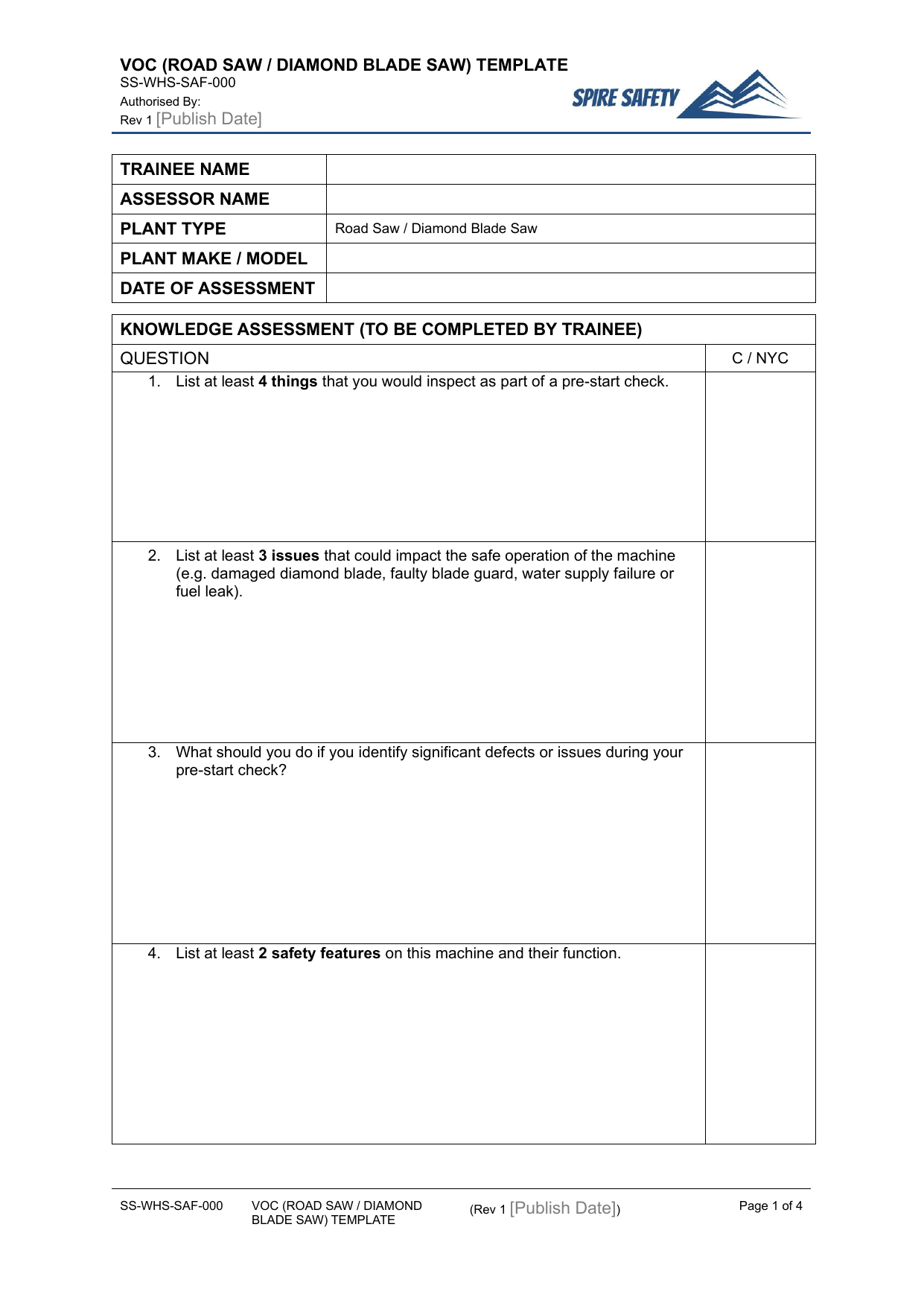
This template is designed to guide a competent assessor through a structured evaluation of an operator's skills. It is broken down into key stages of operation, including theoretical knowledge, pre-operational checks, safe operation, and post-operational procedures.
The assessor observes the operator and uses the checklist to record whether their performance meets the required standard for each criterion.
Assessment criteria typically include:
- Conducting pre-start inspections (e.g., checking blade integrity, guards, water suppression system).
- Demonstrating correct start-up and shut-down procedures.
- Using the saw with correct technique to minimise physical strain and kickback risk.
- Effectively managing dust, noise, and vibration exposures.
- Selecting and using the correct personal protective equipment (PPE).
- Recognising hazards and implementing appropriate controls.
IMPORTANT: This document is a starting-point template. We have designed it as a foundation that you must review and customise to reflect the specific models of road saw, tasks, and unique site conditions and risks present in your workplace.
A generic assessment is insufficient for demonstrating due diligence. You can adapt this structure for other tools, such as our Circular Saw VOC.
When to use it
A Verification of Competency should be conducted at several key points, not just once. It is an ongoing process to ensure skills remain current. Key triggers for conducting a VOC include:
- Pre-employment or mobilisation: Before a new or contracted worker operates a road saw for the first time on your site.
- Introduction of new equipment: When a new make or model of road saw with different features or controls is introduced.
- Post-incident: Following any incident or near miss involving a road saw, to identify and close any competency gaps.
- Identified performance issues: If a supervisor observes unsafe or incorrect operation.
- Periodic refreshers: As part of a regular schedule determined by a risk assessment. For high-risk tasks, this might be annually or biennially. The effectiveness of these processes can be checked through regular WHS compliance auditing.
Who should use it
This resource is intended for any person responsible for ensuring workers are competent to use plant and equipment safely. This includes:
- Supervisors and Site Managers: To assess the skills of their team members before assigning tasks involving a road saw.
- WHS Advisors and Officers: To implement and manage a consistent competency framework across the organisation.
- Internal Trainers and Assessors: As the primary tool for conducting and documenting the assessment.
Crucially, the person conducting the VOC must be competent themselves. This means they must have the requisite technical knowledge, hands-on experience, and relevant training on the specific road saw being assessed.
They must be able to make a confident judgement about the operator's abilities and provide corrective feedback if required. For other specialised plant, such as those used in vertical access, a specific tool like our Boom Lift or Knuckle Boom VOC would be required.
In construction, other concrete-related equipment also requires assessment, which is where a Concrete Vibrator VOC template can be useful. For more tools to support your safety system, browse our comprehensive free WHS resources library.
Common mistakes
Common mistakes to avoid
- Treating the VOC as a 'tick-and-flick' paperwork exercise without meaningful observation.
- Failing to customise the template for the specific road saw models and tasks at the workplace.
- Using an assessor who is not familiar or competent with the specific equipment being assessed.
- Neglecting to formally document the outcome and any corrective actions or further training required.
Legal references
Legal considerations
The following legal requirements may be relevant to this type of work.
- Work Health and Safety Act (Harmonised) — Provides the primary duties for protecting workers and other people from work health and safety risks.
- Work Health and Safety Regulations (Harmonised) — Sets out requirements supporting the management of workplace hazards and risks.
The following codes may be relevant to this type of work.
- Managing WHS Risks Code of Practice — Provides practical guidance on identifying hazards, assessing risks and applying effective controls.
- Work Health and Safety Consultation, Cooperation and Coordination Code of Practice — Provides practical guidance on consulting workers and coordinating with other duty holders.
- Managing the Work Environment and Facilities Code of Practice — Provides practical guidance on safe work environments, workplace facilities and related controls.
Did you know
Silica Dust Hazard
Cutting concrete, brick, or rock with a road saw can generate respirable crystalline silica dust. Inhaling this dust can lead to silicosis, a serious and incurable lung disease.
Noise Levels
A typical road saw can operate at over 110 decibels (dB), which is well above the Australian workplace exposure standard of 85 dB. This level of noise can cause permanent hearing damage in a very short time without proper hearing protection.
FAQ
Frequently asked questions
01What is the difference between a high-risk work licence and a Verification of Competency?
02How often should a road saw VOC be conducted?
03Can a road saw VOC be done in a classroom setting?
04Who is a 'competent person' to assess a road saw operator?
Share this resource
Verification of Competency (Road Saw or Diamond Blade Saw)
Browse Categories
How To Use It
- 1Download and open in Word or PDF.
- 2Replace the placeholders with your business details.
- 3Get it reviewed by a WHS specialist before rollout.
Need it customised?
Our WHS consultants can adapt this template to your site, run a gap analysis, or audit what you already have in place.
Book a Free Consultation WHS consulting servicesor call 1300 156 382