
Verification of Competency (Semi-Trailer or Prime Mover)
Ensure driver competence with our Verification of Competency (Semi-Trailer or Prime Mover) template. Aligned with Australian WHS practice.
Verification of Competency (Semi-Trailer or Prime Mover)
DOCX • 138 KB + PDF
Updated Oct 2026
No signup required
Purpose of the Verification of Competency (Semi-Trailer or Prime Mover)
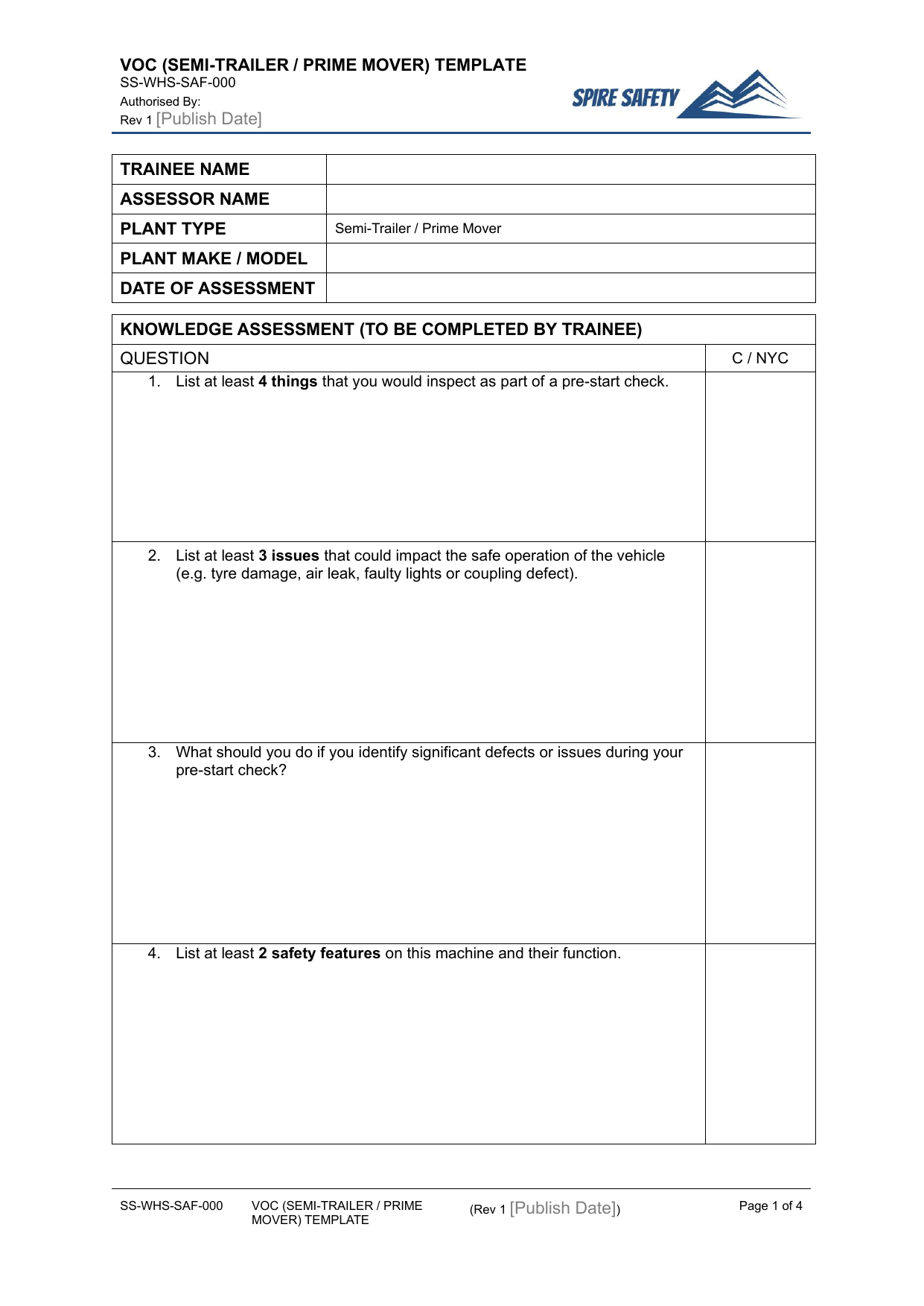
Operating a prime mover with a semi-trailer is a high-risk activity that requires more than just a heavy vehicle licence. This Verification of Competency (Semi-Trailer or Prime Mover) template provides a structured method for a Person Conducting a Business or Undertaking (PCBU) to confirm that a worker can operate this equipment safely and competently within a specific workplace context.
It assesses a driver's practical skills, knowledge of site rules, and ability to manage risks associated with coupling, uncoupling, maneuvering, and transporting loads. Using this document helps a PCBU fulfil their primary duty of care by ensuring workers have the necessary skills and training for the tasks they perform.
A robust VOC process is a critical component of an organisation's overall safety framework. It provides documented evidence of a worker's ability, which can be integrated into broader WHS management systems. This formal verification helps identify any gaps in training or understanding before they can lead to an incident, protecting the driver, other workers, and the public.
Video walkthrough
How to use the Verification of Competency (Semi-Trailer or Prime Mover)
This document is a downloadable template available in DOCX and PDF formats. It is designed as a starting point, providing a comprehensive checklist of criteria for assessing an operator.
The process should be conducted by a person who is themselves competent and experienced with the specific type of prime mover and trailer combination in use. The assessment should include direct observation of practical tasks and a theory component to check the operator's understanding of key safety principles and procedures.
Important: We have designed this document as a starting point. You must customise it to reflect the specific semi-trailers, prime movers, loads, routes, and workplace procedures at your site.
Different equipment requires different checks, a process you might see in our Verification of Competency (Boom Lift or Knuckle Boom) Template, and this principle applies equally to heavy vehicles.
Customisation should address the unique hazards of your operations. This might include specific instructions for navigating tight loading docks, procedures for securing unusual loads, or protocols for on-site traffic management.
The goal is to create an assessment that accurately reflects the real-world tasks and risks the driver will face, much like you would tailor an Asphalt Paver Verification of Competency Template for road work environments.
When to use it
A VOC for a semi-trailer operator should not be a one-time event. It is a valuable tool to be used in several situations to proactively manage risk. Common triggers for conducting a verification include:
- Pre-employment or prior to starting: To verify the skills claimed by a new operator before they begin work.
- Introduction of new equipment: When a driver is required to operate a new make or model of prime mover or a different type of trailer (e.g., flat top, refrigerated, tanker).
- Post-incident: As part of an investigation following an incident or a near-miss involving a heavy vehicle.
- Observed unsafe behaviour: If a supervisor or co-worker observes a driver operating the vehicle in an unsafe manner.
- Periodic re-assessment: On a regular basis (e.g., every 2-3 years) as part of an ongoing competency program, especially on sites with complex interactions, such as a construction project where other equipment may be in use that has its own checks, like those in a Verification of Competency (Concrete Saw or Floor Saw) Template.
Who should use it
This template is designed for use by individuals responsible for workplace safety and operational management within the transport, logistics, construction, and manufacturing industries. This includes:
- Transport Managers and Fleet Supervisors
- Workplace Health and Safety (WHS) Officers or Advisors
- Operations Managers
- Competent and experienced drivers or trainers tasked with assessing other workers
The person conducting the assessment must have the authority, experience, and knowledge to make an objective judgement about the operator's competence. Developing and implementing a comprehensive VOC program that aligns with your specific operational risks can be complex; engaging external specialists for WHS consulting can provide valuable expertise and ensure your processes are robust and effective.
Common mistakes
Common mistakes to avoid
- Using a generic VOC that doesn't cover site-specific hazards (e.g., tight loading bays, steep grades, or specific coupling systems).
- The assessor lacking sufficient hands-on experience on the specific prime mover or trailer combination being assessed.
- Treating the VOC as a 'tick-and-flick' exercise instead of a genuine assessment of practical skill and knowledge.
- Forgetting to verify the driver's knowledge of emergency procedures, such as managing brake failure or a tyre blowout.
Legal references
Legal considerations
The following legal requirements may be relevant to this type of work.
- Work Health and Safety Act (Harmonised) — Provides the primary duties for protecting workers and other people from work health and safety risks.
- Work Health and Safety Regulations (Harmonised) — Sets out requirements supporting the management of workplace hazards and risks.
The following codes may be relevant to this type of work.
- Managing WHS Risks Code of Practice — Provides practical guidance on identifying hazards, assessing risks and applying effective controls.
- Work Health and Safety Consultation, Cooperation and Coordination Code of Practice — Provides practical guidance on consulting workers and coordinating with other duty holders.
- Managing the Work Environment and Facilities Code of Practice — Provides practical guidance on safe work environments, workplace facilities and related controls.
Did you know
Jackknife Risk
A 'jackknife' skid occurs when a prime mover's drive wheels lose traction, causing the trailer to push it from behind and swing around. It's a leading cause of serious heavy vehicle incidents in Australia.
Driver Fatigue
Fatigue is a major factor in over 10% of fatal heavy vehicle crashes. A VOC can include questions to assess a driver's understanding of their responsibilities under fatigue management plans and logbook rules.
FAQ
Frequently asked questions
01What is the difference between a heavy vehicle licence and a Verification of Competency?
02How often should a semi-trailer VOC be conducted?
03Who can conduct a Verification of Competency for a prime mover?
04Does this VOC template cover load restraint?
Share this resource
Verification of Competency (Semi-Trailer or Prime Mover)
Browse Categories
How To Use It
- 1Download and open in Word or PDF.
- 2Replace the placeholders with your business details.
- 3Get it reviewed by a WHS specialist before rollout.
Need it customised?
Our WHS consultants can adapt this template to your site, run a gap analysis, or audit what you already have in place.
Book a Free Consultation WHS consulting servicesor call 1300 156 382