
Verification of Competency (Rebar Bender)
Confirm operator skill for rebar benders with our Verification of Competency template. A structured starting point for assessing worker competence.
Verification of Competency (Rebar Bender)
DOCX • 138 KB + PDF
Updated Oct 2026
No signup required
Purpose of the Verification of Competency (Rebar Bender)
Operating a rebar bender, whether a portable unit or a stationary bench model, requires specific skills to manage risks like entanglement, crushing, and hazardous manual tasks. A Verification of Competency (Rebar Bender) is a formal process used to confirm that an operator can use the equipment safely and effectively, according to your workplace procedures and aligned with Australian WHS practice.
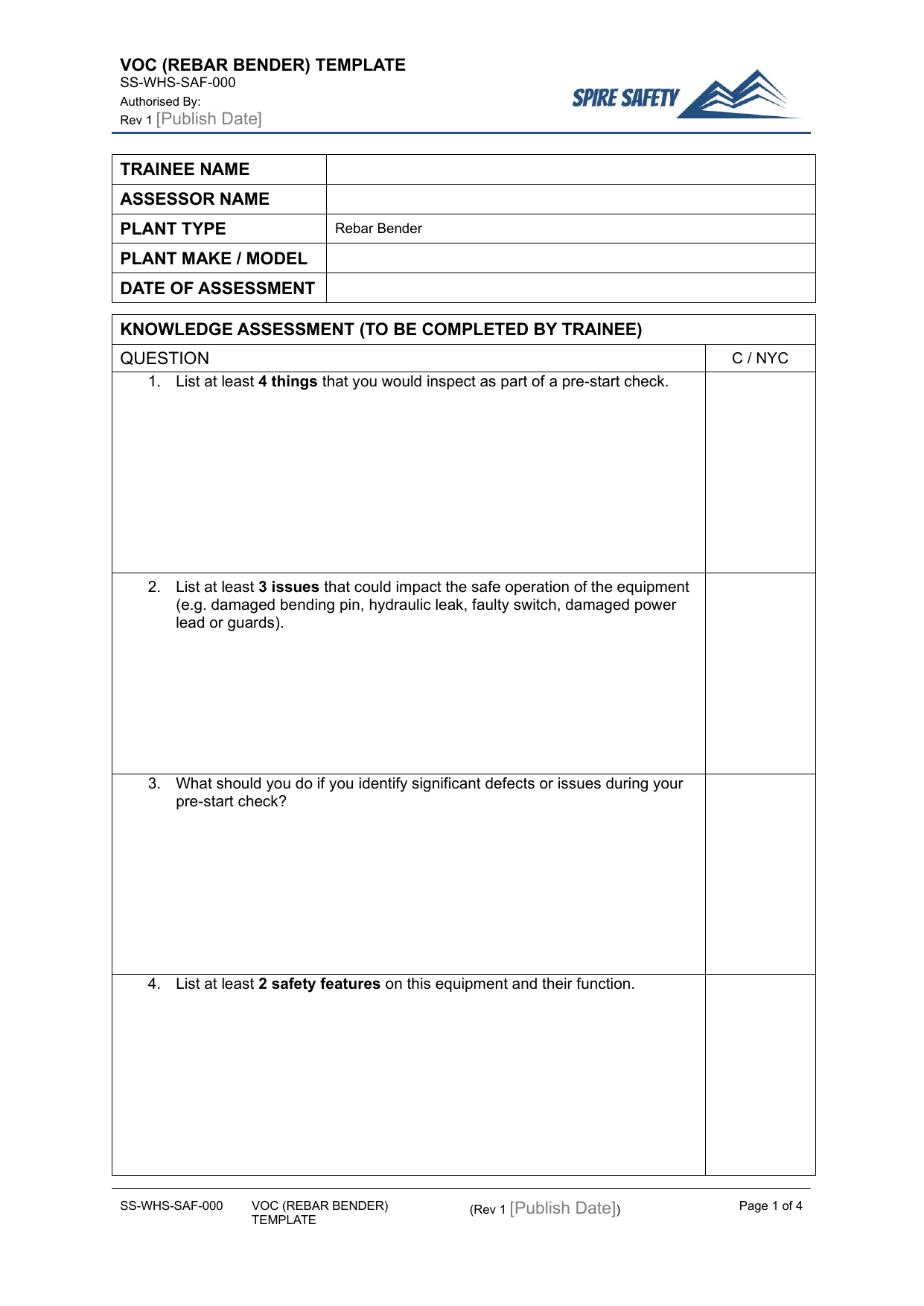
This document provides a structured starting point for assessing and documenting an individual's ability to operate a rebar bender correctly, covering everything from pre-start checks to safe shutdown.
It is important to understand that a VOC is not a substitute for formal training. Instead, it is a method for an organisation to verify that the training provided has been understood and that the worker is competent in the practical application of those skills in their specific work environment.
Similar to how you would verify skills for other construction plant, like with a Free Concrete vibrator VOC, this process provides evidence that you have taken steps to ensure worker competency for specific tasks.
Video walkthrough
How to use the Verification of Competency (Rebar Bender)
This template is designed to be used by a competent assessor, such as a supervisor or safety advisor, to evaluate an operator. The process involves direct observation of the worker operating the rebar bender in a real or simulated work task, combined with targeted questions to test their safety knowledge.
The assessor uses the checklist to record performance against key criteria, identifying any gaps in skill or understanding.
Important: This document is a template and must be customised to your specific workplace. You need to review and amend it to reflect the make and model of your rebar bender, your site-specific hazards, and your Safe Work Method Statements (SWMS).
Integrating these customised assessments is a key part of building robust WHS management systems that effectively manage plant-related risks.
When to use it
A Verification of Competency should be conducted at several key points to ensure ongoing safety. Common triggers include:
- After a worker completes initial training on the rebar bender.
- As part of a pre-employment or pre-mobilisation screening process.
- When an operator has not used a rebar bender for an extended period.
- If a supervisor or co-worker observes unsafe behaviour or a near miss.
- Following an incident or accident involving the equipment.
- When new equipment is introduced, such as a different model of bender or other metalworking tools like those covered in our Verification of Competency (Plasma Cutter) template.
Who should use it
This template is intended for use by Persons Conducting a Business or Undertaking (PCBUs), employers, managers, supervisors, and WHS professionals. The individual conducting the assessment must be competent themselves—they should have a thorough understanding of the rebar bender's operation, its specific hazards, and the control measures required to manage risk.
They must be able to make an objective judgement about the operator's performance.
Key Assessment Criteria
A comprehensive rebar bender VOC should cover three main areas:
- Pre-use and Planning: Includes visual inspection of the machine, checking guards, verifying power sources are safe, and ensuring the work area is clear and stable.
- Operation: Assesses the operator's ability to handle and load rebar safely, set bending angles correctly, use two-handed controls where fitted, maintain safe body positioning, and manage entanglement risks.
- Post-use Procedures: Covers correct shutdown sequences, cleaning the machine of debris, and proper storage.
- Knowledge: Questions to confirm understanding of hazards, emergency stop functions, required Personal Protective Equipment (PPE), and procedures for dealing with malfunctions.
Documenting this process is vital for your safety records and is a key part of regular WHS compliance auditing. It demonstrates a practical commitment to ensuring your workforce is skilled and safe. This is just as important for smaller portable equipment as it is for large plant.
The principles of verification apply to many tools on a construction site, including those covered by our Free Circular Saw VOC. Ultimately, a well-executed VOC program helps reduce incidents and fosters a stronger safety culture within the organisation.
Common mistakes
Common mistakes to avoid
- Treating the VOC as a 'tick and flick' exercise without genuine observation.
- Using an assessor who is not fully competent in operating the rebar bender themselves.
- Forgetting to assess knowledge of emergency procedures and specific machine hazards.
- Failing to customise the template for the specific machine model and associated site risks.
Legal references
Legal considerations
The following legal requirements may be relevant to this type of work.
- Work Health and Safety Act (Harmonised) — Provides the primary duties for protecting workers and other people from work health and safety risks.
- Work Health and Safety Regulations (Harmonised) — Sets out requirements supporting the management of workplace hazards and risks.
The following codes may be relevant to this type of work.
- Managing WHS Risks Code of Practice — Provides practical guidance on identifying hazards, assessing risks and applying effective controls.
- Work Health and Safety Consultation, Cooperation and Coordination Code of Practice — Provides practical guidance on consulting workers and coordinating with other duty holders.
- Managing the Work Environment and Facilities Code of Practice — Provides practical guidance on safe work environments, workplace facilities and related controls.
Did you know
Pinch Point Power
The hydraulic and mechanical forces in rebar benders are immense, creating significant crush and pinch point hazards. A key part of competency is always being aware of hand and body positioning.
Manual Handling Risk
Beyond machine operation, a major risk is the manual handling of long and heavy steel bars. Competent operators must demonstrate safe lifting and carrying techniques to prevent musculoskeletal injuries.
FAQ
Frequently asked questions
01Is a Verification of Competency the same as a licence?
02How often should a rebar bender VOC be conducted?
03What happens if an operator fails their VOC?
04Can I use this template for both portable and bench-mounted rebar benders?
Share this resource
Verification of Competency (Rebar Bender)
Browse Categories
How To Use It
- 1Download and open in Word or PDF.
- 2Replace the placeholders with your business details.
- 3Get it reviewed by a WHS specialist before rollout.
Need it customised?
Our WHS consultants can adapt this template to your site, run a gap analysis, or audit what you already have in place.
Book a Free Consultation WHS consulting servicesor call 1300 156 382