
Verification of Competency (Random Orbital Sander)
Download our free Verification of Competency (Random Orbital Sander) template.
Verification of Competency (Random Orbital Sander)
DOCX • 138 KB + PDF
Updated Oct 2026
No signup required
Purpose of the Verification of Competency (Random Orbital Sander)
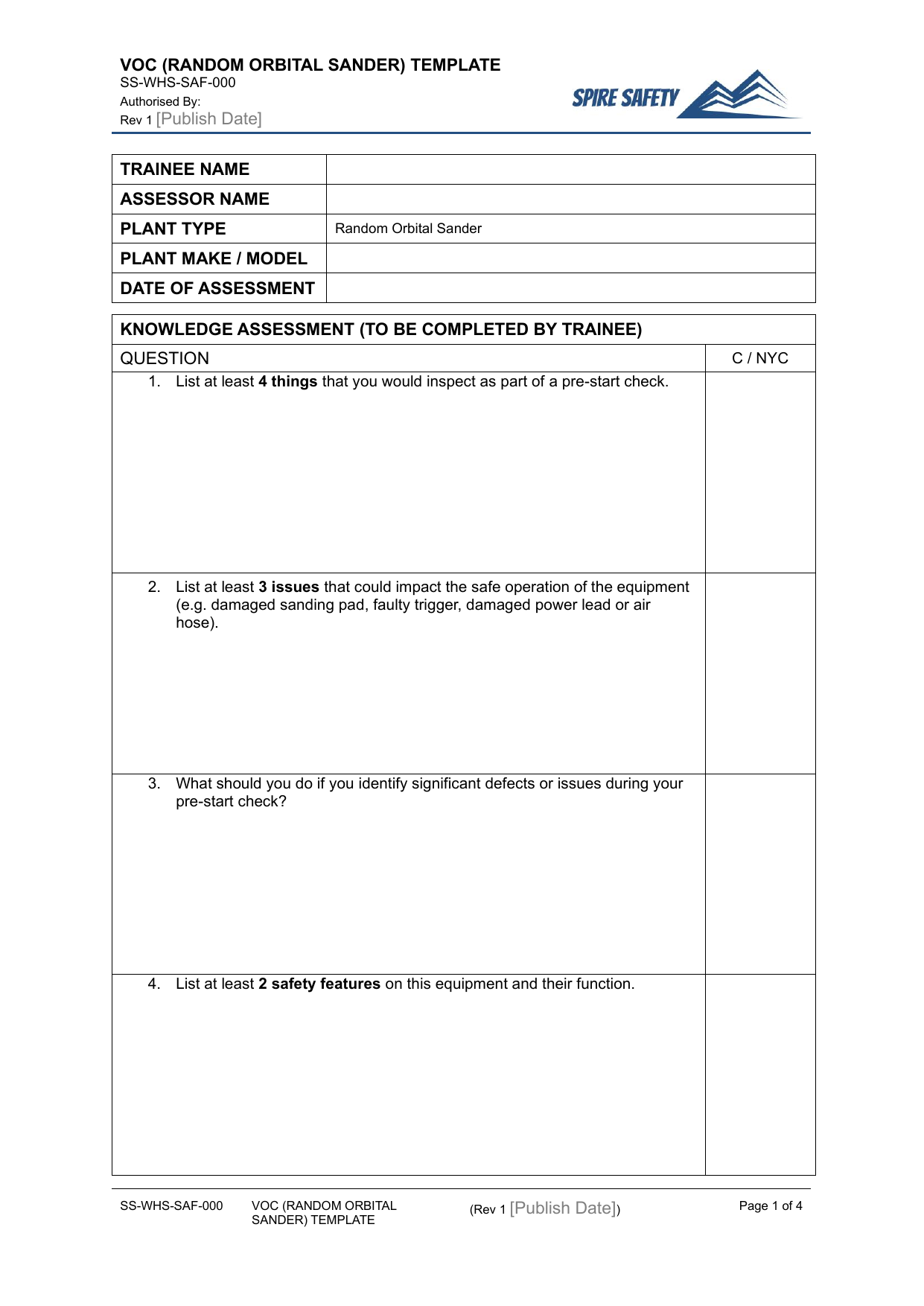
A Verification of Competency (VOC) is a practical assessment used by an organisation to confirm that a worker has the current skills, knowledge, and experience to operate equipment safely and effectively. This Verification of Competency (Random Orbital Sander) template provides a structured method to assess an operator's ability to use the tool according to manufacturer instructions and established safe work procedures.
It helps identify any gaps in training, reinforces safe work habits, and creates a documented record of competency, which is a key component of an effective safety management system.
Using this VOC helps a Person Conducting a Business or Undertaking (PCBU) meet their primary duty of care to ensure worker safety. It formalises the process of checking that a worker can not only perform the task but also recognise and manage associated risks like dust exposure, vibration, electrical hazards, and ergonomic strain.
Integrating such procedures is a critical part of developing robust WHS management systems that protect workers and support compliance.
Video walkthrough
How to use the Verification of Competency (Random Orbital Sander)
To use this document, a competent person (the assessor) observes a worker (the operator) performing tasks with a random orbital sander in a typical work environment. The assessor uses the checklist to evaluate the operator's performance against specific criteria, covering pre-start checks, operational techniques, dust control, and shutdown procedures.
The template includes sections for the assessor to record observations, confirm competence, and recommend further training if needed. This process is similar for other sanding tools, and you may also find our Verification of Competency (Orbital Sander) Template useful for related equipment.
Important: This is a template designed as a starting point. We have based it on common WHS practice, but you must customise it to reflect the specific models of random orbital sanders, materials, and unique risks in your workplace.
Always consult the sander’s operating manual and your site-specific Safe Work Method Statement (SWMS) when adapting the document.
When to use it
A VOC for a random orbital sander should be conducted at several key points to ensure ongoing safety and competence. These include:
- Pre-employment or prior to assignment: To verify the skills of new hires or workers new to the task.
- Post-incident: As part of an investigation following an incident or near miss involving the equipment.
- Introduction of new equipment: When a new make or model of random orbital sander with different features or risks is introduced.
- At regular intervals: As part of a scheduled competency review program (e.g., annually or biennially) to ensure skills have not diminished over time.
- Following a long absence: For workers returning to the role after an extended period away.
The principles of competency verification apply to a wide range of powered hand tools. For example, a similar process would be followed when using our free Circular Saw VOC to assess an operator's skill with that equipment.
Who should use it
This template is designed for use by individuals responsible for workplace safety and operational supervision. This typically includes:
- Supervisors and Team Leaders
- Workplace Health and Safety (WHS) Advisors and Officers
- Managers
- Internal Trainers and Assessors
The most critical requirement is that the person conducting the assessment must be competent themselves. This means they must possess in-depth knowledge and practical experience with random orbital sanders, understand the associated hazards, and be qualified to judge another person's performance.
The results of these assessments can also be a valuable input for WHS compliance auditing, providing evidence of how the organisation is managing plant and equipment risks.
A workshop may have a variety of equipment requiring similar assessments. This VOC can be used alongside other specific checklists, such as a Free Bench Grinder VOC (Verification of Competency) Template, to build a comprehensive competency program.
Having a systematic approach for all key plant and tools, including a Free Drill Press VOC (Verification of Competency) Template, ensures consistency and thoroughness. You can explore our complete range in the free WHS resources library to find templates for your other equipment.
Common mistakes
Common mistakes to avoid
- Using a generic checklist that isn't customised for the specific sander model and task.
- Failing to properly assess the use and effectiveness of dust control measures, like on-tool vacuum extraction.
- Having an assessor who lacks deep, practical experience with the equipment conduct the verification.
- Treating the VOC as a paperwork exercise rather than a genuine observation of skill and safe behaviour.
Legal references
Legal considerations
The following legal requirements may be relevant to this type of work.
- Work Health and Safety Act (Harmonised) — Provides the primary duties for protecting workers and other people from work health and safety risks.
- Work Health and Safety Regulations (Harmonised) — Sets out requirements supporting the management of workplace hazards and risks.
The following codes may be relevant to this type of work.
- Managing WHS Risks Code of Practice — Provides practical guidance on identifying hazards, assessing risks and applying effective controls.
- Work Health and Safety Consultation, Cooperation and Coordination Code of Practice — Provides practical guidance on consulting workers and coordinating with other duty holders.
- Managing the Work Environment and Facilities Code of Practice — Provides practical guidance on safe work environments, workplace facilities and related controls.
Did you know
Random vs. Orbital
The 'random' in a random orbital sander refers to its unique dual-action pad movement. It spins in a circle while also moving in small, elliptical orbits, which prevents the abrasive from following the same path twice and eliminates the swirl marks common with standard orbital sanders.
Invisible Dust Dangers
The fine dust produced by sanders can be a serious health hazard. Materials like MDF contain formaldehyde, while sanding old paint can release lead, and sanding concrete can generate respirable crystalline silica—all of which can cause severe, long-term health issues if inhaled.
FAQ
Frequently asked questions
01What is a Verification of Competency (VOC) for a random orbital sander?
02Is a VOC the same as a training certificate or licence?
03How often should a random orbital sander VOC be conducted?
04Who is qualified to assess competency on a random orbital sander?
Share this resource
Verification of Competency (Random Orbital Sander)
Browse Categories
How To Use It
- 1Download and open in Word or PDF.
- 2Replace the placeholders with your business details.
- 3Get it reviewed by a WHS specialist before rollout.
Need it customised?
Our WHS consultants can adapt this template to your site, run a gap analysis, or audit what you already have in place.
Book a Free Consultation WHS consulting servicesor call 1300 156 382