
Verification of Competency (Reach Stacker)
Download our free Verification of Competency (Reach Stacker) template (DOCX & PDF). A structured starting point for assessing operator skills in Australia.
Verification of Competency (Reach Stacker)
DOCX • 138 KB + PDF
Updated Oct 2026
No signup required
Purpose of the Verification of Competency (Reach Stacker)
Operating a reach stacker is a high-risk activity that requires significant skill and safety awareness. While a High Risk Work Licence (HRWL) is the mandatory baseline, a Verification of Competency (VOC) confirms that an operator can apply their knowledge and skills safely in your specific work environment.
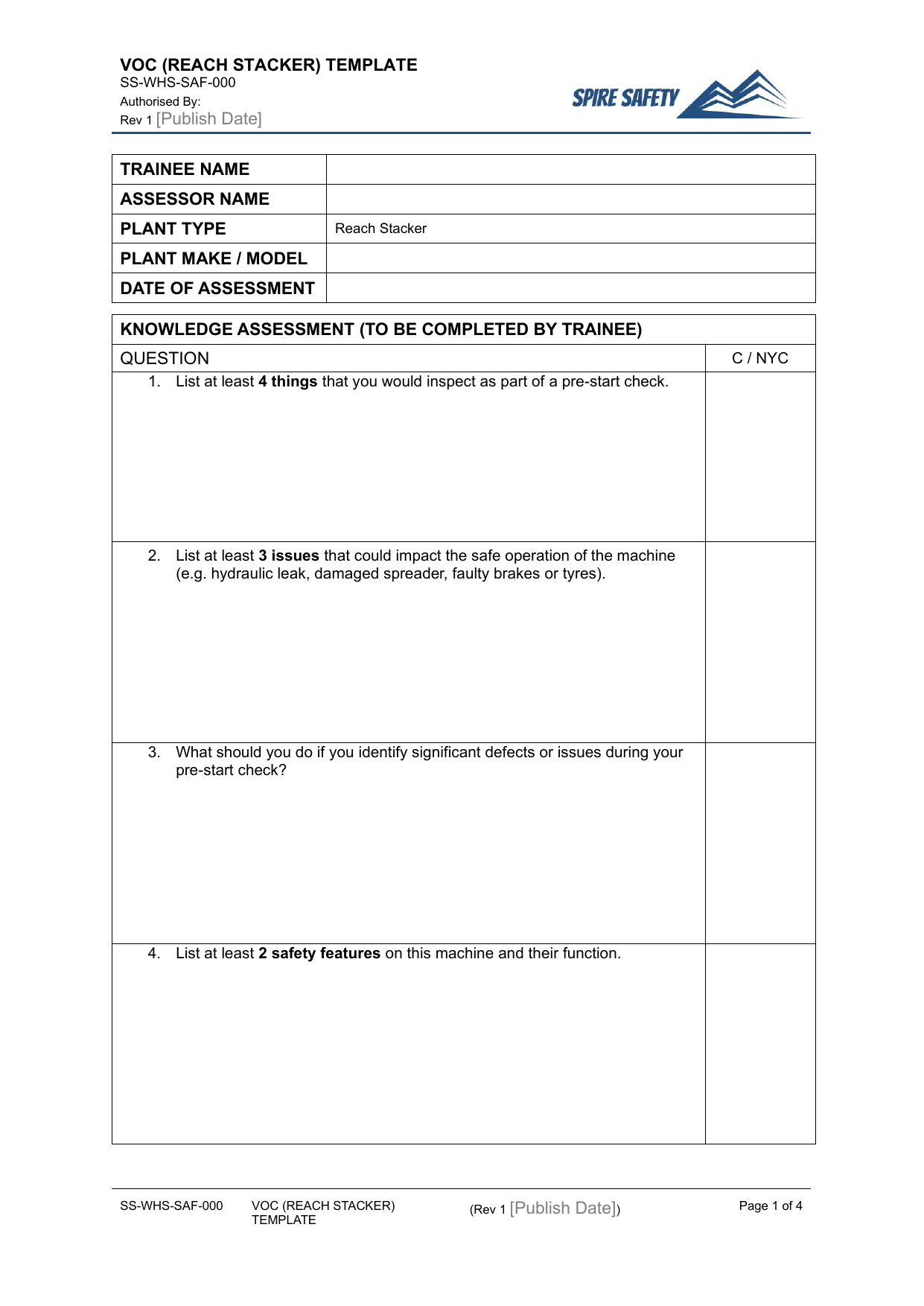
This Verification of Competency (Reach Stacker) template provides a structured method for assessing an operator's current ability to operate the plant safely, handle different loads, and respond to workplace-specific hazards.
Using a formal VOC process helps a Person Conducting a Business or Undertaking (PCBU) meet their primary duty of care. It creates a clear record of the steps taken to ensure workers are competent, moving beyond simply holding a licence.
This process is a vital part of effective WHS management systems, demonstrating proactive risk management and a commitment to workplace safety.
Video walkthrough
How to use the Verification of Competency (Reach Stacker)
This document is designed as a starting point for developing your own site-specific assessment. It includes a combination of theoretical questions, a checklist for observing a pre-operational inspection, and a practical assessment component to observe the operator performing typical tasks.
To get started:
- Download the template in your preferred format (DOCX for easy editing or PDF).
- Review the criteria against your site's specific reach stacker models, attachments (e.g., container spreaders, C-hooks), common container types (20ft, 40ft, high-cube), and operating conditions (e.g., uneven ground, high traffic areas, interaction with other vehicles).
- The assessor should be a competent person with extensive experience and knowledge of reach stacker operations, capable of making an informed judgement on the operator's skills.
- Brief the operator on the assessment process, conduct the theory and practical observations, and record all findings directly on the form.
- Discuss the outcome with the operator, highlighting areas of strength and identifying any gaps where further training or supervision may be required.
Important: This is a generic template aligned with Australian WHS principles. We strongly recommend you customise it to reflect the specific plant, procedures, and risks unique to your workplace. The process for assessing competency on a reach stacker differs from that for other equipment, such as what's detailed in a Verification of Competency for a Boom Lift or Knuckle Boom.
When to use it
A Verification of Competency for a reach stacker is not a one-off event. It should be integrated into your safety procedures and conducted at several key moments:
- Pre-Employment: To verify the skills claimed by a potential new hire.
- New Equipment: Before an operator uses a new make or model of reach stacker they are unfamiliar with.
- Post-Incident: As part of an investigation following an incident or a significant near miss involving a reach stacker.
- Scheduled Intervals: As part of a regular safety program (e.g., every 1-3 years) to ensure skills have not diminished over time.
- Identified Performance Issues: If a supervisor or co-worker raises concerns about an operator's behaviour or skill level.
Regular competency checks can be a key outcome of broader safety reviews and can be implemented as a control measure following formal WHS compliance auditing to address identified system gaps.
Who should use it
This resource is designed for anyone responsible for managing plant safety and worker competency. This includes:
- Logistics and Port Operations Managers
- Container Park Supervisors
- WHS/HSE Managers and Advisors
- Warehouse and Transport Supervisors
- Internal Trainers and Assessors
The individual conducting the assessment (the assessor) must be competent themselves. This means they possess the necessary knowledge, skills, and experience with reach stackers to capably assess another person's performance.
The same principle of assessor competence applies whether verifying skills on large machinery like a reach stacker or assessing competency on smaller tools using a free Circular Saw VOC template. You can explore many other equipment-specific templates in our free WHS resources library to see this principle in action.
Common mistakes
Common mistakes to avoid
- Using a generic checklist that doesn't cover site-specific hazards or reach stacker attachments.
- Having the VOC conducted by a supervisor who lacks deep technical knowledge of reach stacker operation.
- Failing to formally document the assessment outcome, actions, and any required retraining.
- Treating the VOC as a 'tick and flick' exercise rather than a genuine opportunity to assess and improve operator skills.
Legal references
Legal considerations
The following legal requirements may be relevant to this type of work.
- Work Health and Safety Act (Harmonised) — Provides the primary duties for protecting workers and other people from work health and safety risks.
- Work Health and Safety Regulations (Harmonised) — Sets out requirements supporting the management of workplace hazards and risks.
The following codes may be relevant to this type of work.
- Managing WHS Risks Code of Practice — Provides practical guidance on identifying hazards, assessing risks and applying effective controls.
- Work Health and Safety Consultation, Cooperation and Coordination Code of Practice — Provides practical guidance on consulting workers and coordinating with other duty holders.
- Managing the Work Environment and Facilities Code of Practice — Provides practical guidance on safe work environments, workplace facilities and related controls.
Did you know
Lifting Capacity
Modern reach stackers can lift incredibly heavy loads, with some models capable of lifting over 45 tonnes in the first row. However, this capacity decreases significantly as the boom extends to the second or third container row.
The 'Ticket' is Just the Start
Regulators increasingly view a High Risk Work Licence as evidence of baseline training, not a lifetime pass for safe operation. Documented, ongoing competency verification is becoming standard industry practice to demonstrate due diligence.
FAQ
Frequently asked questions
01What is the difference between a High Risk Work Licence and a reach stacker VOC?
02How often should a reach stacker operator's competency be verified?
03Who is considered a 'competent person' to conduct a reach stacker VOC?
04Is a Verification of Competency legally required for reach stackers in Australia?
Share this resource
Verification of Competency (Reach Stacker)
Browse Categories
How To Use It
- 1Download and open in Word or PDF.
- 2Replace the placeholders with your business details.
- 3Get it reviewed by a WHS specialist before rollout.
Need it customised?
Our WHS consultants can adapt this template to your site, run a gap analysis, or audit what you already have in place.
Book a Free Consultation WHS consulting servicesor call 1300 156 382