
Verification of Competency (Plate Compactor (Large))
Confirm operator skill for large plate compactors with our Verification of Competency template. Aligned with Australian WHS standards, it helps manage risks.
Verification of Competency (Plate Compactor (Large))
DOCX • 138 KB + PDF
Updated Oct 2026
No signup required
Purpose of the Verification of Competency (Plate Compactor (Large))
Operating heavy plant like a large plate compactor introduces significant risks, including noise, vibration, and potential for serious injury from improper handling. This Verification of Competency (Plate Compactor (Large)) template provides a structured method for a Person Conducting a Business or Undertaking (PCBU) to confirm that an operator not only holds the relevant licence or ticket, but also possesses the current skills and knowledge to operate the machinery safely within a specific workplace context.
It serves as a critical tool for managing plant-related risks and forms a key part of an organisation's duty of care.
A VOC goes beyond initial training by providing a practical assessment of an individual’s ability to handle the equipment according to site-specific rules, pre-start checks, and emergency procedures. It creates a formal record that competence has been verified, which is a fundamental component of effective WHS management systems. Using this document helps ensure that only skilled and aware personnel are assigned to operate potentially hazardous machinery, directly contributing to a safer work environment for everyone on site.
Video walkthrough
How to use the Verification of Competency (Plate Compactor (Large))
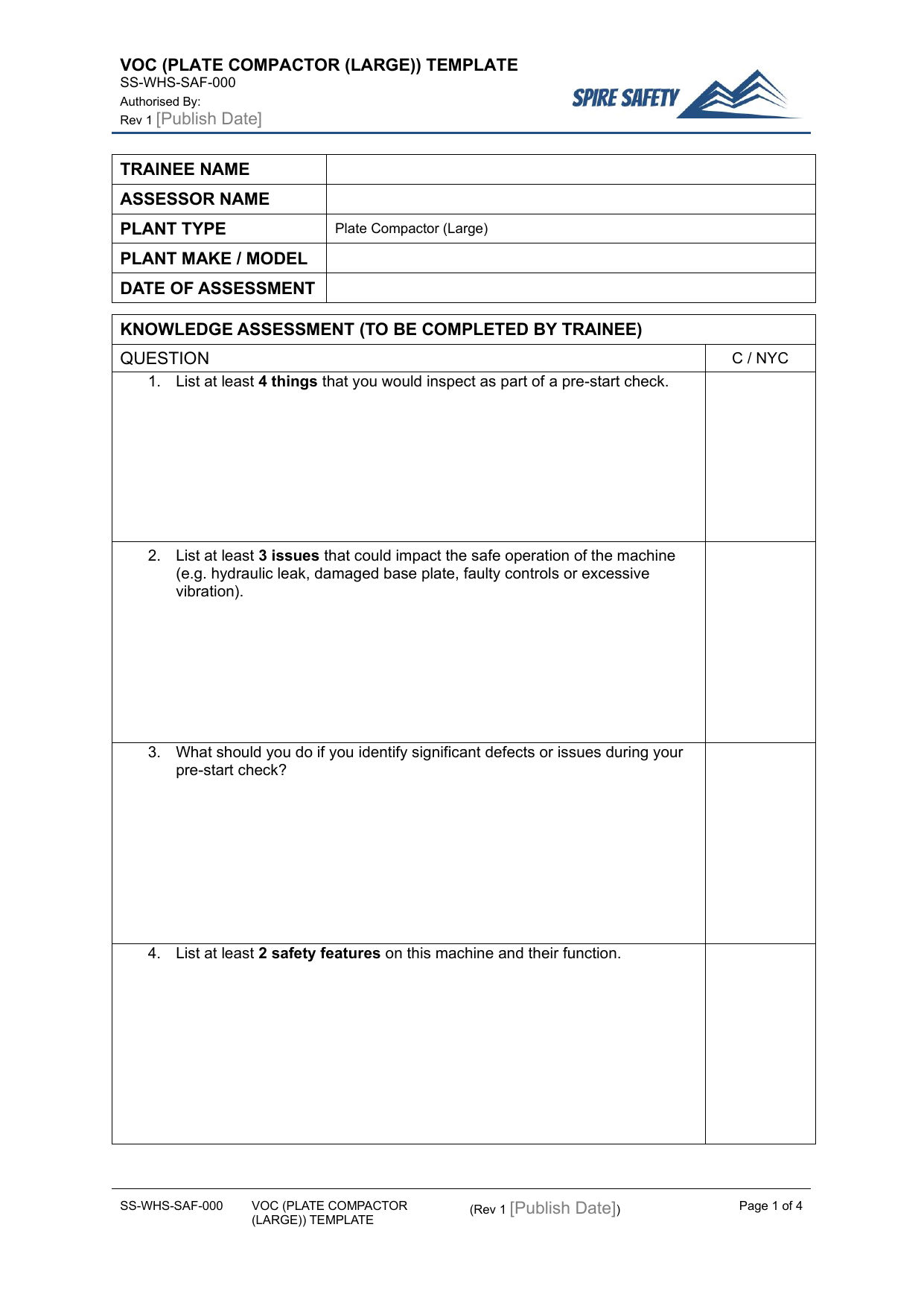
This document is a comprehensive template designed to be adapted to your unique operational needs. It is structured to assess both the theoretical knowledge and the practical skills of an operator.
The first section typically covers theory, asking questions about WHS responsibilities, hazard identification (e.g., trench collapses, underground services, dust control), and understanding the manufacturer’s operating manual. The second section is a practical observation checklist where a qualified assessor observes the operator performing tasks with the large plate compactor.
This checklist should guide the assessor through key operational stages, including:
- Conducting a thorough pre-start inspection of the machine.
- Correctly starting, stopping, and securing the equipment.
- Demonstrating safe operating techniques on various surfaces (e.g., soil, gravel, backfill).
- Manoeuvring safely around obstacles and other personnel.
- Implementing appropriate hazard controls, such as for noise, dust, and vibration.
- Following correct shutdown and refuelling procedures.
The process is similar to using our VOC template for a concrete saw, where both knowledge and hands-on skill are evaluated in the work environment. The assessor uses the checklist to record performance, providing clear feedback and identifying any areas requiring further training.
Please note: We provide this document as a starting point. You must customise it to reflect the specific equipment, procedures, and risks in your workplace.
This includes referencing your own Safe Work Method Statements (SWMS) and site safety plans.
When to use it
A Verification of Competency should be conducted at several key points to ensure ongoing safety and compliance. It is not a one-time event. Consider using this VOC process in the following scenarios:
- Pre-employment or prior to starting on a new site: To verify the skills of new workers or contractors before they operate equipment.
- Introduction of new equipment: When a new make or model of large plate compactor is introduced to the workplace.
- Post-incident: Following a near-miss or incident involving the equipment to identify and correct any competency gaps.
- Identified performance issues: If a supervisor observes unsafe or inefficient operation.
- Periodic re-assessment: As part of a scheduled competency review program (e.g., every 2-3 years) to ensure skills remain current. This can be scheduled alongside assessments for other machinery, such as using a concrete vibrator VOC template for workers in concreting trades.
Regularly scheduled VOCs demonstrate a proactive approach to safety management. The frequency should be determined by a risk assessment, considering the complexity of the task, the operator's experience, and the specific hazards of the work environment.
These checks can be incorporated into your schedule for regular WHS compliance auditing to ensure the system is functioning as intended.
Who should use it
This Verification of Competency template is designed for use by any person with responsibility for ensuring the safe operation of plant and equipment. This includes:
- Supervisors and Line Managers: They are directly responsible for the safety of their teams and must ensure every operator is competent for the tasks they are assigned.
- WHS Advisors and Safety Officers: They use VOCs to implement and monitor the effectiveness of the organisation's safety procedures and training programs.
- Project Managers: On construction and civil sites, they hold overall responsibility for site safety and must ensure all plant operators are verified as competent.
- Assessors and Trainers: Individuals designated to conduct the assessment must be competent persons themselves, possessing deep technical knowledge of the equipment and assessment practices.
Ultimately, the PCBU is responsible for providing the necessary resources and processes to manage workplace risks. If your organisation lacks in-house expertise to customise or conduct these assessments, engaging specialist WHS consulting services can provide the necessary support.
You can also explore our full library of free WHS resources for other useful templates and guides.
Common mistakes
Common mistakes to avoid
- Treating the VOC as a 'tick and flick' exercise without genuine observation.
- Using an assessor who is not an expert on the specific model of plate compactor.
- Failing to customise the template for site-specific hazards like trenches, slopes, or overhead powerlines.
- Neglecting to record the assessment outcome and any corrective actions required.
Legal references
Legal considerations
The following legal requirements may be relevant to this type of work.
- Work Health and Safety Act (Harmonised) — Provides the primary duties for protecting workers and other people from work health and safety risks.
- Work Health and Safety Regulations (Harmonised) — Sets out requirements supporting the management of workplace hazards and risks.
The following codes may be relevant to this type of work.
- Managing WHS Risks Code of Practice — Provides practical guidance on identifying hazards, assessing risks and applying effective controls.
- Work Health and Safety Consultation, Cooperation and Coordination Code of Practice — Provides practical guidance on consulting workers and coordinating with other duty holders.
- Managing the Work Environment and Facilities Code of Practice — Provides practical guidance on safe work environments, workplace facilities and related controls.
Did you know
Whole-Body Vibration
Prolonged use of plate compactors can expose operators to significant whole-body vibration (WBV), a known risk factor for musculoskeletal disorders and other long-term health issues.
Compaction Force
Large reversible plate compactors can exert a centrifugal force of over 30 kilonewtons (kN), allowing them to effectively compact deep layers of soil, gravel, and sub-base materials.
FAQ
Frequently asked questions
01What is a Verification of Competency (VOC)?
02Is a VOC legally required for a plate compactor in Australia?
03How often should a VOC for a large plate compactor be conducted?
04Can anyone conduct a VOC?
Share this resource
Verification of Competency (Plate Compactor (Large))
Browse Categories
How To Use It
- 1Download and open in Word or PDF.
- 2Replace the placeholders with your business details.
- 3Get it reviewed by a WHS specialist before rollout.
Need it customised?
Our WHS consultants can adapt this template to your site, run a gap analysis, or audit what you already have in place.
Book a Free Consultation WHS consulting servicesor call 1300 156 382