
Verification of Competency (Multi-Tool (Oscillating Tool)) Template
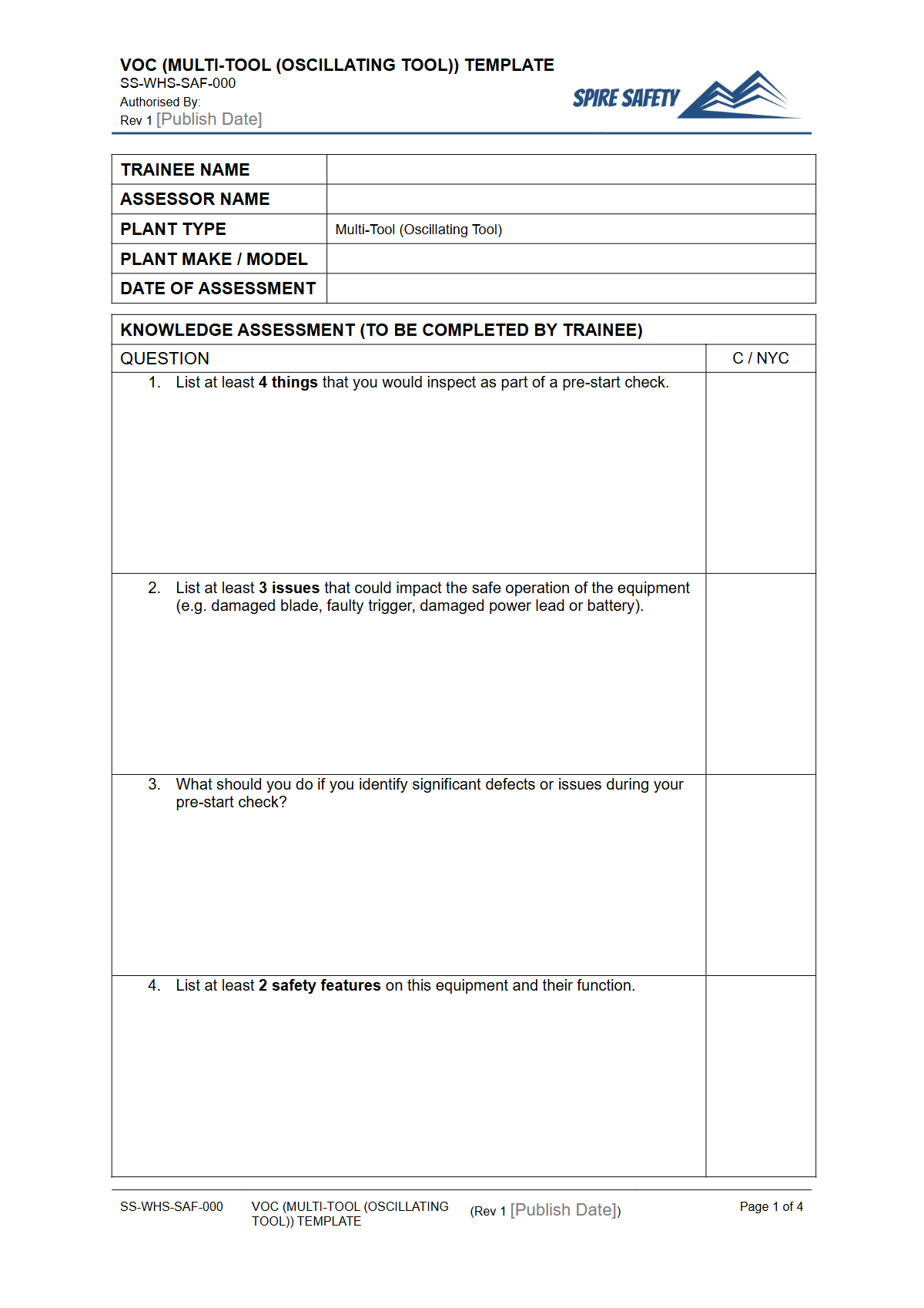
Download our free Verification of Competency (Multi-Tool (Oscillating Tool)) Template. A structured tool for assessing worker competency. Get your copy today!
Verification of Competency (Multi-Tool (Oscillating Tool)) Template
DOCX • 138 KB + PDF
Updated Oct 2026
No signup required
Purpose of the Verification of Competency (Multi-Tool (Oscillating Tool)) Template
Our free Verification of Competency (Multi-Tool (Oscillating Tool)) Template provides a robust framework for assessing and verifying the skills and knowledge of workers operating multi-tools (oscillating tools) in Australian workplaces. This crucial document helps ensure that individuals are competent to perform tasks safely, reducing the risk of incidents associated with tool misuse or inadequate training.
By systematically evaluating an operator's ability, you can confirm they understand the safe operating procedures, maintenance requirements, and potential hazards involved with this versatile power tool.
Using a structured Verification of Competency (VOC) process for power tools like the multi-tool (oscillating tool) is integral to effective WHS management systems. It demonstrates a proactive approach to workplace safety, aligned with Australian WHS practice, by ensuring that only competent personnel handle potentially hazardous equipment. This template is designed to guide supervisors or assessors through a comprehensive evaluation, covering theoretical knowledge and practical application, thereby contributing to a safer working environment.
Video walkthrough
How to use the Verification of Competency (Multi-Tool (Oscillating Tool)) Template
This DOCX Verification of Competency (Multi-Tool (Oscillating Tool)) Template is a starting point for your workplace. It must be customised to your specific operational context, the exact model of multi-tool used, and your WHS policies and procedures. To effectively use this template:
- Review and Adapt: Thoroughly read through the template. Modify any sections, questions, or assessment criteria to reflect the specific tasks, hazards, and controls relevant to multi-tool use in your workplace. Consider specific attachments or accessories used with the oscillating tool and any unique site conditions.
- Identify Assessors: Ensure the person conducting the VOC is competent themselves, possessing the necessary knowledge, experience, and ideally, formal assessment qualifications related to multi-tool operation.
- Conduct Assessment: Use the template to guide both theoretical questioning and practical observation of the worker utilising the multi-tool. Document all observations, answers, and outcomes meticulously.
- Provide Feedback: Discuss the results with the worker, highlighting areas of strong performance and any areas requiring further training or development.
- Record Keeping: Maintain accurate records of all completed VOCs. These records are vital for demonstrating due diligence and for future reviews of worker competency. Regularly reviewing these records helps identify training gaps and contributes to continuous improvement in WHS.
For more examples of plant VOC templates, explore our Free Reciprocating Saw VOC Template or a Free Mitre Saw VOC Template.
When to use it
A Verification of Competency (VOC) for multi-tools (oscillating tools) should be conducted in several key situations to maintain high safety standards:
- Initial Assignment: Before a worker operates a multi-tool for the first time in your workplace, particularly if they are new to the organisation or the specific task.
- Change in Equipment: If a new model of multi-tool is introduced, or if there are significant modifications to existing equipment that change its operation or associated risks.
- Changes in Work Procedures: When there are new work methods or tasks involving the multi-tool that require different skills or knowledge.
- Following an Incident: After any incident, near miss, or safety breach involving a multi-tool to re-evaluate competence and identify potential skill gaps.
- Refresher Training: As part of a periodic review program to ensure ongoing competency, especially for high-risk plant or tasks.
- Performance Concerns: If there are observations of unsafe work practices or concerns about a worker's ability to operate the multi-tool safely.
Who should use it
This multi-tool (oscillating tool) VOC template is primarily designed for:
- Workplace Supervisors and Managers: Responsible for overseeing worker activities and ensuring compliance with WHS procedures.
- WHS Officers and Coordinators: Tasked with developing, implementing, and maintaining WHS management systems and ensuring worker safety.
- Trainers and Assessors: Individuals qualified to deliver training and assess competency in the use of plant and equipment.
- Business Owners and Employers: Who bear the ultimate responsibility for providing a safe working environment and ensuring workers are competent for their roles.
Organisations that frequently use power tools across various trades, such as construction companies, manufacturing facilities, maintenance departments, and workshops, will find this a valuable resource. It supports the broader goal of hazard identification and risk management and can be a component of an overall WHS consulting strategy.
Common mistakes
Common mistakes to avoid
- Failing to conduct a VOC for new workers or for workers using new or modified multi-tools.
- Not customising the VOC template to the specific multi-tool model and workplace tasks.
- Allowing unqualified personnel to conduct the competency assessment.
- Neglecting to provide refresher training or re-assess competency after an incident or observed unsafe behaviour.
Legal references
Legal considerations
The following legal requirements may be relevant to this type of work.
- Work Health and Safety Act (Harmonised) — Provides the primary duties for protecting workers and other people from work health and safety risks.
- Work Health and Safety Regulations (Harmonised) — Sets out requirements supporting the management of workplace hazards and risks.
The following codes may be relevant to this type of work.
- Managing WHS Risks Code of Practice — Provides practical guidance on identifying hazards, assessing risks and applying effective controls.
- Work Health and Safety Consultation, Cooperation and Coordination Code of Practice — Provides practical guidance on consulting workers and coordinating with other duty holders.
- Managing the Work Environment and Facilities Code of Practice — Provides practical guidance on safe work environments, workplace facilities and related controls.
Did you know
Versatile Tools
Multi-tools, also known as oscillating tools, are incredibly versatile, used for cutting, sanding, grinding, and scraping across various materials by rapidly oscillating a fitted attachment.
Noise Exposure
Operating multi-tools can generate significant noise levels. Employers must manage noise exposure as part of their WHS obligations, potentially requiring hearing protection and regular audiometric testing.
FAQ
Frequently asked questions
01What is a Verification of Competency for a Multi-Tool (Oscillating Tool)?
02Is a VOC legally required for multi-tools in Australia?
03How often should a worker's competency with a multi-tool be verified?
04Can I use this template for other power tools?
Share this resource
Verification of Competency (Multi-Tool (Oscillating Tool)) Template
Browse Categories
How To Use It
- 1Download and open in Word or PDF.
- 2Replace the placeholders with your business details.
- 3Get it reviewed by a WHS specialist before rollout.
Need it customised?
Our WHS consultants can adapt this template to your site, run a gap analysis, or audit what you already have in place.
Book a Free Consultation WHS consulting servicesor call 1300 156 382
Related templates
- Verification of Competency (Orbital Sander) Template
- Verification of Competency (Overhead Bridge Crane) Template
- Verification of Competency (Oxy-Acetylene Welding Equipment) Template
- Verification of Competency (Pallet Jack (Electric)) Template
- Verification of Competency (Pipe Cutter) Template
- Verification of Competency (Pipe Threader) Template