
Elevated Work Platform Safety Toolbox Talk Template
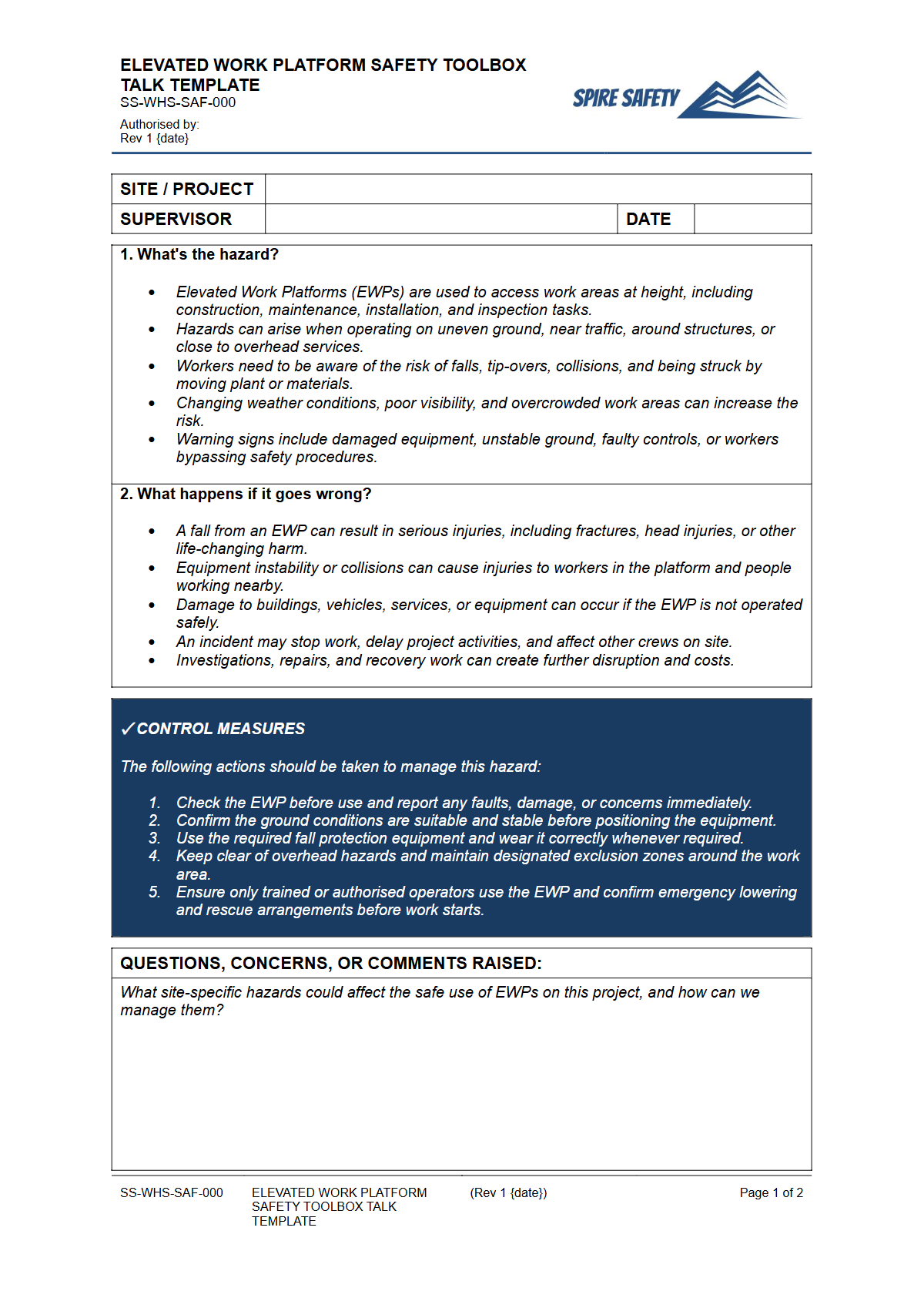
Download our free Elevated Work Platform Safety Toolbox Talk Template. A clear, Australian-compliant resource to enhance workplace safety discussions.
Elevated Work Platform Safety Toolbox Talk Template
DOCX • 137 KB + PDF
Updated Oct 2026
No signup required
Purpose of this document
This Elevated Work Platform Safety Toolbox Talk Template provides a structured framework for conducting essential discussions on EWP safety. Designed to support Australian workplaces, it helps facilitate regular safety briefings, ensuring that all personnel involved in operating, supervising, or working near Elevated Work Platforms understand the associated risks and control measures. The template aims to foster a proactive safety culture, minimise incidents, and promote compliance with WHS requirements related to EWP operations.
Regular toolbox talks on critical topics like EWP safety are a cornerstone of effective WHS management systems. They serve as an important tool for disseminating information, reinforcing safe work practices, and providing an opportunity for workers to raise concerns or offer suggestions regarding workplace safety.
Video walkthrough
How to use this Toolbox Talk
This Elevated Work Platform Safety Toolbox Talk Template is intended as a guide to assist in conducting site-specific safety discussions. To be effective, it must be customised to your workplace's specific EWP types, operational procedures, site conditions, and risk assessments. Before conducting the toolbox talk, review the template thoroughly and:
Identify specific EWP models used on site (e.g., boom lifts, scissor lifts, vertical mast lifts).
Incorporate details from your site's EWP pre-start checklists and maintenance logs.
Reference your organisation's specific Safe Work Method Statements (SWMS) for EWP operation.
Tailor the discussion points to reflect recent incidents, near misses, or observations related to EWP use on your site.
Include any specific site rules or permits required for EWP operation.
Encourage active participation by asking open-ended questions and facilitating group discussion.
Document attendance, discussion points, and any actions agreed upon during the talk.
Remember, a toolbox talk is a conversation, not just a lecture. Adapt the content and delivery to suit your audience and the specific context of your work site.
When to use it
This Elevated Work Platform Safety Toolbox Talk Template should be used:
Prior to commencing any work involving Elevated Work Platforms, especially when new teams are formed or new equipment is introduced.
As part of regular, scheduled safety meetings (e.g., weekly or fortnightly safety briefings).
After any EWP-related incident, near-miss, or observation of unsafe EWP practices.
When there are changes to EWP operating procedures, site conditions, or relevant WHS regulations.
During worker induction for those who will operate or work near EWPs.
Periodically to reinforce critical safety messages and maintain high levels of awareness regarding EWP hazards and controls.
Who should use it
This template is designed for use by:
Supervisors and Team Leaders: Responsible for leading safety discussions and ensuring their teams understand and follow safe EWP practices.
WHS Officers/Managers: To support their organisation's overall WHS program and provide resources for safety training.
Project Managers: To integrate EWP safety discussions into project planning and execution.
Safety Representatives: To assist in facilitating discussions and advocating for worker safety.
EWP Operators and Workers: While typically participants, experienced operators can also co-facilitate discussions, sharing their practical knowledge and experience.
Ultimately, anyone with responsibility for, or involvement in, EWP operations within an Australian workplace will find this template beneficial for promoting safe work behaviour and maintaining compliance. For further assistance with compliance requirements, consider reviewing our other free WHS resources library or engaging with Spire Safety for general WHS consulting services.
Common mistakes
Common mistakes to avoid
- Failing to conduct a thorough pre-start inspection of the EWP.
- Not assessing ground conditions for stability before operating the EWP.
- Bypassing safety interlocks or modifying the EWP without proper authorisation.
- Operating an EWP without the required training or licence.
Legal references
Legal considerations
The following legal requirements may be relevant to this type of work.
- Work Health and Safety Act (Harmonised) — Provides the primary duties for protecting workers and other people from work health and safety risks.
- Work Health and Safety Regulations (Harmonised) — Sets out requirements supporting the management of workplace hazards and risks.
The following codes may be relevant to this type of work.
- Managing WHS Risks Code of Practice — Provides practical guidance on identifying hazards, assessing risks and applying effective controls.
- Work Health and Safety Consultation, Cooperation and Coordination Code of Practice — Provides practical guidance on consulting workers and coordinating with other duty holders.
- Managing the Work Environment and Facilities Code of Practice — Provides practical guidance on safe work environments, workplace facilities and related controls.
Did you know
EWP Maintenance Matters
Regular inspection and maintenance of EWPs are not just good practice but a legal requirement under Australian WHS regulations, ensuring equipment reliability and preventing mechanical failures which can lead to serious incidents.
Clearances are Key
A significant number of EWP incidents involve contact with overhead power lines. Always maintain safe approach distances to power lines, as specified in WHS regulations and relevant codes of practice.
FAQ
Frequently asked questions
01What is an Elevated Work Platform (EWP)?
02How often should EWP safety toolbox talks be conducted?
03What are the common hazards associated with EWPs?
04Are EWP operators required to be licensed or competent in Australia?
Share this resource
Elevated Work Platform Safety Toolbox Talk Template
Browse Categories
How To Use It
- 1Download and open in Word or PDF.
- 2Replace the placeholders with your business details.
- 3Get it reviewed by a WHS specialist before rollout.
Need it customised?
Our WHS consultants can adapt this template to your site, run a gap analysis, or audit what you already have in place.
Book a Free Consultation WHS consulting servicesor call 1300 156 382
Related templates
- Emergency Procedures Awareness Toolbox Talk Template
- Environmental Awareness on Site Toolbox Talk Template
- Ergonomics and Sedentary Work Toolbox Talk Template
- Events and Crowd Safety Toolbox Talk Template
- Excavation and Trenching Safety Toolbox Talk Template
- Eye Protection and Eye Hazards Toolbox Talk Template