
Ergonomics and Sedentary Work Toolbox Talk Template
Download our free Ergonomics and Sedentary Work Toolbox Talk Template (DOCX/PDF). A structured starting point for discussing workstation safety. Get yours now!
Ergonomics and Sedentary Work Toolbox Talk Template
DOCX • 139 KB + PDF
Updated Oct 2026
No signup required
Purpose of this document
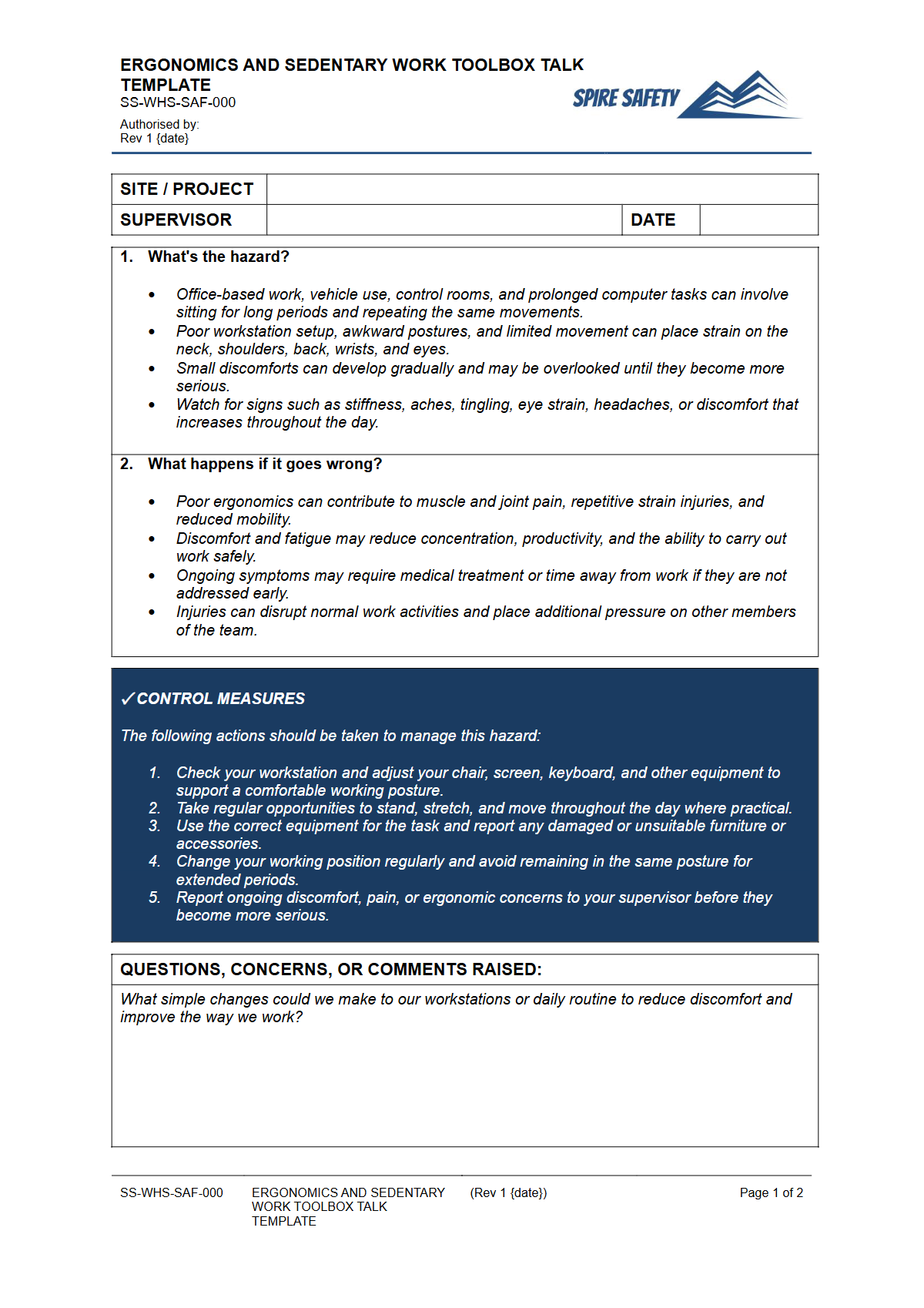
This Ergonomics and Sedentary Work Toolbox Talk Template provides a structured outline for conducting a brief, informal discussion with workers about the risks associated with sedentary work and poor ergonomics. Its primary purpose is to raise awareness, prompt discussion, and encourage proactive measures to mitigate these risks in the workplace. The template aids in communicating key WHS principles relating to workstation setup, body posture, regular movement, and early reporting of discomfort or injury. It serves as an educational tool to foster a safer and healthier work environment by focusing on preventable musculoskeletal and other health issues linked to prolonged sitting and inadequate ergonomic practices. It's an essential resource for any organisation committed to worker wellbeing.
Video walkthrough
How to use this Toolbox Talk
This Ergonomics and Sedentary Work Toolbox Talk Template is provided as a foundational document and must be customised to your workplace's specific conditions, hazards, and control measures. Download it in your preferred format (DOCX or PDF). For the DOCX version, edit the content to reflect your organisation's policies, relevant job roles, equipment used, and specific identified risks. Include examples pertinent to your operations and the tasks your workers perform. Add details about your internal reporting procedures for WHS concerns or injuries. Before delivery, review the customised content to ensure it accurately represents your workplace's WHS framework and addresses the unique challenges faced by your team. Encourage interactive participation during the talk, using the template as a guide for key discussion points rather than a rigid script. Remember that effective WHS management integrates such discussions into broader WHS management systems and ongoing training.
When to use it
An Ergonomics and Sedentary Work Toolbox Talk is particularly valuable in several scenarios. It should be conducted:
- During initial worker inductions, especially for roles involving prolonged desk work or repetitive tasks.
- As part of regular WHS meetings or team briefings, perhaps quarterly or bi-annually, to reinforce good practices.
- Following the introduction of new equipment or changes to workstation setups.
- When new WHS legislation or guidelines regarding sedentary work or ergonomics are released.
- If there's an increase in reported musculoskeletal discomfort, strains, or injuries related to workstation use.
- As a refresher training session to maintain ongoing awareness and reinforce a culture of safety.
- After any WHS audit or incident investigation that highlights ergonomic or sedentary work issues.
Who should use it
This Ergonomics and Sedentary Work Toolbox Talk Template is designed for use by:
- WHS managers, officers, and coordinators responsible for WHS compliance and worker wellbeing.
- Team leaders, supervisors, or managers who oversee staff performing sedentary tasks or using display screen equipment.
- Trainers delivering WHS or induction programs.
- Anyone facilitating a WHS safety meeting or discussion with a team on topics related to workstation setup and movement.
- Individuals preparing for WHS compliance auditing who need to demonstrate proactive risk communication.
Common mistakes
Common mistakes to avoid
- Not customising the template to specific workplace hazards and tasks.
- Delivering the talk as a lecture rather than an interactive discussion.
- Failing to follow up on WHS concerns or suggestions raised during the talk.
- Using technical jargon instead of plain language understandable to all workers.
Legal references
Legal considerations
The following legal requirements may be relevant to this type of work.
- Work Health and Safety Act (Harmonised) — Provides the primary duties for protecting workers and other people from work health and safety risks.
- Work Health and Safety Regulations (Harmonised) — Sets out requirements supporting the management of workplace hazards and risks.
The following codes may be relevant to this type of work.
- Managing WHS Risks Code of Practice — Provides practical guidance on identifying hazards, assessing risks and applying effective controls.
- Work Health and Safety Consultation, Cooperation and Coordination Code of Practice — Provides practical guidance on consulting workers and coordinating with other duty holders.
- Managing the Work Environment and Facilities Code of Practice — Provides practical guidance on safe work environments, workplace facilities and related controls.
Did you know
Impact of poor ergonomics
Musculoskeletal disorders (MSDs) are among the most common work-related injuries, often linked to poor ergonomics and sedentary work practices. Implementing good ergonomic principles can significantly reduce their incidence.
FAQ
Frequently asked questions
01What is ergonomics in the workplace?
02Why is sedentary work a WHS concern?
03What are common ergonomic risks?
04How often should workers take breaks from sedentary work?
Share this resource
Ergonomics and Sedentary Work Toolbox Talk Template
Browse Categories
How To Use It
- 1Download and open in Word or PDF.
- 2Replace the placeholders with your business details.
- 3Get it reviewed by a WHS specialist before rollout.
Need it customised?
Our WHS consultants can adapt this template to your site, run a gap analysis, or audit what you already have in place.
Book a Free Consultation WHS consulting servicesor call 1300 156 382