
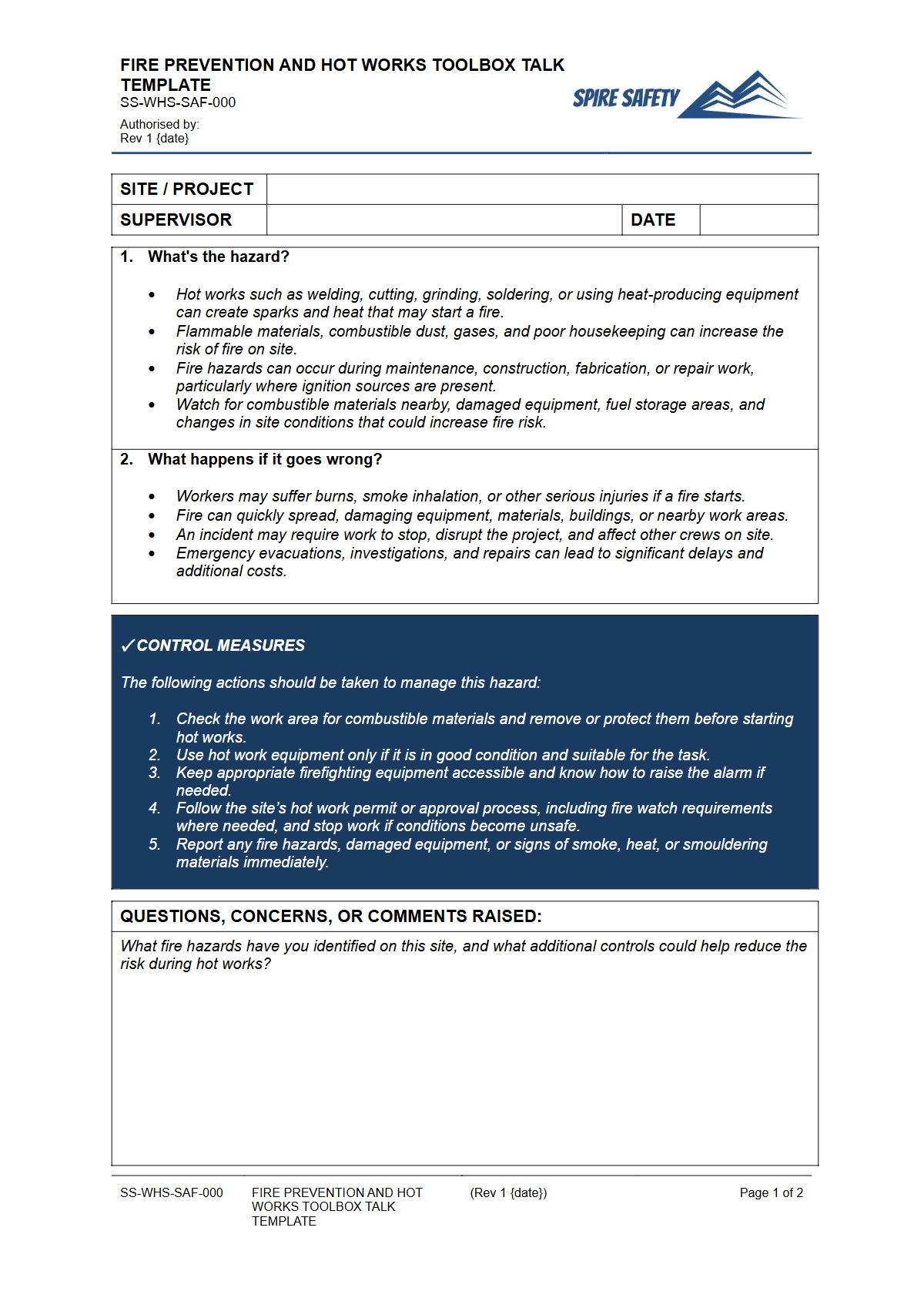
Fire Prevention and Hot Works Toolbox Talk Template
Download our free Fire Prevention and Hot Works Toolbox Talk Template. A structured starting point for your team's safety discussions.
Fire Prevention and Hot Works Toolbox Talk Template
DOCX • 140 KB + PDF
Updated Oct 2026
No signup required
Purpose of this document
This Fire Prevention and Hot Works Toolbox Talk Template serves as a crucial resource for workplaces conducting activities that pose a fire risk. It provides a structured framework for facilitating discussions about fire prevention strategies, safely managing hot works (such as welding, grinding, and torch cutting), and ensuring the overall safety of your team and site. The template aims to elevate awareness regarding potential ignition sources, flammable materials, and the critical control measures required to mitigate fire hazards. By using this Toolbox Talk, organisations can reinforce safe working practices, highlight the importance of thorough planning, and ensure workers understand their responsibilities in preventing fires and responding effectively if one occurs.
Effectively communicating these safety principles not only helps prevent incidents but also fosters a proactive safety culture. Regular discussions on topics like this are integral to robust WHS management systems, ensuring that safety remains a top priority in all operations, particularly those involving elevated risks.
Video walkthrough
How to use this Toolbox Talk
This Fire Prevention and Hot Works Toolbox Talk Template is designed for practical application in your workplace. Download the DOCX file, which allows you to easily edit and tailor the content to suit your specific operational context, equipment, and identified hazards. Before conducting the talk, review the template thoroughly and customise it with relevant examples, site-specific procedures, and any unique risks associated with your hot work activities. Add details about your emergency response plans, the location of fire suppression equipment, and the roles and responsibilities of personnel during hot work operations. You can also incorporate questions specific to your workplace to encourage active participation and critical thinking from your team.
As a free resource from Spire Safety, this template is a structured starting point. It is essential to remember that this template must be customised to your workplace’s specific needs, hazards, and WHS obligations to be effective and relevant. Present the talk in an engaging manner, encouraging questions and open discussion. Document attendance and any key takeaways or actions points from the session to demonstrate your commitment to ongoing safety education and compliance.
When to use it
This Fire Prevention and Hot Works Toolbox Talk Template should be used regularly, especially before commencing any hot work activities or when there are new workers, new equipment, or changes to work processes that might introduce or alter fire risks. It is also beneficial to conduct this Toolbox Talk:
- As part of your induction process for all workers who may be involved in or around hot work.
- Following any near-misses or incidents related to fire or hot work, to reinforce learnings and address deficiencies.
- Periodically, as part of your scheduled safety meetings, to maintain high levels of awareness and vigilance.
- When reviewing or updating your hot work permits or fire prevention procedures.
- During seasonal changes that may increase fire risks (e.g., dry seasons, high wind periods).
Who should use it
This template is ideal for anyone responsible for WHS in Australian workplaces, particularly those where hot work or fire hazards are present. This includes:
- WHS Managers and Coordinators
- Supervisors and Team Leaders overseeing work where hot works are performed
- Project Managers
- Site Managers responsible for overall safety
- Business Owners and Directors ensuring a safe working environment
- Anyone conducting WHS compliance auditing to verify the effectiveness of safety communication.
It's designed to facilitate effective communication between management and workers, ensuring a shared understanding of fire prevention and hot work safety requirements across all levels of the organisation. All workers, particularly those directly performing hot work or acting as fire watchers, should participate in these discussions to ensure they are fully informed and competent in applying safe work practices.
Common mistakes
Common mistakes to avoid
- Not clearing combustible materials sufficiently far from the hot work area.
- Failing to conduct a thorough pre-hot work inspection or risk assessment.
- Not assigning a dedicated fire watcher or having them leave the area too soon.
- Using inappropriate or uncharged fire suppression equipment.
Legal references
Legal considerations
The following legal requirements may be relevant to this type of work.
- Work Health and Safety Act (Harmonised) — Provides the primary duties for protecting workers and other people from work health and safety risks.
- Work Health and Safety Regulations (Harmonised) — Sets out requirements supporting the management of workplace hazards and risks.
The following codes may be relevant to this type of work.
- Managing WHS Risks Code of Practice — Provides practical guidance on identifying hazards, assessing risks and applying effective controls.
- Work Health and Safety Consultation, Cooperation and Coordination Code of Practice — Provides practical guidance on consulting workers and coordinating with other duty holders.
- Managing the Work Environment and Facilities Code of Practice — Provides practical guidance on safe work environments, workplace facilities and related controls.
Did you know
Historical Impact of Hot Work Fires
Fires caused by inadequately controlled hot work have led to some of the most devastating industrial accidents globally, resulting in significant loss of life, severe injuries, and immense property damage. Proper planning and communication are essential to prevent recurrence.
The Role of Fire Watchers
A designated fire watcher is a critical control measure during hot work. Their sole responsibility is to monitor for sparks, flames, or smoke during and for at least 30-60 minutes after hot work, ready to extinguish small fires or raise an alarm.
FAQ
Frequently asked questions
01What is 'hot work' in a WHS context?
02Why is a permit-to-work system important for hot works?
03What are common ignition sources during hot work?
04How often should fire prevention toolbox talks be conducted?
Share this resource
Fire Prevention and Hot Works Toolbox Talk Template
Browse Categories
How To Use It
- 1Download and open in Word or PDF.
- 2Replace the placeholders with your business details.
- 3Get it reviewed by a WHS specialist before rollout.
Need it customised?
Our WHS consultants can adapt this template to your site, run a gap analysis, or audit what you already have in place.
Book a Free Consultation WHS consulting servicesor call 1300 156 382