
Formwork and Falsework Safety Toolbox Talk Template
Download your free Formwork and Falsework Safety Toolbox Talk template. A structured starting point for critical safety discussions on site. Get yours today!
Formwork and Falsework Safety Toolbox Talk Template
DOCX • 140 KB + PDF
Updated Oct 2026
No signup required
Purpose of this document
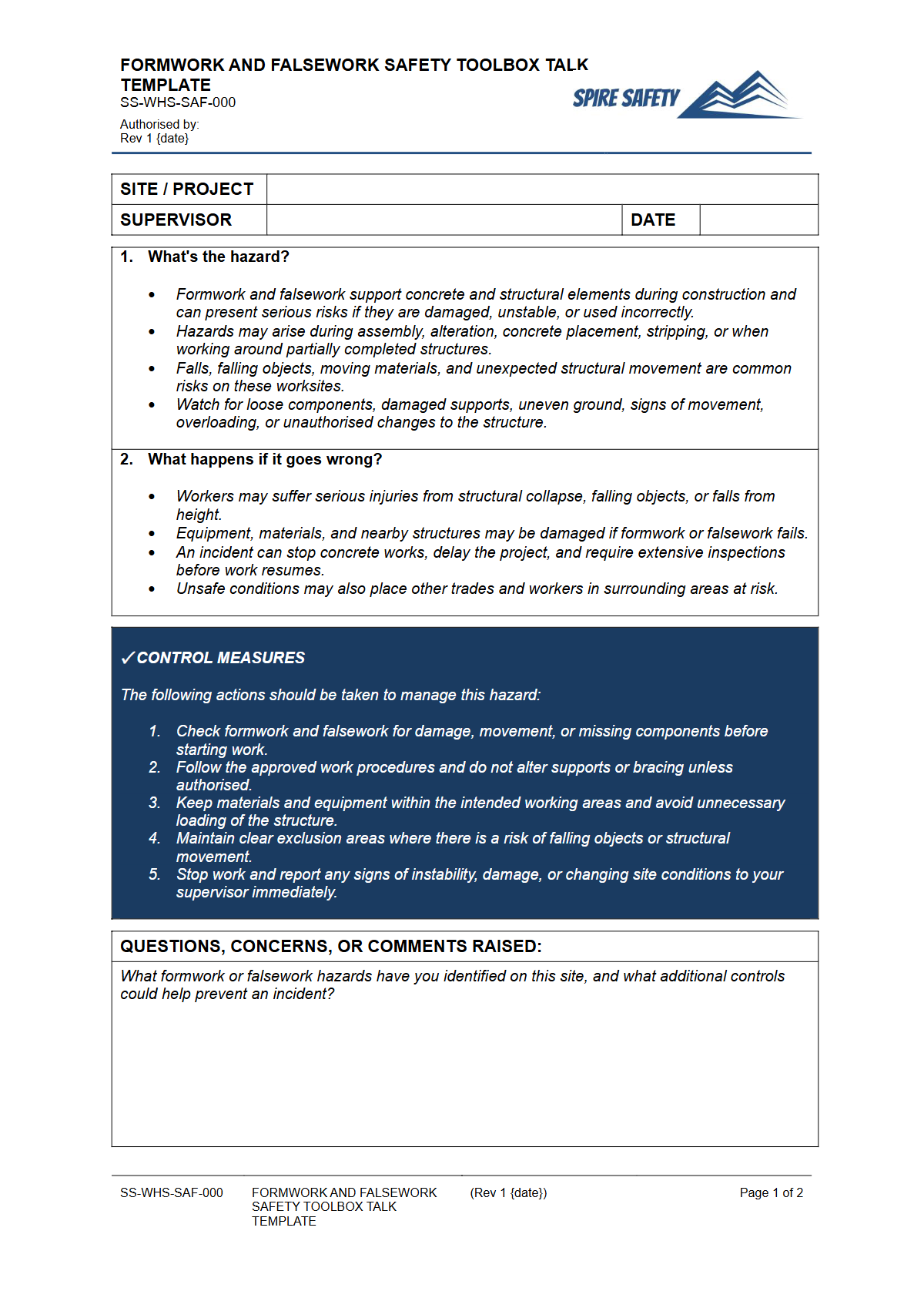
This Formwork and Falsework Safety Toolbox Talk template provides a structured starting point for conducting essential safety discussions on construction sites. It's designed to help supervisors and safety managers address critical hazards, controls, and safe work practices associated with formwork and falsework operations. By facilitating regular talks, organisations can reinforce safety messages, encourage worker participation, and contribute to a safer working environment. This template is based on the model WHS framework and aims to align with good Australian WHS practices, prompting discussion around key risks like structural integrity, fall prevention, and plant operation.
Using this template will assist in ensuring that all workers involved with formwork and falsework — from design and erection to stripping — understand their responsibilities and the importance of adhering to safety procedures. It covers topics such as proper installation, inspection protocols, load bearing capacities, and emergency procedures. Regularly addressing these points is crucial for preventing incidents and maintaining the structural integrity of temporary works, which is paramount for overall site safety. For comprehensive safety integration, consider how this fits into your broader WHS management systems.
Video walkthrough
How to use this Toolbox Talk
Download the Formwork and Falsework Safety Toolbox Talk template in DOCX format (or PDF for quick reference). Before conducting your Toolbox Talk, customise the content to reflect the specific formwork and falsework systems, site conditions, and risks present at your workplace. Specifically, you must customise this template to your workplace's unique risks, control measures, and operational procedures. Incorporate details about the specific types of formwork (e.g., jump form, table form) and falsework being used, the particular plant and equipment involved, and any site-specific hazards. Add photos or diagrams relevant to your project for enhanced understanding. Discuss each point, encourage questions, and document attendance and any actions arising from the discussion. Use the provided checklist section to record key points discussed and ensure all attendees have understood the information. This template is a guide; its effectiveness depends on thorough customisation and active engagement during the talk.
When to use it
This Formwork and Falsework Safety Toolbox Talk should be used whenever work involving formwork or falsework is being planned or undertaken. This includes:
- Before commencing any new formwork or falsework construction phase.
- When there are changes to the design, materials, or methods of formwork/falsework.
- Following any incident or near-miss related to formwork or falsework.
- As part of routine safety meetings, especially before significant load changes or concrete pours.
- When new workers join a team involved in formwork/falsework activities.
- When reviewing or updating Safe Work Method Statements (SWMS) for formwork/falsework.
Who should use it
The Formwork and Falsework Safety Toolbox Talk template is primarily intended for:
- Construction site supervisors and foremen.
- Project managers overseeing temporary works.
- Safety officers and WHS managers.
- Workers involved in the design, erection, inspection, use, and stripping of formwork and falsework.
- Engineers responsible for temporary works design and supervision.
- Anyone responsible for conducting safety discussions related to formwork and falsework operations on a construction site. This resource is an excellent addition to any professional's free WHS resources library.
Common mistakes
Common mistakes to avoid
- Failing to adequately secure formwork against lateral movement or uplift.
- Overlooking proper training for workers involved in erection and stripping.
- Not conducting regular, documented inspections, especially after adverse weather or before concrete pours.
- Incorrectly calculating or exceeding design load capacities for formwork and falsework components.
Legal references
Legal considerations
The following legal requirements may be relevant to this type of work.
- Work Health and Safety Act (Harmonised) — Provides the primary duties for protecting workers and other people from work health and safety risks.
- Work Health and Safety Regulations (Harmonised) — Sets out requirements supporting the management of workplace hazards and risks.
The following codes may be relevant to this type of work.
- Managing WHS Risks Code of Practice — Provides practical guidance on identifying hazards, assessing risks and applying effective controls.
- Work Health and Safety Consultation, Cooperation and Coordination Code of Practice — Provides practical guidance on consulting workers and coordinating with other duty holders.
- Managing the Work Environment and Facilities Code of Practice — Provides practical guidance on safe work environments, workplace facilities and related controls.
Did you know
Historical Roots of Formwork
Ancient Romans were among the first to utilise advanced formwork techniques, using timber and even intricate lost-form methods similar to modern concrete pouring, for structures like the Pantheon and Colosseum.
Global Formwork Market
The global formwork market is a multi-billion dollar industry, driven by continuous infrastructure development and innovative construction techniques, highlighting its critical role in modern building worldwide.
FAQ
Frequently asked questions
01What is the difference between formwork and falsework?
02Why is regular inspection of formwork and falsework so important?
03Does this template supports your compliance efforts with all Australian WHS laws?
04What documentation should accompany a Formwork and Falsework Toolbox Talk?
Share this resource
Formwork and Falsework Safety Toolbox Talk Template
Browse Categories
How To Use It
- 1Download and open in Word or PDF.
- 2Replace the placeholders with your business details.
- 3Get it reviewed by a WHS specialist before rollout.
Need it customised?
Our WHS consultants can adapt this template to your site, run a gap analysis, or audit what you already have in place.
Book a Free Consultation WHS consulting servicesor call 1300 156 382