
Hazard Reporting Toolbox Talk Template
Download our free Hazard Reporting Toolbox Talk Template (DOCX/PDF) to foster a proactive safety culture in your workplace. Empower your team today.
Hazard Reporting Toolbox Talk Template
DOCX • 141 KB + PDF
Updated Oct 2026
No signup required
Purpose of this document
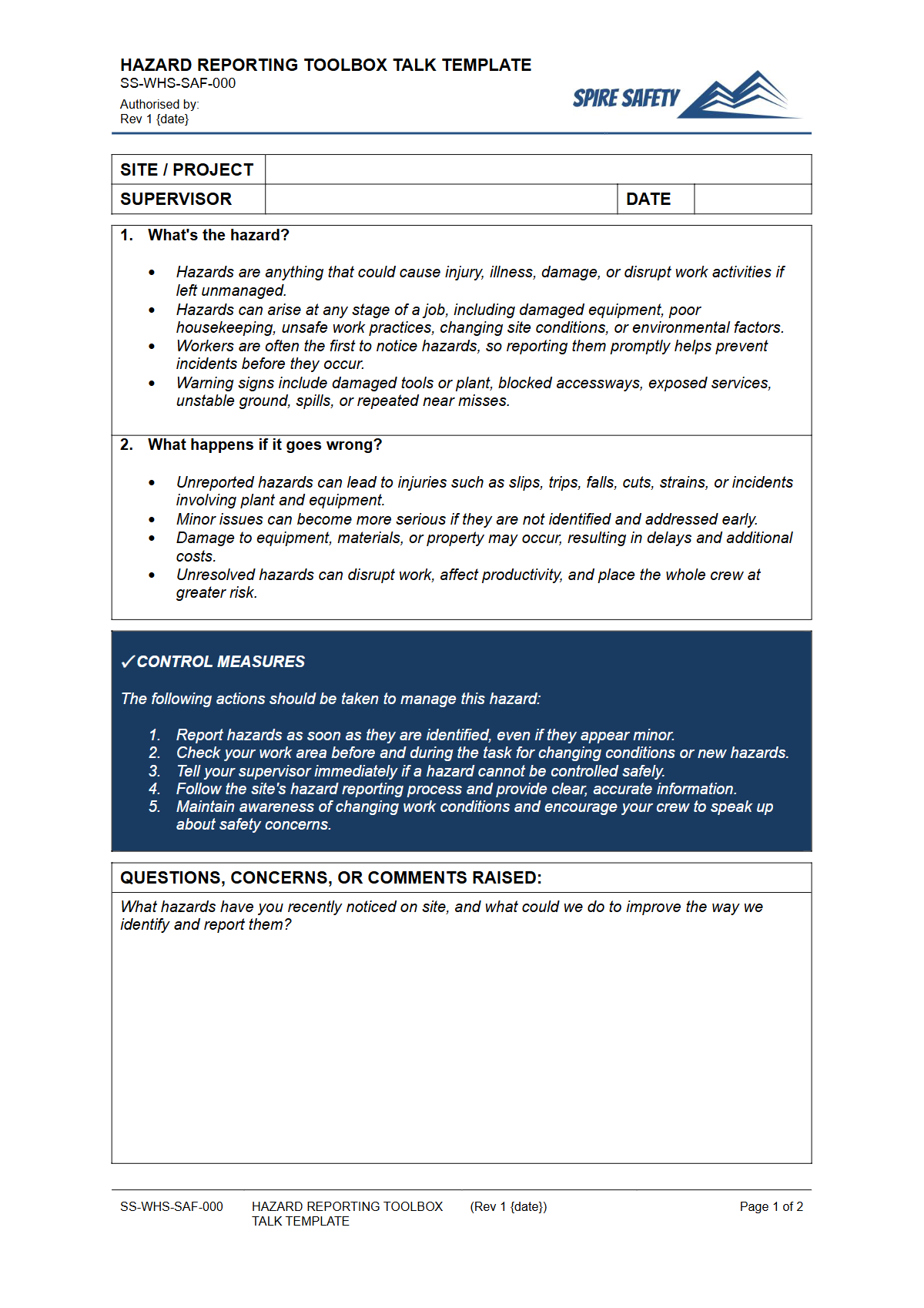
This Hazard Reporting Toolbox Talk Template is designed to help Australian workplaces facilitate essential discussions about identifying and reporting hazards. Proactive hazard reporting is a cornerstone of effective work health and safety (WHS) management, enabling organisations to address potential risks before they lead to incidents or injuries. This resource aims to provide a structured approach for communicating the importance of hazard identification, reporting procedures, and the role every worker plays in maintaining a safe work environment.
By using this template, you can reinforce key WHS principles, encourage open communication, and empower your team to contribute actively to safety. It serves as a practical tool for supervisors and safety officers to conduct meaningful sessions that reinforce an organisational commitment to safety, assisting in the development of robust WHS management systems.
Video walkthrough
How to use this Toolbox Talk
Download this Hazard Reporting Toolbox Talk Template in either DOCX or PDF format. The DOCX version is fully editable, allowing you to tailor the content to your specific workplace context, industry, and the unique hazards your team may encounter. The PDF version is ready for immediate use if minimal customisation is required.
Before conducting the toolbox talk, review the template thoroughly. Customise sections to reflect your company's specific hazard reporting forms, procedures, and contact persons. Include examples of hazards relevant to your operations and discuss actual incidents or near misses (without naming individuals) to make the session relatable. Encourage participation by asking open-ended questions and facilitating a discussion rather than delivering a lecture. Remember, this template is a starting point; it must be customised to your workplace's specific risks and WHS procedures to be effective and relevant.
After the session, ensure all attendees sign an attendance sheet, which you can attach to the completed toolbox talk document for your WHS records. Regular review and discussion of hazard reporting mechanisms are vital for continuous improvement in WHS performance.
When to use it
This Hazard Reporting Toolbox Talk Template is ideal for regular safety meetings, particularly:
- During new employee inductions to establish safety expectations from day one.
- Before commencing new projects or tasks where new or different hazards may be present.
- Following any WHS incidents or near misses to reinforce reporting procedures and learn from events.
- As part of routine safety briefings or weekly toolbox talks to maintain a high level of hazard awareness.
- When there are changes to workplace processes, equipment, or environments that could introduce new hazards.
- To refresh workers' understanding of WHS roles and responsibilities in hazard identification and reporting.
Who should use it
This resource is suitable for:
- Team leaders and supervisors responsible for their work teams' daily safety.
- WHS managers and officers overseeing overall workplace safety programs.
- Site managers and project managers coordinating activities across various teams.
- Anyone tasked with delivering WHS training or conducting safety briefings within an Australian workplace.
- Organisations looking to enhance their WHS culture and encourage proactive hazard management across all levels.
Common mistakes
Common mistakes to avoid
- Not customising the template to specific workplace hazards and procedures.
- Delivering the talk as a lecture rather than an interactive discussion.
- Failing to follow up on reported hazards or provide feedback to workers.
- Not documenting the Toolbox Talk attendance and key discussion points.
Legal references
Legal considerations
The following legal requirements may be relevant to this type of work.
- Work Health and Safety Act (Harmonised) — Provides the primary duties for protecting workers and other people from work health and safety risks.
- Work Health and Safety Regulations (Harmonised) — Sets out requirements supporting the management of workplace hazards and risks.
The following codes may be relevant to this type of work.
- Managing WHS Risks Code of Practice — Provides practical guidance on identifying hazards, assessing risks and applying effective controls.
- Work Health and Safety Consultation, Cooperation and Coordination Code of Practice — Provides practical guidance on consulting workers and coordinating with other duty holders.
- Managing the Work Environment and Facilities Code of Practice — Provides practical guidance on safe work environments, workplace facilities and related controls.
Did you know
Proactive Reporting Saves Lives
WorkSafe Australia data consistently shows that workplaces with higher rates of hazard reporting tend to have lower rates of serious incidents and injuries.
Psychological Hazards are WHS Hazards Too
WHS laws now explicitly recognise psychological hazards (stress, bullying, fatigue) as reportable. Our template encourages reporting all types of hazards, including those affecting mental health.
FAQ
Frequently asked questions
01What is a Toolbox Talk?
02How often should hazard reporting Toolbox Talks be conducted?
03What's the difference between a hazard and a risk?
04Can this template be used for all industries?
Share this resource
Hazard Reporting Toolbox Talk Template
Browse Categories
How To Use It
- 1Download and open in Word or PDF.
- 2Replace the placeholders with your business details.
- 3Get it reviewed by a WHS specialist before rollout.
Need it customised?
Our WHS consultants can adapt this template to your site, run a gap analysis, or audit what you already have in place.
Book a Free Consultation WHS consulting servicesor call 1300 156 382