
Head Protection Toolbox Talk Template
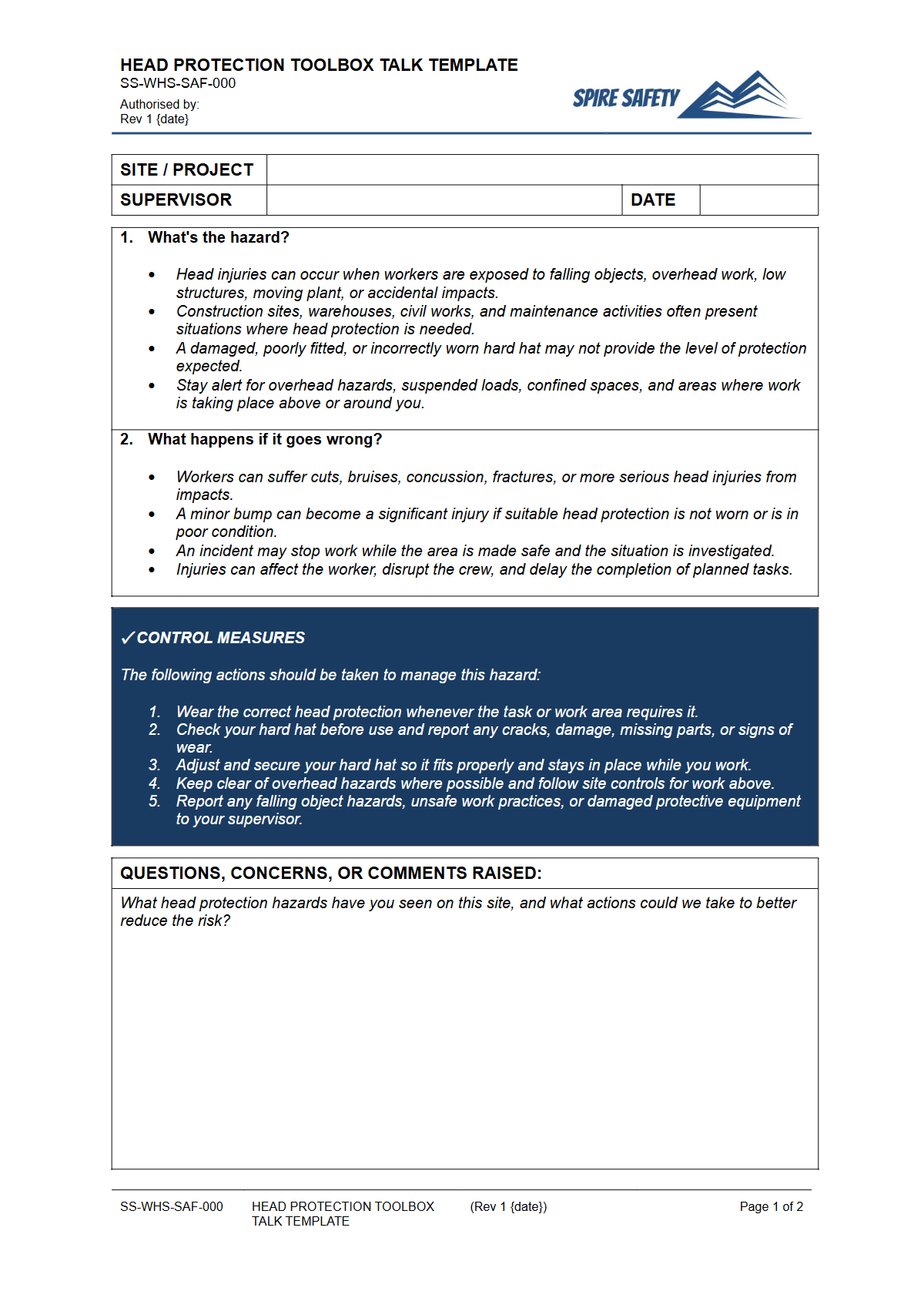
Download our complimentary Head Protection Toolbox Talk Template. A structured resource to facilitate discussions on head safety in your workplace.
Head Protection Toolbox Talk Template
DOCX • 140 KB + PDF
Updated Oct 2026
No signup required
Purpose of this document
This Head Protection Toolbox Talk Template provides a structured starting point for conducting essential workplace safety discussions. Recognising that head injuries can be severe, this template is designed to help organisations consistently address the importance of head protection, identify common hazards, and reinforce safe work practices. It assists facilitators in covering key information, promoting worker engagement, and documenting attendance for WHS records. By using this template, you can ensure that critical information about Personal Protective Equipment (PPE) for head protection is effectively communicated, contributing to a proactive safety culture.
Regular toolbox talks are a cornerstone of effective WHS management systems, helping to maintain awareness and foster a shared responsibility for safety across all levels of an organisation.
Video walkthrough
How to use this Toolbox Talk
Our Head Protection Toolbox Talk Template is delivered as a primary DOCX download, making it fully editable and adaptable to your specific organisational needs. It includes sections for discussion points, hazard identification, control measures, and an attendance register. Upon download, we stress that this template must be customised to your workplace’s unique risks, equipment, and procedures. Add specific examples relevant to your work environment, incorporate photos of the head protection used on your site, and detail your company’s policies regarding the inspection, maintenance, and replacement of head protection. A PDF version is also provided for easy viewing and electronic distribution once customised.
When to use it
This Head Protection Toolbox Talk Template is ideal for use during:
- Induction training for new employees, particularly those working in areas with head injury risks.
- Regular safety meetings (e.g., weekly, monthly) to refresh knowledge and address ongoing concerns.
- Before commencing tasks or projects that involve a heightened risk of head injury, such as working at heights, in proximity to falling objects, or with moving machinery.
- Following any incident or near-miss involving head protection or potential head injury, to reinforce learnings and prevent recurrence.
- As part of a broader review of PPE requirements or WHS procedures within your organisation.
Who should use it
This template is primarily intended for WHS managers, supervisors, team leaders, and safety representatives responsible for conducting toolbox talks and facilitating safety discussions. Workers who participate in these sessions will also benefit from the structured approach to learning and discussion about head protection. It's a valuable resource for any organisation committed to protecting its workers and maintaining a strong safety record. For more general free WHS resources library, explore our full collection of templates and guides.
Common mistakes
Common mistakes to avoid
- Not customising generic templates to specific workplace hazards and operational procedures.
- Failing to regularly conduct and document toolbox talks, leading to knowledge gaps.
- Assuming workers understand PPE requirements without providing explicit instruction and demonstrations.
- Neglecting to inspect and maintain head protection, reducing its effectiveness.
Legal references
Legal considerations
The following legal requirements may be relevant to this type of work.
- Work Health and Safety Act (Harmonised) — Provides the primary duties for protecting workers and other people from work health and safety risks.
- Work Health and Safety Regulations (Harmonised) — Sets out requirements supporting the management of workplace hazards and risks.
The following codes may be relevant to this type of work.
- Managing WHS Risks Code of Practice — Provides practical guidance on identifying hazards, assessing risks and applying effective controls.
- Work Health and Safety Consultation, Cooperation and Coordination Code of Practice — Provides practical guidance on consulting workers and coordinating with other duty holders.
- Managing the Work Environment and Facilities Code of Practice — Provides practical guidance on safe work environments, workplace facilities and related controls.
Did you know
Impact Resistance
Modern hard hats are engineered to absorb significant impact energy, dispersing the force over a wider area to protect the wearer's skull and brain from direct trauma.
Temperature Tolerance
The materials used in head protection are often designed to maintain their protective qualities across a wide range of temperatures, from extreme cold to intense heat, without becoming brittle or soft.
FAQ
Frequently asked questions
01What is a Head Protection Toolbox Talk Template?
02Why is head protection so important in the workplace?
03Who is responsible for providing head protection at work?
04How often should head protection be inspected and replaced?
Share this resource
Head Protection Toolbox Talk Template
Browse Categories
How To Use It
- 1Download and open in Word or PDF.
- 2Replace the placeholders with your business details.
- 3Get it reviewed by a WHS specialist before rollout.
Need it customised?
Our WHS consultants can adapt this template to your site, run a gap analysis, or audit what you already have in place.
Book a Free Consultation WHS consulting servicesor call 1300 156 382