
Housekeeping Toolbox Talk Template
Download our free Housekeeping Toolbox Talk Template DOCX/PDF to discuss workplace tidiness, risk reduction, and maintaining a safe environment with your team.
Housekeeping Toolbox Talk Template
DOCX • 139 KB + PDF
Updated Oct 2026
No signup required
Purpose of this document
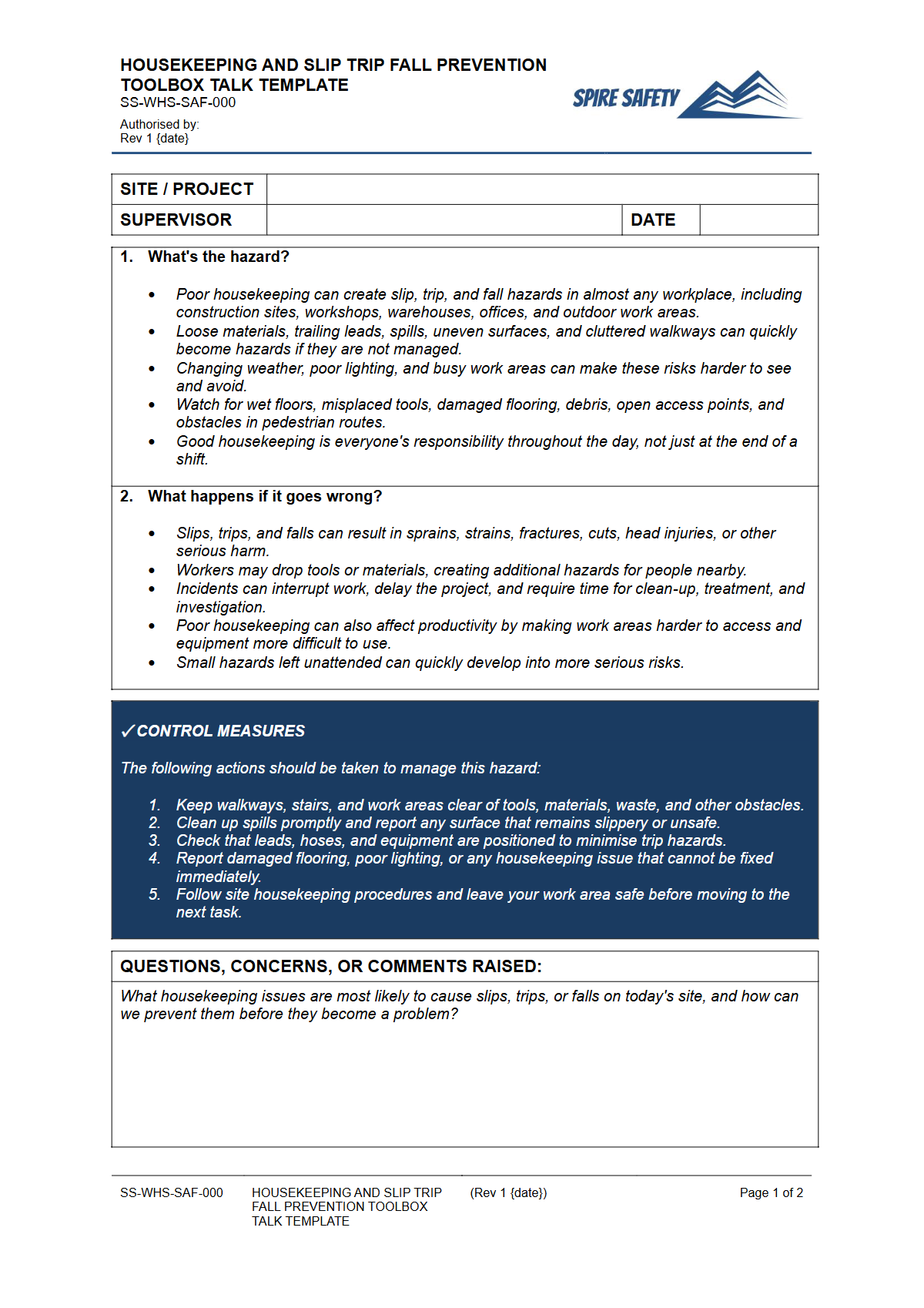
This Housekeeping Toolbox Talk Template provides a structured and discussion-driven tool for organisations to address the importance of good housekeeping practices in the workplace. Effective housekeeping is fundamental to maintaining a safe and productive environment, preventing accidents, and ensuring regulatory compliance. This template guides supervisors and team leaders through key talking points, focusing on identifying hazards related to poor housekeeping, understanding their potential consequences, and implementing practical control measures relevant to Australian workplaces.
By utilising this template, you can facilitate meaningful conversations with your workers about their roles and responsibilities in upholding high standards of workplace tidiness and organisation. It aims to foster a proactive safety culture where everyone recognises their contribution to a clean, safe, and efficient work area. This resource aligns with Australian WHS practice by promoting worker consultation and continuous improvement in risk management.
Video walkthrough
How to use this Toolbox Talk
This Housekeeping Toolbox Talk Template is designed to be a flexible framework for your safety discussions. Download the DOCX version to customise it thoroughly for your specific operational needs, workplace hazards, and team composition. Before each use, review the content and adapt it to make it highly relevant to the day's tasks or recent incidents. Incorporate site-specific examples, photos of good and bad practices, and discuss any challenges your team faces in maintaining good housekeeping.
Encourage open dialogue, ask questions, and listen to worker feedback. Document attendance and key discussion points, including any actions agreed upon during the talk. Remember, this template is a starting point — it must be customised to your workplace to be effective and relevant to your operations and hazards. Regular use of tailored toolbox talks is a key component of effective WHS management systems.
When to use it
This Toolbox Talk on housekeeping is ideal for regular safety briefings, particularly:
- At the start of a new project or work phase.
- When introducing new equipment or processes that might impact workplace layout or cleanliness.
- Following any incidents or near misses attributable to poor housekeeping.
- As a refresher during routine safety meetings or as part of continuous improvement initiatives.
- When conducting WHS compliance auditing to reinforce safe work practices.
Consistent reinforcement of housekeeping principles helps embed these practices into daily routines, reducing risks and improving overall operational efficiency.
Who should use it
This resource is suitable for:
- Supervisors, team leaders, and forepersons responsible for leading safety discussions.
- WHS officers and managers overseeing safety programs.
- Anyone tasked with delivering regular safety briefings or conducting on-site training.
- Organisations aiming to enhance their safety culture and worker engagement in risk management.
It supports those who are establishing, maintaining, or improving their WHS practices across various industries in Australia. You can find more targeted resources in our free WHS resources library.
Common mistakes
Common mistakes to avoid
- Treating housekeeping as a one-off task rather than a continuous effort.
- Failing to involve workers in identifying housekeeping issues and solutions.
- Not providing adequate resources (e.g., bins, storage) for effective housekeeping.
- Overlooking 'invisible' hazards, like poorly managed cables or cluttered digital workspaces.
Legal references
Legal considerations
The following legal requirements may be relevant to this type of work.
- Work Health and Safety Act (Harmonised) — Provides the primary duties for protecting workers and other people from work health and safety risks.
- Work Health and Safety Regulations (Harmonised) — Sets out requirements supporting the management of workplace hazards and risks.
The following codes may be relevant to this type of work.
- Managing WHS Risks Code of Practice — Provides practical guidance on identifying hazards, assessing risks and applying effective controls.
- Work Health and Safety Consultation, Cooperation and Coordination Code of Practice — Provides practical guidance on consulting workers and coordinating with other duty holders.
- Managing the Work Environment and Facilities Code of Practice — Provides practical guidance on safe work environments, workplace facilities and related controls.
Did you know
Housekeeping and Productivity
Well-organised workplaces with good housekeeping practices often report higher productivity rates. Reduced time spent searching for tools or materials and fewer interruptions from accidents directly contribute to operational efficiency.
A Proactive Safety Measure
Effective housekeeping is not just about cleanliness; it's a fundamental proactive safety measure that prevents the accumulation of hazards. It helps identify risks before they manifest into incidents, showcasing a strong commitment to worker safety.
FAQ
Frequently asked questions
01What is the primary benefit of good housekeeping in the workplace?
02How often should housekeeping toolbox talks be conducted?
03Does poor housekeeping contribute to psychosocial risks?
04Can this template be used for remote or hybrid workplaces?
Share this resource
Housekeeping Toolbox Talk Template
Browse Categories
How To Use It
- 1Download and open in Word or PDF.
- 2Replace the placeholders with your business details.
- 3Get it reviewed by a WHS specialist before rollout.
Need it customised?
Our WHS consultants can adapt this template to your site, run a gap analysis, or audit what you already have in place.
Book a Free Consultation WHS consulting servicesor call 1300 156 382