
Insect and Snake Awareness Toolbox Talk Template
Download our free Insect and Snake Awareness Toolbox Talk Template, an essential resource for WHS discussions and risk mitigation.
Insect and Snake Awareness Toolbox Talk Template
DOCX • 139 KB + PDF
Updated Oct 2026
No signup required
Purpose of this document
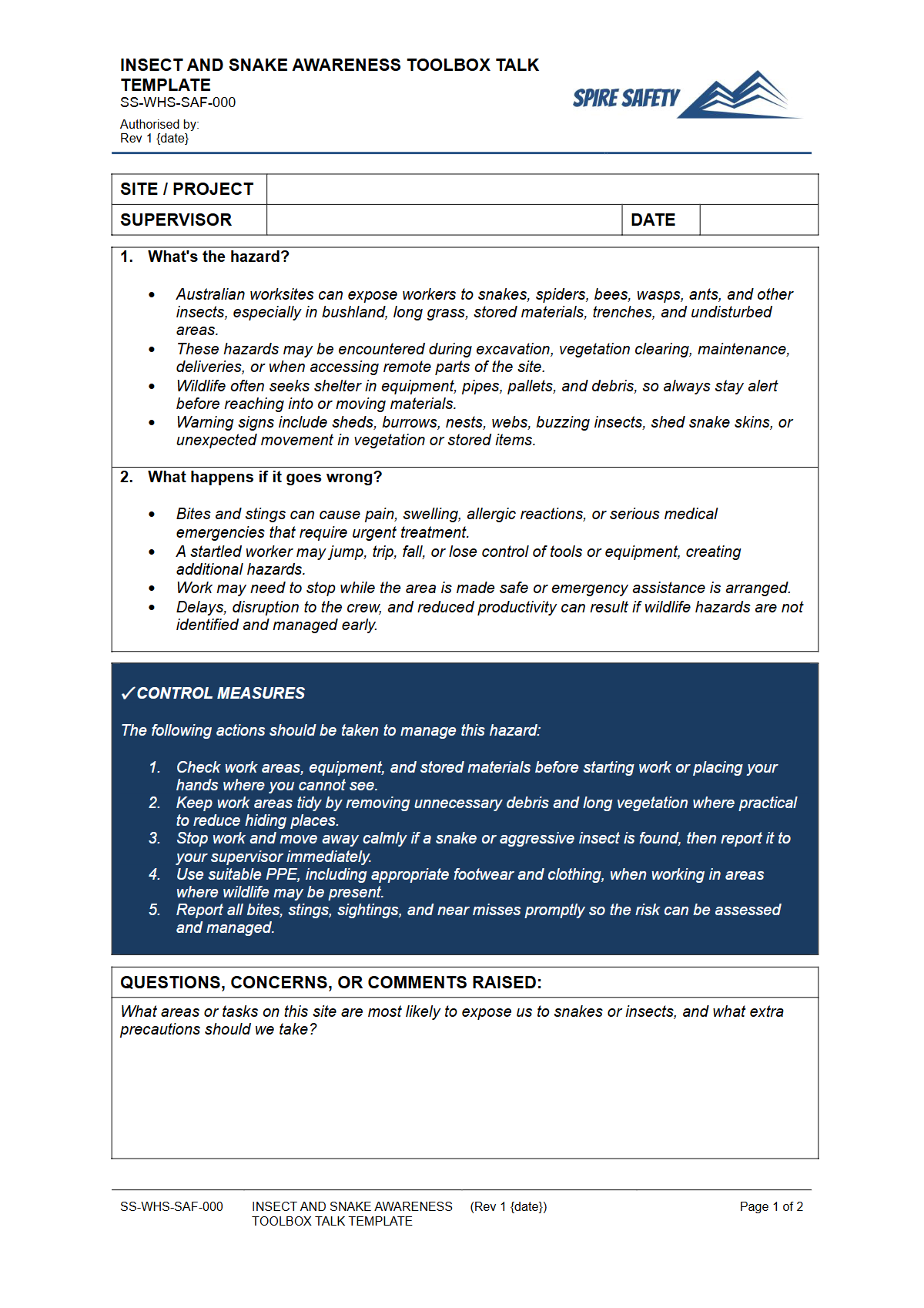
This Insect and Snake Awareness Toolbox Talk Template offers a structured framework for conducting essential WHS discussions on managing risks associated with insects and snakes in the workplace. Developed in alignment with Australian WHS practice, this template provides a foundational resource for organisations seeking to educate their workforce on environmental hazards. It covers key topics such as identification of common dangerous species, understanding their habitats, implementing preventative measures, and appropriate response protocols in the event of an encounter or bite.
Effective WHS management includes proactive communication and training. This free resource helps facilitate those vital conversations, ensuring workers are informed about potential risks and equipped with the knowledge to protect themselves. This awareness is particularly crucial for personnel working outdoors, in remote areas, or in environments where encounters with wildlife are common.
Video walkthrough
How to use this Toolbox Talk
This template is designed for team leaders, supervisors, and WHS officers to facilitate engaging and informative discussions with their teams. Before delivery, review the content to ensure it aligns with your specific workplace context and environmental conditions. You will need to customise this template to reflect the particular insect and snake species prevalent in your operational areas, your organisation's specific procedures, and any relevant site-specific safety instructions. Consider incorporating photographs or physical examples (where safe and appropriate) of identified risks to enhance understanding. Encourage open discussion and questions from your team members to foster a participatory learning environment. Remember, effective WHS guidance is always tailored to its audience and specific operational requirements.
After conducting the session, document attendance and any key discussion points or actions. This record forms an important part of your ongoing WHS management system, demonstrating a commitment to continuous improvement and worker safety training.
When to use it
This Insect and Snake Awareness Toolbox Talk is ideal for use during:
- New employee inductions, especially for roles involving outdoor work or fieldwork.
- Seasonal preparedness briefings, particularly at the onset of warmer months when insect and snake activity increases.
- Project kick-off meetings for sites located in natural or semi-natural environments.
- Regular safety meetings as part of an ongoing WHS awareness programme.
- Before commencing tasks in new or unfamiliar outdoor work areas.
- Following any incidents or near-misses involving insects or snakes to reinforce best practices.
Integrating this toolbox talk into your regular WHS schedule demonstrates a proactive approach to hazard identification and risk control, contributing to a safer working environment. For more support in developing comprehensive WHS strategies, consider exploring our WHS consulting services.
Who should use it
This Insect and Snake Awareness Toolbox Talk template is a valuable tool for:
- WHS Managers and Officers: To support their WHS programme development and delivery.
- Site Supervisors and Team Leaders: For direct engagement with their teams on daily or weekly safety briefings.
- Project Managers: To integrate environmental hazard awareness into project planning and execution.
- HR Departments: For inclusion in new employee onboarding processes, particularly for roles with outdoor exposure.
- Small to Medium Enterprises (SMEs): Offering a ready-to-use resource where dedicated WHS personnel might be limited.
By utilising this template, all levels of an organisation can contribute to a robust safety culture, ensuring that crucial information regarding insect and snake hazards is effectively communicated to every worker who might be exposed. Explore our wider collection of free WHS resources library for additional templates and guides.
Common mistakes
Common mistakes to avoid
- Not customising the talk to specific local hazards.
- Failing to conduct refresher training regularly.
- Not encouraging worker participation or questions during the talk.
- Lack of clear procedures for reporting encounters or bites.
Legal references
Legal considerations
The following legal requirements may be relevant to this type of work.
- Work Health and Safety Act (Harmonised) — Provides the primary duties for protecting workers and other people from work health and safety risks.
- Work Health and Safety Regulations (Harmonised) — Sets out requirements supporting the management of workplace hazards and risks.
The following codes may be relevant to this type of work.
- Managing WHS Risks Code of Practice — Provides practical guidance on identifying hazards, assessing risks and applying effective controls.
- Work Health and Safety Consultation, Cooperation and Coordination Code of Practice — Provides practical guidance on consulting workers and coordinating with other duty holders.
- Managing the Work Environment and Facilities Code of Practice — Provides practical guidance on safe work environments, workplace facilities and related controls.
Did you know
Australia's Venomous Creatures
Australia is home to some of the world's most venomous snakes and spiders; understanding local species is crucial for worker safety.
Snakebite First Aid
The recommended first aid for most Australian snakebites is the pressure immobilisation technique, which aims to slow venom spread through the lymphatic system.
FAQ
Frequently asked questions
01What is an Insect and Snake Awareness Toolbox Talk?
02Why is awareness of insects and snakes important in the workplace?
03How often should I conduct an Insect and Snake Awareness Toolbox Talk?
04Does this template guarantee WHS compliance?
Share this resource
Insect and Snake Awareness Toolbox Talk Template
Browse Categories
How To Use It
- 1Download and open in Word or PDF.
- 2Replace the placeholders with your business details.
- 3Get it reviewed by a WHS specialist before rollout.
Need it customised?
Our WHS consultants can adapt this template to your site, run a gap analysis, or audit what you already have in place.
Book a Free Consultation WHS consulting servicesor call 1300 156 382