
Livestock Handling Safety Toolbox Talk Template
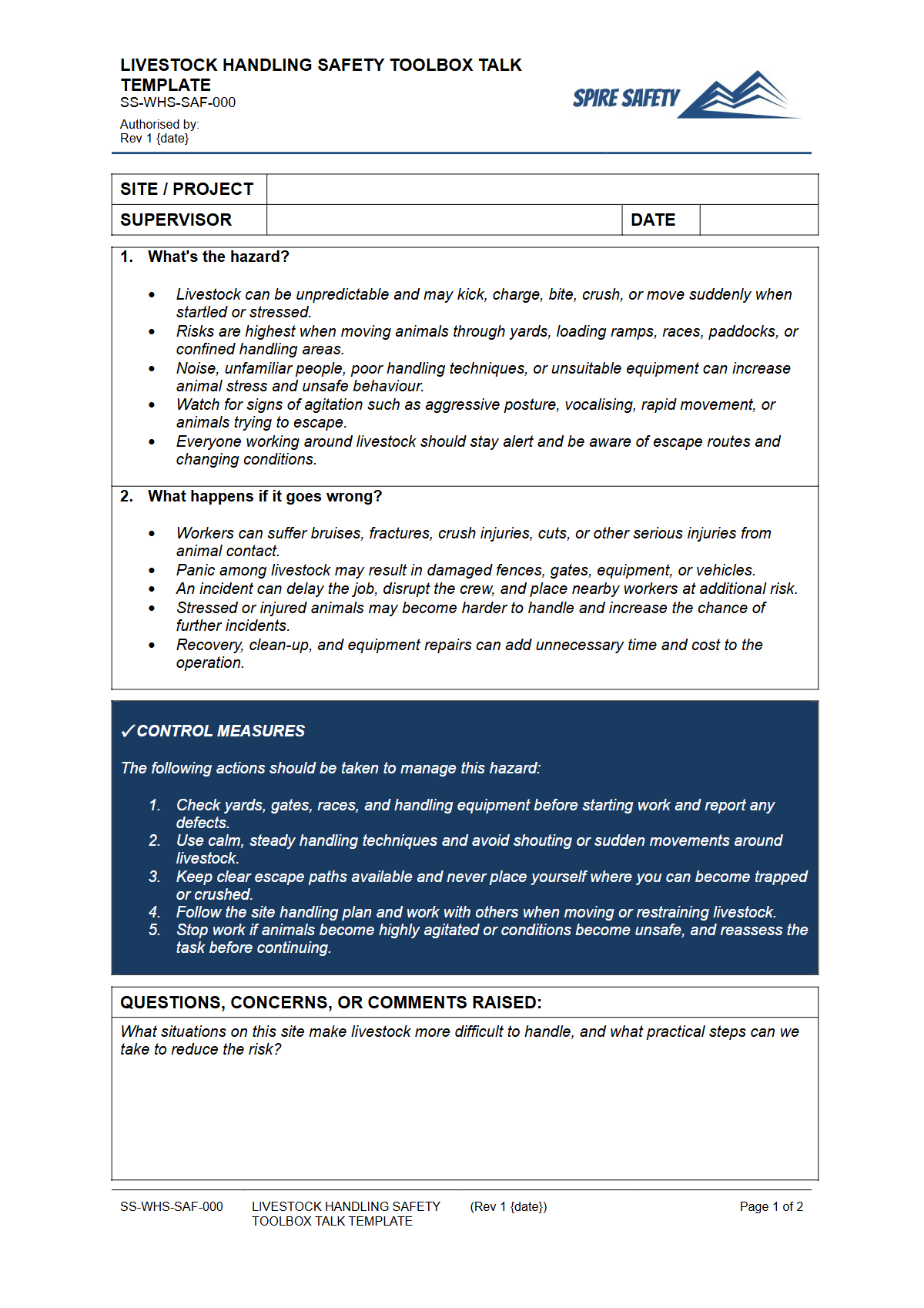
Download our free Livestock Handling Safety Toolbox Talk Template. A structured starting point for discussing farm safety in Australian workplaces.
Livestock Handling Safety Toolbox Talk Template
DOCX • 138 KB + PDF
Updated Oct 2026
No signup required
Purpose of this document
This Livestock Handling Safety Toolbox Talk Template provides a structured framework for facilitating discussions about essential safety measures when working with livestock. Developed to align with Australian WHS practice, this resource supports organisations in recognising and controlling hazards associated with animal handling. It acts as a starting point for educating workers on potential risks such as crush injuries, aggressive animal behaviour, zoonotic diseases, and ergonomic strains from manual tasks. Regular toolbox talks, using a template like this, are a fundamental component of effective WHS management systems, ensuring that safety remains a consistent priority.
Video walkthrough
How to use this Toolbox Talk
This template is designed for supervisors, team leaders, or WHS representatives to lead short, focused safety discussions with their teams. Before conducting the toolbox talk, review the template content and adapt it to the specific types of livestock, handling procedures, and unique environmental conditions present in your workplace. It includes sections for discussion points, hazard identification, control measures, and an attendance register. Remember, this template is a guide; it must be customised to your workplace’s specific operations, risks, and control measures before use. Supplement the discussion with real-world examples, demonstrations of safe techniques, and opportunities for workers to share their experiences and concerns. Utilise it as a component of your broader WHS communication strategy, reinforcing safe work practices and fostering a proactive safety culture.
When to use it
Use this Livestock Handling Safety Toolbox Talk Template regularly, such as fortnightly or monthly, depending on your operational tempo and identified risks. Integrate it into pre-shift briefings before significant livestock movements, during induction for new workers, or following any incident or near-miss involving animals. It is also valuable when introducing new equipment, changing handling procedures, or after periods of adverse weather that might affect animal behaviour or workspace conditions. Consistent use helps to embed safety thinking into daily operations and keeps workers vigilant about livestock handling hazards.
Who should use it
This Toolbox Talk is ideal for anyone with supervisory or WHS responsibilities in agricultural settings, abattoirs, veterinary clinics, transport, or any environment where workers interact with livestock. This includes farm managers, station owners, supervisors, team leaders, and WHS officers. It is also beneficial for WHS trainers as an educational tool. Ultimately, the information discussed is for all workers who handle or are exposed to livestock, ensuring everyone understands their role in maintaining a safe working environment. For further support in developing comprehensive safety programs, consider engaging with WHS consulting specialists.
Common mistakes
Common mistakes to avoid
- Not customising the toolkit to specific workplace hazards and procedures.
- Delivering talks as a lecture rather than a two-way discussion.
- Failing to document attendance and discussion points for record-keeping.
- Inconsistently conducting talks, leading to gaps in safety awareness.
Legal references
Legal considerations
The following legal requirements may be relevant to this type of work.
- Work Health and Safety Act (Harmonised) — Provides the primary duties for protecting workers and other people from work health and safety risks.
- Work Health and Safety Regulations (Harmonised) — Sets out requirements supporting the management of workplace hazards and risks.
The following codes may be relevant to this type of work.
- Managing WHS Risks Code of Practice — Provides practical guidance on identifying hazards, assessing risks and applying effective controls.
- Work Health and Safety Consultation, Cooperation and Coordination Code of Practice — Provides practical guidance on consulting workers and coordinating with other duty holders.
- Managing the Work Environment and Facilities Code of Practice — Provides practical guidance on safe work environments, workplace facilities and related controls.
Did you know
Animal behaviour awareness
Understanding animal behaviour and flight zones significantly reduces the risk of incidents during handling, promoting calmer interactions and safer working conditions.
Zoonotic disease risk
Many diseases can transfer from animals to humans (zoonoses). Proper hygiene, vaccination, and personal protective equipment are critical control measures.
FAQ
Frequently asked questions
01What is a Livestock Handling Safety Toolbox Talk?
02How often should livestock handling toolbox talks be conducted?
03What are common hazards addressed in livestock handling safety?
04Can this template be used for various types of livestock?
Share this resource
Livestock Handling Safety Toolbox Talk Template
Browse Categories
How To Use It
- 1Download and open in Word or PDF.
- 2Replace the placeholders with your business details.
- 3Get it reviewed by a WHS specialist before rollout.
Need it customised?
Our WHS consultants can adapt this template to your site, run a gap analysis, or audit what you already have in place.
Book a Free Consultation WHS consulting servicesor call 1300 156 382