
Mould and Legionella Awareness Toolbox Talk Template
Download our free Mould and Legionella Awareness Toolbox Talk Template. A structured starting point for WHS discussions in your workplace.
Mould and Legionella Awareness Toolbox Talk Template
DOCX • 139 KB + PDF
Updated Oct 2026
No signup required
Purpose of this document
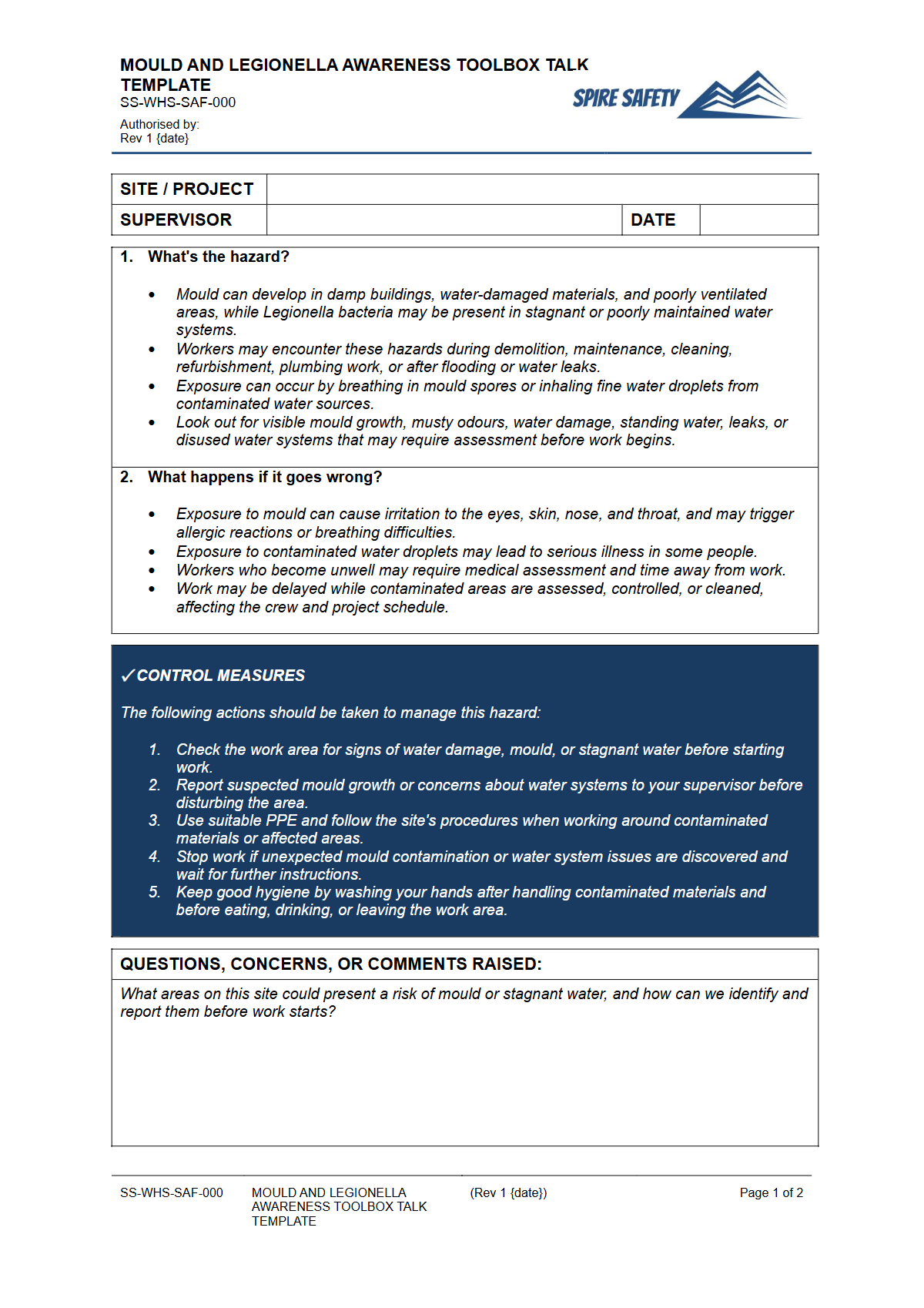
This Mould and Legionella Awareness Toolbox Talk Template provides a structured framework for conducting essential WHS discussions in your workplace. Designed to support Australian organisations, this template helps facilitate conversations about the health risks associated with mould and Legionella bacteria, and the control measures necessary to manage these risks effectively. It serves as a foundational resource to integrate awareness and preventative strategies into your ongoing WHS program, aligning with general Australian WHS practice. Regular toolbox talks are a key component of effective WHS management systems, ensuring that workers are informed about potential hazards and understand their roles in maintaining a safe working environment.
Video walkthrough
How to use this Toolbox Talk
This template is provided in both DOCX and PDF formats to offer flexibility. Download the DOCX version to easily customise it for your specific workplace. Before presenting, review the content thoroughly and adapt all sections to reflect the unique requirements, hazards, and control measures relevant to your site and industry. This template must be customised to your workplace and its specific WHS risks. I cannot guarantee its suitability without your detailed input. Ensure that any references to specific procedures, equipment, or WHS personnel are updated. Encourage open discussion, questions, and worker participation during the talk to maximise its effectiveness. Following the talk, consider documenting attendance and key discussion points as part of your WHS records, demonstrating a commitment to continuous improvement in health and safety outcomes. For comprehensive support in developing tailored WHS documentation, explore our range of WHS consulting services.
When to use it
This Mould and Legionella Awareness Toolbox Talk Template is ideal for use during new worker inductions, particularly in environments where moisture, water systems, or organic materials are prevalent. It is also highly relevant for regular WHS meetings, especially before projects or during seasonal changes that may increase the risk of mould growth or Legionella proliferation (e.g., warmer months, periods of high humidity). Organisations operating cooling towers, evaporative condensers, spa pools, or other engineered water systems should conduct these talks as part of their routine maintenance and risk management schedule. Furthermore, initiating this toolbox talk becomes crucial following any incident involving mould exposure or a potential Legionella risk, or when new information regarding these hazards emerges. Leveraging this resource as part of your continuous WHS education strategy supports a proactive approach to workplace health and safety.
Who should use it
This template is primarily designed for WHS officers, team leaders, supervisors, and management personnel responsible for overseeing worker safety and conducting WHS training sessions. It is also suitable for WHS committees and worker representatives who facilitate safety discussions and promote WHS awareness within their teams. Any individual tasked with delivering information about health risks associated with biological hazards in the workplace will find this Mould and Legionella Awareness Toolbox Talk Template a valuable asset. The objective is to equip those in leadership or WHS roles with a structured tool to effectively communicate critical health and safety information to their workforce, fostering a culture of safety awareness and risk mitigation across all levels of the organisation. For additional resources, feel free to browse our free WHS resources library at Spire Safety.
Common mistakes
Common mistakes to avoid
- Not customising the template to specific workplace risks and controls.
- Presenting the talk without encouraging worker questions or discussion.
- Failing to document attendance and discussion points from the toolbox talk.
- Treating the toolbox talk as a one-off event rather than part of ongoing WHS education.
Legal references
Legal considerations
The following legal requirements may be relevant to this type of work.
- Work Health and Safety Act (Harmonised) — Provides the primary duties for protecting workers and other people from work health and safety risks.
- Work Health and Safety Regulations (Harmonised) — Sets out requirements supporting the management of workplace hazards and risks.
The following codes may be relevant to this type of work.
- Managing WHS Risks Code of Practice — Provides practical guidance on identifying hazards, assessing risks and applying effective controls.
- Work Health and Safety Consultation, Cooperation and Coordination Code of Practice — Provides practical guidance on consulting workers and coordinating with other duty holders.
- Managing the Work Environment and Facilities Code of Practice — Provides practical guidance on safe work environments, workplace facilities and related controls.
Did you know
Ubiquitous Presence
Mould spores are naturally present virtually everywhere, both indoors and outdoors, but they only become a problem when they find moisture and grow on surfaces.
Not Just a Respiratory Hazard
Exposure to certain types of mould can cause various health issues, including allergic reactions, asthma attacks, skin irritation, and even more serious systemic effects in vulnerable individuals.
FAQ
Frequently asked questions
01What is the primary purpose of a toolbox talk on mould and Legionella?
02How often should organisations conduct toolbox talks on mould and Legionella awareness?
03Are there specific industries where mould and Legionella awareness is particularly crucial?
04Can this template help my organisation meet its WHS obligations for managing biological hazards?
Share this resource
Mould and Legionella Awareness Toolbox Talk Template
Browse Categories
How To Use It
- 1Download and open in Word or PDF.
- 2Replace the placeholders with your business details.
- 3Get it reviewed by a WHS specialist before rollout.
Need it customised?
Our WHS consultants can adapt this template to your site, run a gap analysis, or audit what you already have in place.
Book a Free Consultation WHS consulting servicesor call 1300 156 382