
Near Miss Toolbox Talk Template
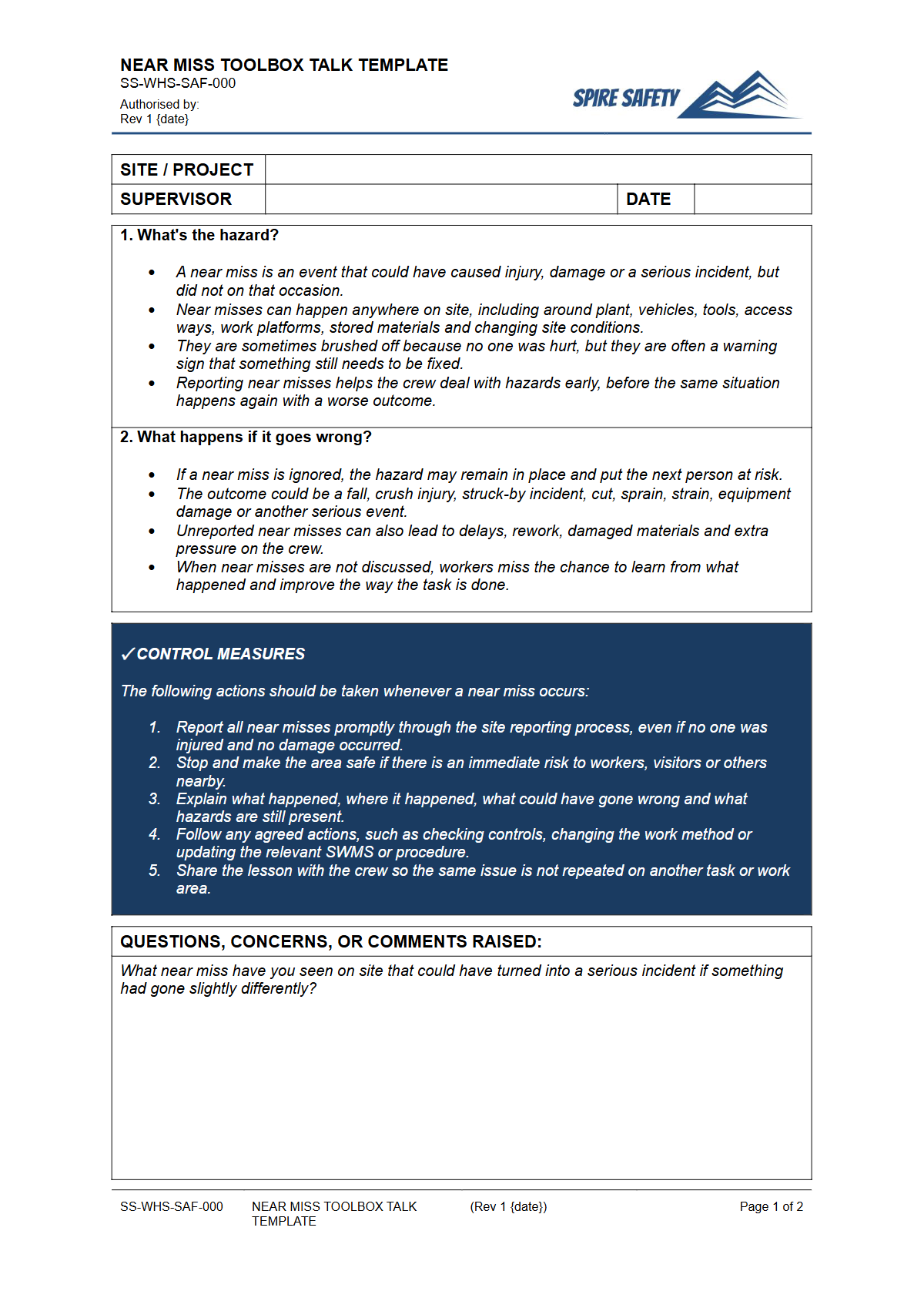
Download our free Near Miss Toolbox Talk Template for Australian workplaces. Promote a proactive safety culture by encouraging near miss reporting.
Near Miss Toolbox Talk Template
DOCX • 137 KB + PDF
Updated Oct 2026
No signup required
Purpose of this document
This Near Miss Toolbox Talk Template is designed to facilitate discussions about the importance of identifying, reporting, and learning from 'near misses' in the workplace. A 'near miss' is an unplanned event that did not result in injury, illness, or damage, but had the potential to do so. These events are invaluable indicators of potential hazards and systemic weaknesses that, if unaddressed, could lead to more serious incidents.
By utilising this template, your organisation can proactively strengthen its work health and safety (WHS) framework. It helps foster a culture where workers feel empowered and encouraged to report near misses without fear of blame, ensuring that valuable safety intelligence is captured and acted upon. Effective near miss reporting is a cornerstone of robust WHS management systems, enabling continuous improvement and hazard control before incidents occur.
Video walkthrough
How to use this Toolbox Talk
This Near Miss Toolbox Talk Template provides a structured framework for conducting brief, yet impactful, safety discussions with your team. To use it effectively, follow these steps:
Review and Customise: Before conducting the talk, thoroughly review the template. It is crucial that this template is customised to your specific workplace, its unique hazards, and the particular near misses that have occurred or are prevalent in your operations. General examples should be replaced or supplemented with real-world scenarios relevant to your team's daily tasks.
Schedule and Prepare: Allot 10-15 minutes for the discussion. Gather any visual aids, such as photos of the worksite or relevant equipment, or anonymised examples of actual near miss reports from your workplace (if appropriate).
Facilitate Discussion: Encourage open dialogue. Ask questions, listen actively, and ensure all team members have an opportunity to contribute. Emphasise that the goal is learning and prevention, not fault-finding.
Document Attendance and Key Points: Record who attended the toolbox talk and any significant issues or actions raised. This documentation forms part of your ongoing safety records.
Implement Actions: Where near misses or potential hazards are identified during the talk, ensure these are escalated through your hazard reporting process and appropriate corrective actions are implemented promptly. Follow-up on these actions to demonstrate commitment to safety.
When to use it
This Near Miss Toolbox Talk Template is suitable for regular integration into your safety program. Consider using it:
As part of your scheduled weekly or fortnightly toolbox talks.
At the start of a new project or task where new or unfamiliar hazards may be present.
Following a significant near miss incident, to review what happened and reinforce reporting procedures.
During onboarding or refresher training for workers, to emphasise the importance of hazard identification and reporting.
When there's a noticeable dip in near miss reporting, to re-engage workers and remind them of its value.
As a component of your broader safety induction process for new employees or contractors.
Who should use it
This resource is invaluable for anyone responsible for leading or participating in safety discussions within an Australian workplace. This includes:
Team Leaders and Supervisors
WHS Officers and Managers
Project Managers
Site Managers
Small Business Owners
Safety Committees and Representatives
Any worker responsible for overseeing the safety of others or contributing to a safe work environment.
It's particularly beneficial for organisations seeking to improve their proactive safety measures and ensure compliance with WHS regulations regarding hazard identification and risk management. This template provides a structured way to educate all personnel on their role in preventing incidents, complementing broader WHS consulting services your organisation may utilise.
Common mistakes
Common mistakes to avoid
- Not customising the template to specific workplace hazards and past near misses.
- Failing to encourage open discussion or allowing a 'blame culture' to stifle reporting.
- Not documenting the toolbox talk or the actions identified during the discussion.
- Not following through on actions identified to correct hazards, undermining worker trust.
Legal references
Legal considerations
The following legal requirements may be relevant to this type of work.
- Work Health and Safety Act (Harmonised) — Provides the primary duties for protecting workers and other people from work health and safety risks.
- Work Health and Safety Regulations (Harmonised) — Sets out requirements supporting the management of workplace hazards and risks.
The following codes may be relevant to this type of work.
- Managing WHS Risks Code of Practice — Provides practical guidance on identifying hazards, assessing risks and applying effective controls.
- Work Health and Safety Consultation, Cooperation and Coordination Code of Practice — Provides practical guidance on consulting workers and coordinating with other duty holders.
- Managing the Work Environment and Facilities Code of Practice — Provides practical guidance on safe work environments, workplace facilities and related controls.
Did you know
Heinrich's Safety Pyramid
For every major injury, there are typically many minor injuries and hundreds of near misses. This highlights why addressing near misses can prevent more serious incidents down the line.
FAQ
Frequently asked questions
01What is the difference between a 'near miss' and an 'incident'?
02Why is it important to report near misses?
03How often should near miss toolbox talks be conducted?
04Does reporting a near miss lead to disciplinary action?
Share this resource
Near Miss Toolbox Talk Template
Browse Categories
How To Use It
- 1Download and open in Word or PDF.
- 2Replace the placeholders with your business details.
- 3Get it reviewed by a WHS specialist before rollout.
Need it customised?
Our WHS consultants can adapt this template to your site, run a gap analysis, or audit what you already have in place.
Book a Free Consultation WHS consulting servicesor call 1300 156 382