
Patient and Client Aggression Toolbox Talk Template
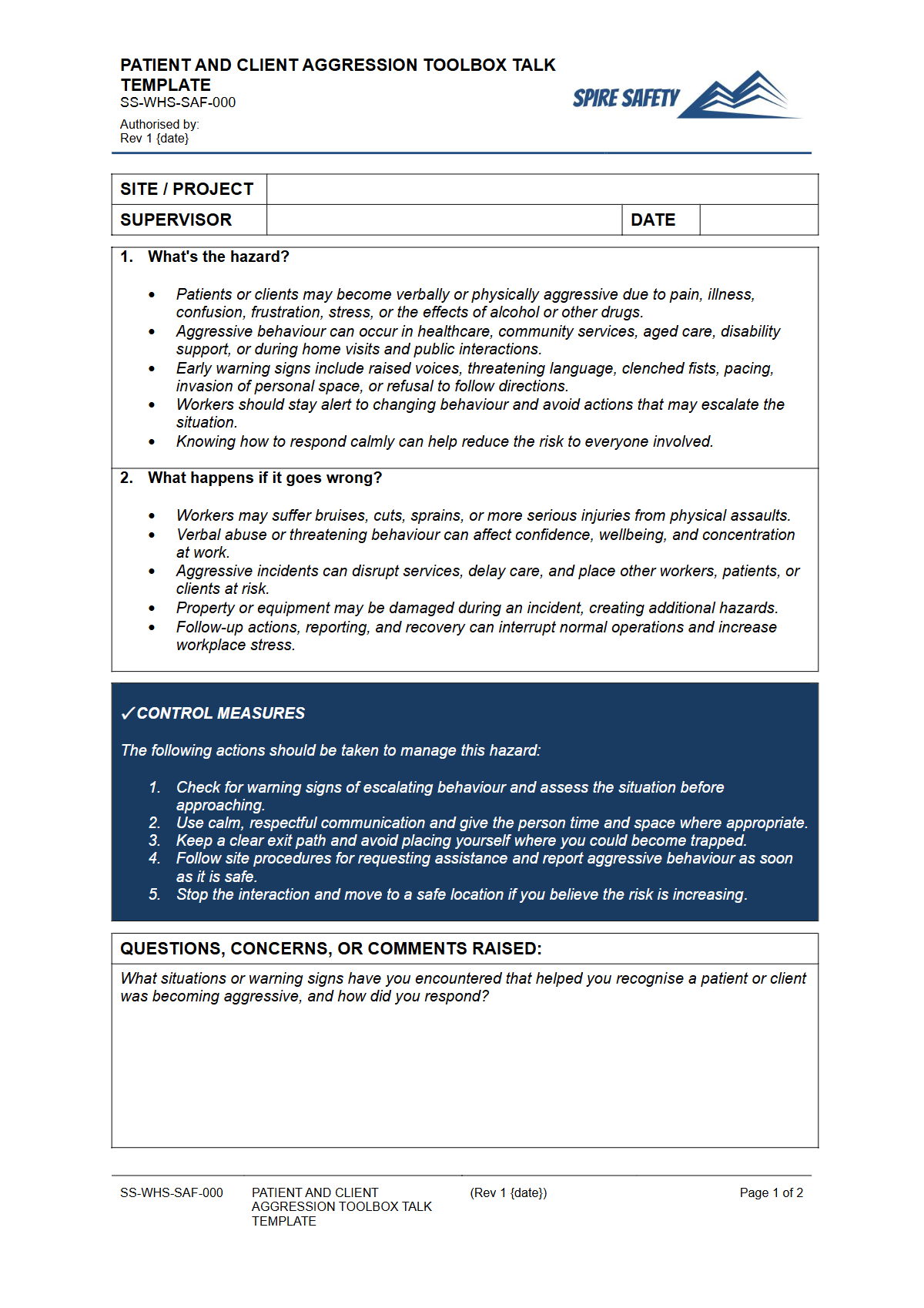
Download our free Patient and Client Aggression Toolbox Talk Template. A structured starting point for discussing workplace aggression and WHS.
Patient and Client Aggression Toolbox Talk Template
DOCX • 138 KB + PDF
Updated Oct 2026
No signup required
Patient and Client Aggression Toolbox Talk Template
Spire Safety offers a free, downloadable Patient and Client Aggression Toolbox Talk Template, designed to help workplaces address the significant WHS risks associated with aggressive behaviour. This template provides a structured starting point for facilitating discussions on identifying, preventing, and responding to patient and client aggression, ensuring a safer environment for workers across various sectors in Australia.
Recognising that aggression can manifest in many forms, from verbal abuse to physical assault, this resource is crucial for proactive risk management. It's an essential tool for any organisation committed to protecting its team from psychosocial hazards and fostering a respectful and secure workplace.
Patient and client aggression is a prevalent issue in many industries, particularly healthcare, community services, retail, and customer service. Openly discussing these challenges through a toolbox talk can significantly enhance worker awareness, reinforce WHS procedures, and promote consistent responses to aggressive incidents.
This template is aligned with Australian WHS practice, offering a foundational framework for initiating these vital conversations within your team.
Video walkthrough
Purpose of this Toolbox Talk
This Patient and Client Aggression Toolbox Talk Template serves to; educate workers on the forms and impacts of patient and client aggression; facilitate discussion on workplace-specific risks and control measures; and provide a framework for consistent responses to aggressive incidents. Its core purpose is to elevate awareness regarding the serious WHS implications of aggression, reinforce existing WHS policies and procedures, and empower workers to contribute to a safer working environment.
By systematically addressing this hazard, organisations can work towards mitigating the physical and psychological harm associated with aggressive encounters.
How to use this Toolbox Talk
This Patient and Client Aggression Toolbox Talk Template is provided as a guide and must be customised to your specific workplace, its unique risks, and your existing WHS policies and procedures. Before conducting the toolbox talk, review the template thoroughly and adapt it to reflect your organisation's context, including relevant incident statistics, control measures, reporting protocols, and available support services. Supplement the discussion with real-life (anonymised) examples if appropriate to make the content more relatable.
Encourage open dialogue, questions, and worker participation to ensure the information is understood and practical. Document attendance and any key actions or suggestions raised during the talk.
For comprehensive support in tailoring WHS documentation or implementing effective psychosocial risk management, consider our WHS consulting services.
When to use it
This Toolbox Talk is ideal for regular WHS meetings, particularly in workplaces where workers frequently interact with patients or clients. It should be used during orientation for new staff, as a refresher for existing teams, or following any reported incident of patient or client aggression.
Implementing this toolbox talk reinforces a proactive safety culture and demonstrates an ongoing commitment to worker well-being. Regular discussions help maintain vigilance and ensure that all workers are familiar with appropriate responses and reporting mechanisms.
Who should use it
This template is primarily for supervisors, team leaders, WHS representatives, and management personnel responsible for conducting safety briefings and WHS discussions within their teams. It is suitable for any organisation where workers may encounter patient or client aggression, including but not limited to healthcare facilities, aged care, disability support services, public-facing retail, hospitality, education, and community services.
The goal is to provide a comprehensive tool that can be facilitated by anyone tasked with promoting and maintaining a safe working environment. For broader WHS strategy, our WHS management systems can offer integrated solutions.
Common mistakes
Common mistakes to avoid
- Not customising the template to fit specific workplace risks and procedures.
- Failing to encourage open discussion and worker input during the toolbox talk.
- Treating the toolbox talk as a one-off event instead of part of ongoing WHS management.
- Neglecting to follow up on identified actions or improve control measures after the discussion.
Legal references
Legal considerations
The following legal requirements may be relevant to this type of work.
- Work Health and Safety Act (Harmonised) — Provides the primary duties for protecting workers and other people from work health and safety risks.
- Work Health and Safety Regulations (Harmonised) — Sets out requirements supporting the management of workplace hazards and risks.
The following codes may be relevant to this type of work.
- Managing WHS Risks Code of Practice — Provides practical guidance on identifying hazards, assessing risks and applying effective controls.
- Work Health and Safety Consultation, Cooperation and Coordination Code of Practice — Provides practical guidance on consulting workers and coordinating with other duty holders.
- Managing the Work Environment and Facilities Code of Practice — Provides practical guidance on safe work environments, workplace facilities and related controls.
Did you know
Impact on Worker Well-being
Aggression from patients or clients is a leading cause of psychosocial injury and stress in many service-based industries, significantly impacting worker mental health and job satisfaction.
Reporting is Key
Many incidents of verbal aggression go unreported, preventing organisations from accurately assessing risks and implementing effective control measures. Encouraging reporting is vital.
FAQ
Frequently asked questions
01What is considered patient and client aggression in a workplace context?
02Why is a specific toolbox talk on patient and client aggression important?
03How can I customise this template to be relevant for my industry?
04Does this template cover prevention strategies for aggression?
Share this resource
Patient and Client Aggression Toolbox Talk Template
Browse Categories
How To Use It
- 1Download and open in Word or PDF.
- 2Replace the placeholders with your business details.
- 3Get it reviewed by a WHS specialist before rollout.
Need it customised?
Our WHS consultants can adapt this template to your site, run a gap analysis, or audit what you already have in place.
Book a Free Consultation WHS consulting servicesor call 1300 156 382