
Power Tool Safety Toolbox Talk Template
Download your free Power Tool Safety Toolbox Talk Template. A structured starting point for discussing safe power tool use in your Australian workplace.
Power Tool Safety - General Toolbox Talk Template
DOCX • 138 KB + PDF
Updated Oct 2026
No signup required
Purpose of this document
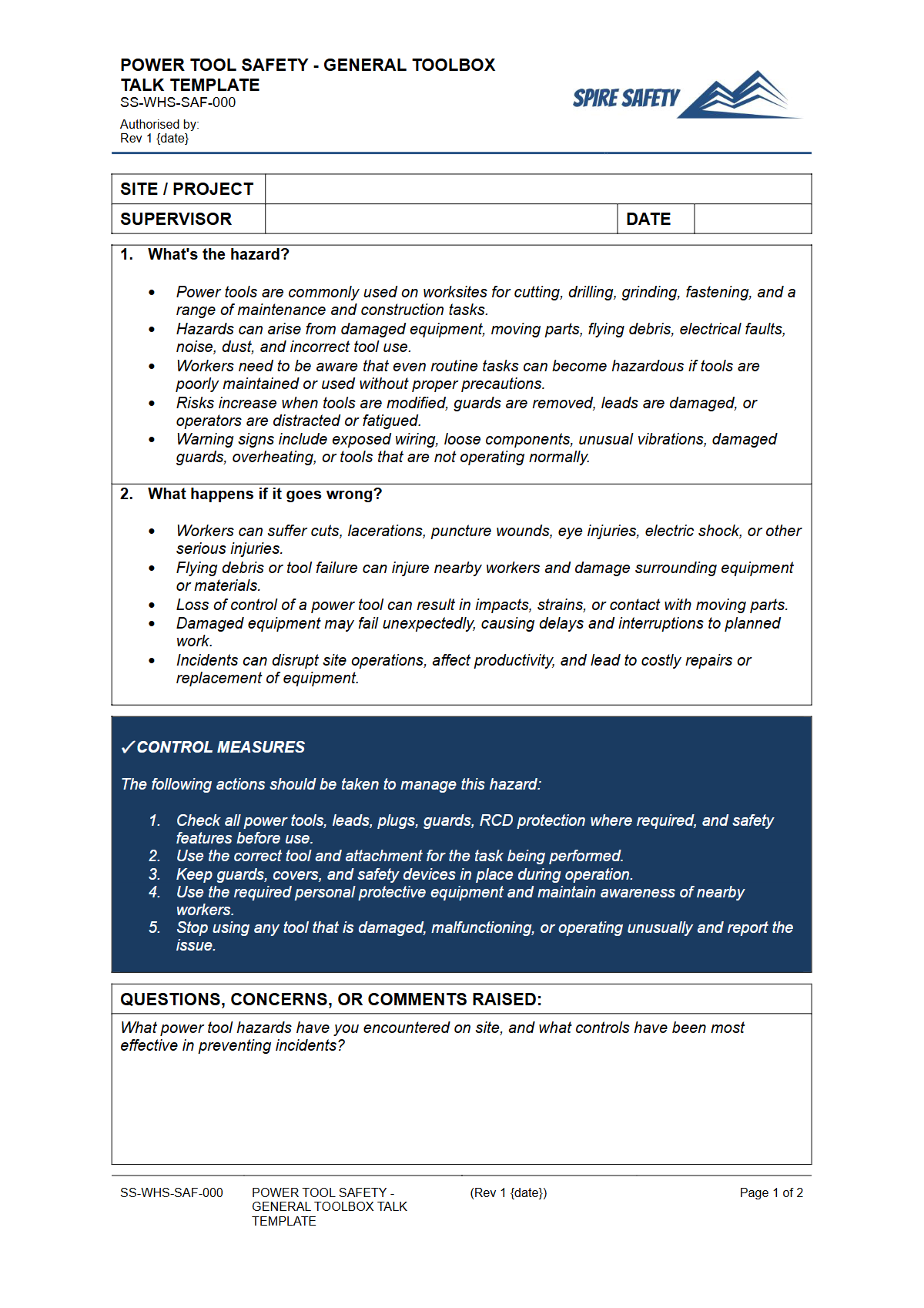
This Power Tool Safety – General Toolbox Talk Template provides a valuable framework for conducting regular safety discussions in your workplace. Power tools are ubiquitous across many Australian industries, from construction to manufacturing, landscaping, and maintenance. While designed to enhance efficiency, their incorrect use or lack of maintenance can lead to serious injuries, including cuts, amputations, electrical shocks, burns, hearing loss, and eye damage. This template is designed to help persons conducting a business or undertaking (PCBUs) and workers identify, understand, and control the common hazards associated with power tools.
By facilitating structured discussions, this resource aims to improve worker awareness, promote safe work practices, and reinforce the importance of personal protective equipment (PPE). It serves as a practical tool for proactive hazard identification and risk management, contributing to a safer working environment in alignment with Australian WHS practice. Regular toolbox talks, such as those enabled by this template, are a key component of effective WHS management systems.
Video walkthrough
How to use this Toolbox Talk
This Power Tool Safety – General Toolbox Talk Template is provided in a downloadable DOCX format (with a PDF alternative) to allow for easy customisation. To use it effectively, follow these steps:
Download the template.
Review the content and adapt it to the specific power tools, tasks, and work environment present in your workplace. This resource is a structured starting point, and it must be customised to your workplace and its unique risks.
Schedule a convenient time for the toolbox talk, ensuring all relevant workers are present.
Assign a competent person to lead the discussion, encouraging active participation and questions from workers.
Utilise the provided sections to cover topics such as pre-operation checks, correct usage, inspection, maintenance, and emergency procedures.
Record attendance and any discussion points or actions agreed upon. This documentation is crucial for demonstrating ongoing WHS efforts and continuous improvement.
Follow up on any issues raised or corrective actions identified during the talk.
When to use it
This Power Tool Safety – General Toolbox Talk Template is ideal for a variety of scenarios:
New Project Induction: Prior to commencing work on any project involving power tools.
Regular Safety Meetings: Integrate into your routine safety meetings (e.g., weekly, monthly).
Introduction of New Equipment: When new power tools are introduced to the workplace.
Post-Incident Review: As a refresher or corrective action after an incident or near-miss involving power tools.
Seasonal Changes: To address specific risks that might arise with particular tools during different weather conditions.
Worker Onboarding: As part of the induction process for new employees who will be using power tools.
Who should use it
This template is designed for use by a range of individuals and groups responsible for WHS in Australian workplaces:
Supervisors and Team Leaders: To lead discussions and ensure their teams understand and follow safe power tool procedures.
WHS Managers and Officers: To facilitate consistent safety messaging across different teams and projects.
Business Owners and PCBUs: To demonstrate a commitment to WHS and fulfil their duty of care regarding plant and equipment.
Workers: As a reference point to stay informed about safe practices and actively participate in workplace safety.
Common mistakes
Common mistakes to avoid
- Failing to inspect power tools for damage before use.
- Not using the correct personal protective equipment (PPE) for the specific power tool.
- Bypassing or removing safety guards on power tools.
- Using power tools for tasks they are not designed for.
Legal references
Legal considerations
The following legal requirements may be relevant to this type of work.
- Work Health and Safety Act (Harmonised) — Provides the primary duties for protecting workers and other people from work health and safety risks.
- Work Health and Safety Regulations (Harmonised) — Sets out requirements supporting the management of workplace hazards and risks.
The following codes may be relevant to this type of work.
- Managing WHS Risks Code of Practice — Provides practical guidance on identifying hazards, assessing risks and applying effective controls.
- Work Health and Safety Consultation, Cooperation and Coordination Code of Practice — Provides practical guidance on consulting workers and coordinating with other duty holders.
- Managing the Work Environment and Facilities Code of Practice — Provides practical guidance on safe work environments, workplace facilities and related controls.
Did you know
Hearing Protection
Prolonged exposure to noise from power tools can cause permanent hearing damage. Earmuffs or earplugs can reduce noise exposure by up to 30dB, protecting workers' hearing.
Cordless Tools
While offering greater mobility, cordless power tools still present hazards. Ensure batteries are charged correctly, inspect for damage, and avoid using them in wet conditions.
FAQ
Frequently asked questions
01What is a toolbox talk template?
02Why are toolbox talks important for power tool safety?
03How often should toolbox talks on power tool safety be conducted?
04Can this template replace formal training for power tool safety?
Share this resource
Power Tool Safety - General Toolbox Talk Template
Browse Categories
How To Use It
- 1Download and open in Word or PDF.
- 2Replace the placeholders with your business details.
- 3Get it reviewed by a WHS specialist before rollout.
Need it customised?
Our WHS consultants can adapt this template to your site, run a gap analysis, or audit what you already have in place.
Book a Free Consultation WHS consulting servicesor call 1300 156 382