
Psychosocial Hazards at Work Toolbox Talk Template
Download your free Psychosocial Hazards at Work Toolbox Talk Template. A structured starting point for discussing workplace psychological safety.
Psychosocial Hazards at Work Toolbox Talk Template
DOCX • 141 KB + PDF
Updated Oct 2026
No signup required
Purpose of this document
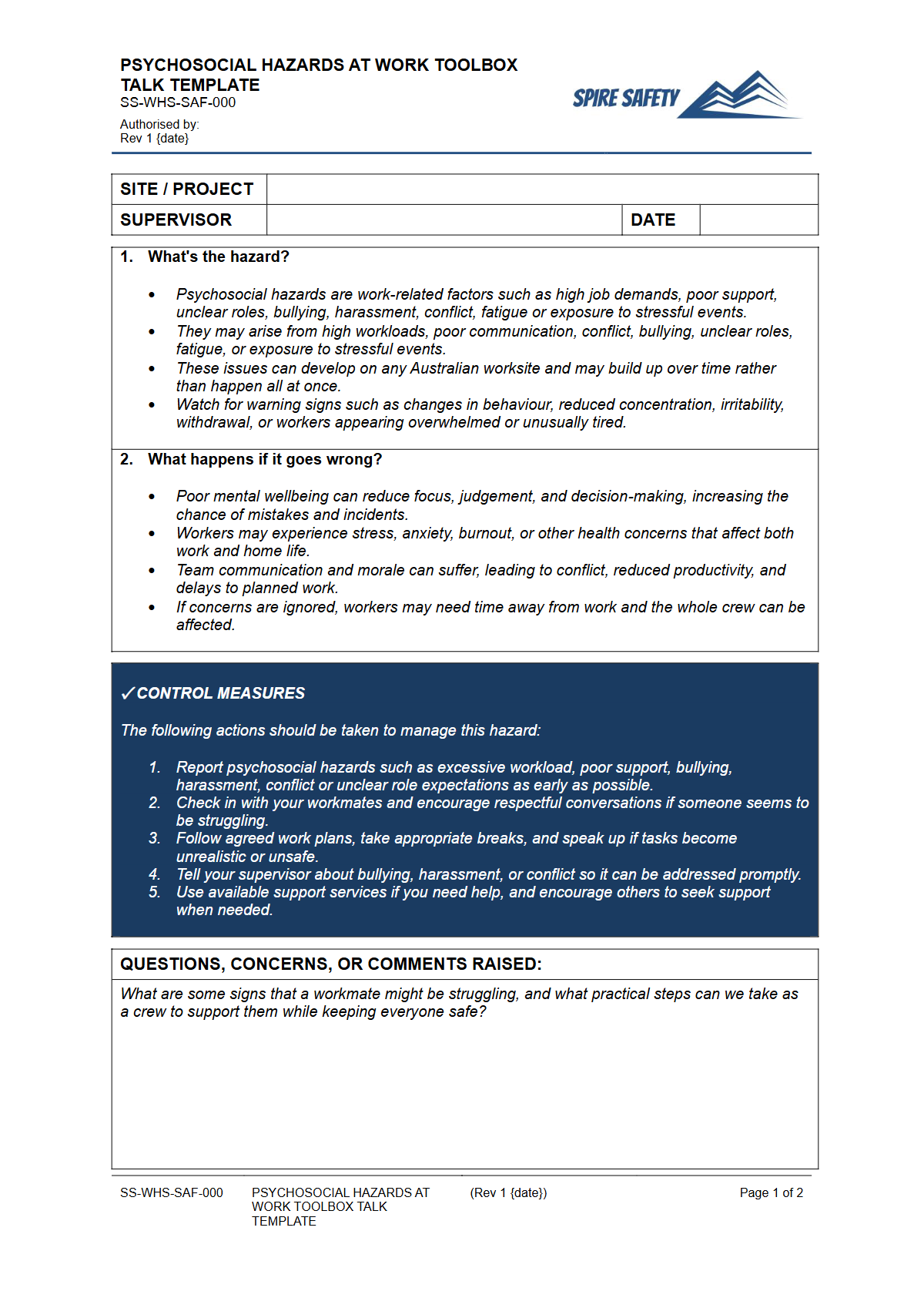
This Toolbox Talk Template for Psychosocial Hazards at Work is designed to help organisations facilitate important discussions about psychological safety in the workplace. It provides a structured framework to introduce, explain, and discuss psychosocial hazards, their potential impacts, and practical control measures within teams. By using this template, you can raise awareness, encourage open communication, and promote a proactive approach to managing psychosocial risks, contributing to a healthier and safer work environment for everyone. It serves as a valuable tool in your overall WHS management systems.
Video walkthrough
How to use this Toolbox Talk
This template is best utilised as a discussion prompt during team meetings or dedicated toolbox sessions. Download the DOCX version to customise it thoroughly for your specific workplace. Before presenting, review the content and consider adding examples relevant to your industry, roles, and current work environment. It includes sections for defining psychosocial hazards, identifying common examples, discussing potential impacts on workers, and outlining control measures. Facilitate an open discussion, encouraging workers to share their experiences and ask questions. Remember, this is a starting point, and it must be customised to your workplace's unique risks, policies, and procedures to be effective and relevant. It is not an 'off-the-shelf' solution for compliance but a foundational document to build upon.
When to use it
This Toolbox Talk on psychosocial hazards can be used periodically as part of your regular WHS communication schedule, during induction for new workers, or in response to specific workplace incidents or trends. It is particularly relevant when introducing new work processes, undergoing organisational change, or after receiving feedback regarding workplace culture or stress levels. Consistent discussions about psychosocial hazards help to embed a culture of psychological safety. Consider integrating it with other discussions from our free WHS resources library to maintain ongoing awareness.
Who should use it
This Psychosocial Hazards at Work Toolbox Talk Template is ideal for supervisors, team leaders, WHS representatives, and management personnel responsible for conducting team briefings or WHS discussions. It is also beneficial for WHS managers and officers who wish to consistently deliver information on psychosocial risks across different departments or teams. Any individual tasked with fostering a safe and healthy work environment, particularly concerning psychological well-being, will find this template valuable. It supports the duties of PCBUs and officers to ensure safe systems of work.
Common mistakes
Common mistakes to avoid
- Not customising the template to reflect specific workplace risks and controls.
- Presenting the information without facilitating open discussion and worker input.
- Failing to follow up on concerns or suggestions raised during the Toolbox Talk.
- Treating psychosocial hazards as only individual problems rather than systemic workplace issues.
Legal references
Legal considerations
The following legal requirements may be relevant to this type of work.
- Work Health and Safety Act (Harmonised) — Provides the primary duties for protecting workers and other people from work health and safety risks.
- Work Health and Safety Regulations (Harmonised) — Sets out requirements supporting the management of workplace hazards and risks.
The following codes may be relevant to this type of work.
- Managing WHS Risks Code of Practice — Provides practical guidance on identifying hazards, assessing risks and applying effective controls.
- Work Health and Safety Consultation, Cooperation and Coordination Code of Practice — Provides practical guidance on consulting workers and coordinating with other duty holders.
- Managing the Work Environment and Facilities Code of Practice — Provides practical guidance on safe work environments, workplace facilities and related controls.
Did you know
Impact of Psychosocial Hazards
Work-related psychological injuries have a profound impact, often involving longer recovery times and higher workers' compensation costs compared to physical injuries.
Australia's WHS Focus
Australia is increasingly strengthening its WHS laws and codes of practice to specifically address psychosocial hazards, emphasising their equal importance to physical hazards.
FAQ
Frequently asked questions
01What is a psychosocial hazard in the workplace?
02Why is it important to discuss psychosocial hazards?
03How often should we hold Toolbox Talks on psychosocial hazards?
04Can this template replace formal risk assessments?
Share this resource
Psychosocial Hazards at Work Toolbox Talk Template
Browse Categories
How To Use It
- 1Download and open in Word or PDF.
- 2Replace the placeholders with your business details.
- 3Get it reviewed by a WHS specialist before rollout.
Need it customised?
Our WHS consultants can adapt this template to your site, run a gap analysis, or audit what you already have in place.
Book a Free Consultation WHS consulting servicesor call 1300 156 382