
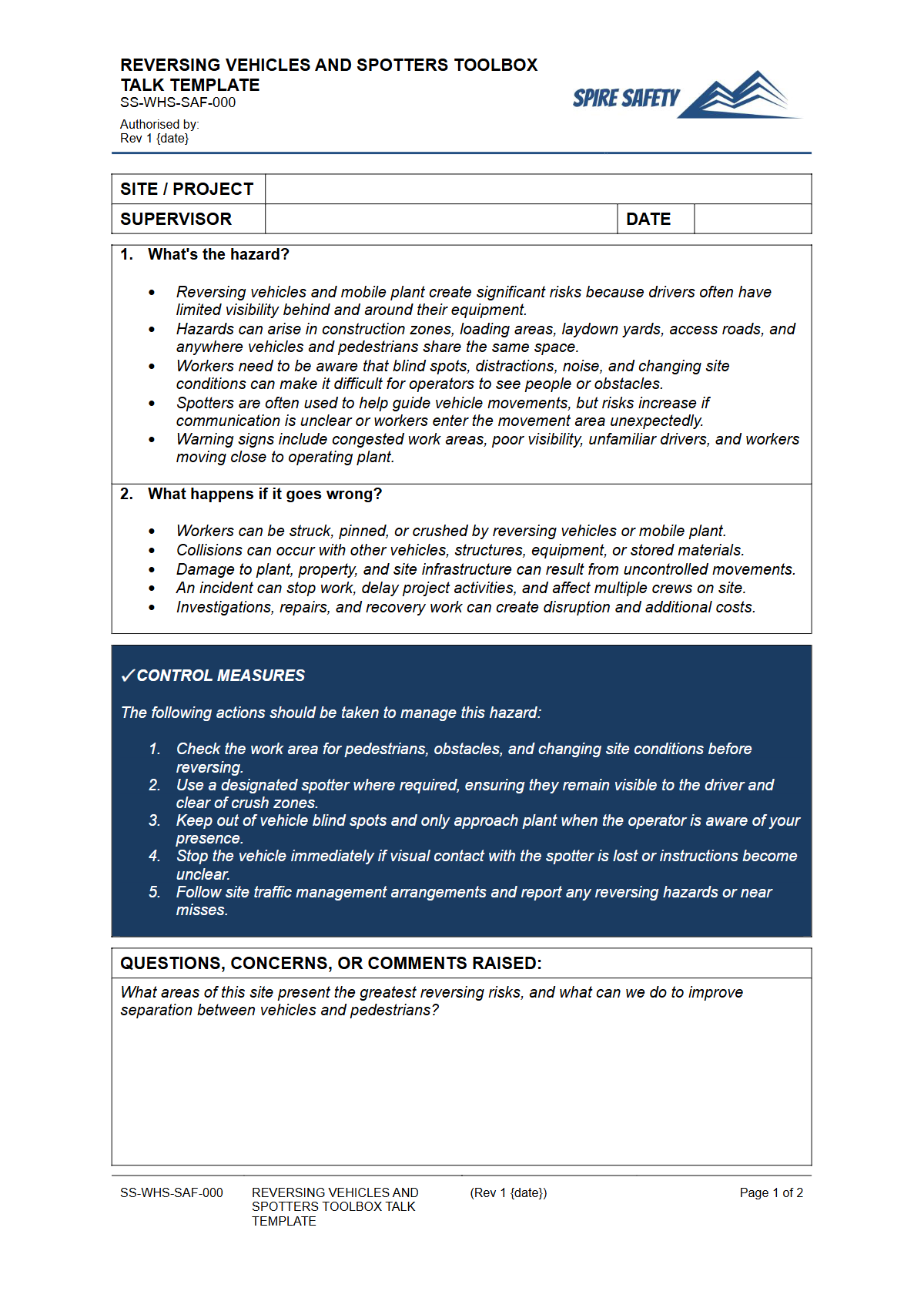
Reversing Vehicles and Spotters Toolbox Talk Template
Download our free Reversing Vehicles and Spotters Toolbox Talk Template (DOCX/PDF) for a structured discussion on improving workplace safety.
Reversing Vehicles and Spotters Toolbox Talk Template
DOCX • 138 KB + PDF
Updated Oct 2026
No signup required
Purpose of this document
Our Reversing Vehicles and Spotters Toolbox Talk Template provides a structured framework for facilitating a critical safety discussion in your workplace. This template is designed to help organisations address the significant risks associated with reversing vehicles and the vital role of spotters in preventing incidents. Vehicular movements, particularly reversing operations, are a common cause of workplace accidents, ranging from minor collisions to severe injuries or fatalities involving pedestrians and other plant equipment. This resource supports your proactive approach to WHS by enabling focused, regular safety communication.
By using this template, you can effectively remind your team about safe reversing procedures, the responsibilities of both vehicle operators and spotters, and the importance of clear communication. It encourages open dialogue about potential hazards specific to your work environment and helps reinforce safe work practices, aligning with Australian WHS practice for managing plant and traffic management risks.
Regular toolbox talks on topics like reversing vehicles and spotters are an integral part of maintaining a robust safety culture and are key to continually improving your WHS management systems. They serve as a practical mechanism for ongoing training, instruction, and consultation with workers on health and safety matters, helping to identify and control risks before they lead to adverse events.
Video walkthrough
How to use this Toolbox Talk
This Reversing Vehicles and Spotters Toolbox Talk Template is provided as a foundational document in both DOCX and PDF formats. To effectively implement it within your organisation, download the DOCX version and customise it to reflect your specific work environment, plant, procedures, and risks. It must be customised to your workplace and its specific hazards and control measures.
Before conducting the toolbox talk, review the content and add details relevant to your site. Consider:
Specific types of reversing vehicles used (e.g., forklifts, trucks, excavators).
Common reversing routes or areas in your workplace.
Existing site traffic management plans.
Current communication protocols between operators and spotters.
Recent near misses or incidents related to vehicle movements.
Any unique environmental factors (e.g., blind spots, noise, weather conditions).
Lead the discussion, encouraging active participation from all attendees. Document attendance and any actions identified during the talk. This record serves as evidence of your commitment to ongoing safety training and risk management. Remember that a toolbox talk is an opportunity for two-way communication, allowing workers to raise concerns and contribute to finding practical safety solutions.
When to use it
This Reversing Vehicles and Spotters Toolbox Talk Template is ideal for regular use as part of your ongoing WHS program. It should be used:
Prior to commencing work involving vehicle reversing operations, especially when new plant or personnel are introduced.
As a refresher training session for all workers involved in or near vehicle movements.
Following any near-miss incidents or minor accidents related to reversing vehicles or ineffective spotting.
When reviewing or updating your site's traffic management plan or safe operating procedures.
As part of induction training for new employees who will be working in areas with reversing vehicles.
Monthly or quarterly as part of your scheduled toolbox talk program to maintain safety awareness.
Who should use it
This template is designed for use by:
Supervisors and Team Leaders: To facilitate engaging and informative safety discussions with their teams.
WHS Managers and Officers: To ensure consistent messaging and high standards of safety across the organisation.
Site Managers: To reinforce site-specific safety rules and expectations regarding vehicle movements.
Safety Committees: As a resource to promote discussion and identify areas for improvement in vehicle and pedestrian safety.
Induction Trainers: To provide essential information to new workers about vehicle reversing risks and spotter requirements.
Ultimately, anyone responsible for managing safety or conducting training in workplaces where reversing vehicles operate will find this template a valuable addition to their free WHS resources library. Furthermore, it can contribute to the requirements for ISO 45001 certification by demonstrating proactive hazard identification and control.
Common mistakes
Common mistakes to avoid
- Inadequate communication between operator and spotter.
- Spotters entering the vehicle's blind spots or danger zones.
- Lack of site-specific training for operators and spotters.
- Failing to establish clear exclusion zones for pedestrians during reversing operations.
Legal references
Legal considerations
The following legal requirements may be relevant to this type of work.
- Work Health and Safety Act (Harmonised) — Provides the primary duties for protecting workers and other people from work health and safety risks.
- Work Health and Safety Regulations (Harmonised) — Sets out requirements supporting the management of workplace hazards and risks.
The following codes may be relevant to this type of work.
- Managing WHS Risks Code of Practice — Provides practical guidance on identifying hazards, assessing risks and applying effective controls.
- Work Health and Safety Consultation, Cooperation and Coordination Code of Practice — Provides practical guidance on consulting workers and coordinating with other duty holders.
- Managing the Work Environment and Facilities Code of Practice — Provides practical guidance on safe work environments, workplace facilities and related controls.
Did you know
Blind Spots Are Dangerous
Large vehicles can have multiple and extensive blind spots, making it extremely difficult for operators to see everything around them. Spotters are essential to cover these unseen areas.
Common Cause of Fatality
Workplace incidents involving reversing vehicles are a significant cause of serious injuries and fatalities in Australia. Effective spotting and traffic management are critical preventative measures.
FAQ
Frequently asked questions
01What is the primary role of a spotter for reversing vehicles?
02What communication methods should be used between an operator and a spotter?
03When is a spotter typically required for reversing vehicles?
04What training should a spotter receive before performing their duties?
Share this resource
Reversing Vehicles and Spotters Toolbox Talk Template
Browse Categories
How To Use It
- 1Download and open in Word or PDF.
- 2Replace the placeholders with your business details.
- 3Get it reviewed by a WHS specialist before rollout.
Need it customised?
Our WHS consultants can adapt this template to your site, run a gap analysis, or audit what you already have in place.
Book a Free Consultation WHS consulting servicesor call 1300 156 382