
Safety Culture and Speaking Up Toolbox Talk Template
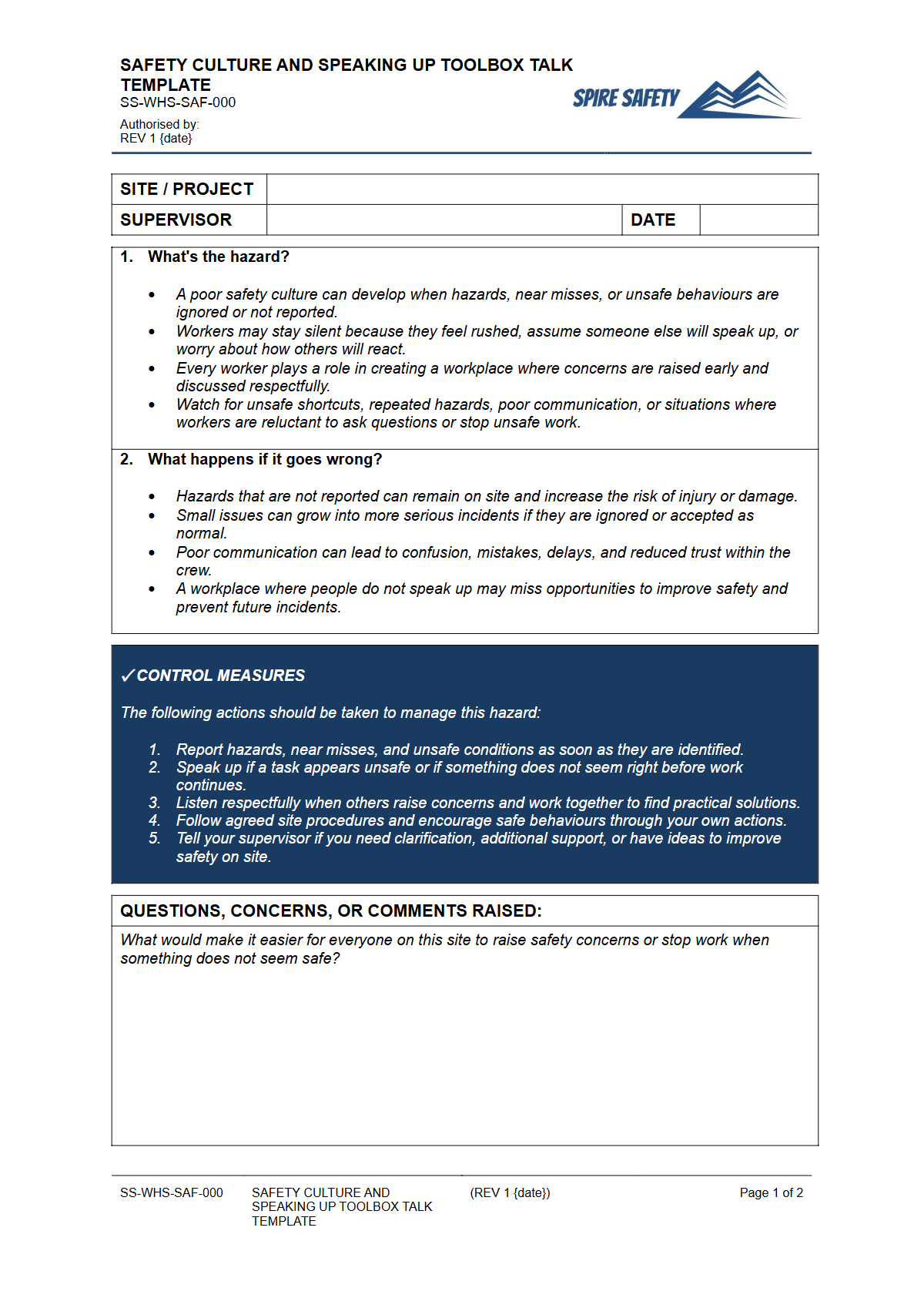
Download our free Safety Culture and Speaking Up Toolbox Talk template. Improve workplace safety by fostering open communication. Get your copy today!
Safety Culture and Speaking Up Toolbox Talk Template
DOCX • 142 KB + PDF
Updated Oct 2026
No signup required
Purpose of this document
This Safety Culture and Speaking Up Toolbox Talk template is designed to help Australian businesses foster a positive safety culture where workers feel empowered to identify hazards, report incidents, and suggest safety improvements without fear of reprisal. A strong safety culture is fundamental to effective WHS management, contributing directly to the physical and psychological well-being of your team.
The template provides a structured format to discuss critical aspects of safety culture, including the importance of open communication, active participation in WHS processes, and the mechanism for workers to speak up about safety concerns. It reinforces the idea that safety is a shared responsibility and that every worker has a vital role to play in maintaining a safe and healthy workplace.
By regularly engaging in discussions around these topics, organisations can embed safety as a core value, moving beyond mere compliance to genuine commitment.
Video walkthrough
How to use this Toolbox Talk
This Toolbox Talk template provides a foundational structure for discussing safety culture and speaking up. To be effective, you must customise it to your specific workplace, its operations, and any identified WHS risks. Review all sections, add details relevant to your context, and include specific examples from your operations.
Focus on recent incidents, near misses, or safety improvements relevant to your team. Facilitate an open discussion, encouraging questions and input from all participants.
Record attendance and any actions or suggestions raised during the talk. Integrate this into your broader WHS management systems to ensure consistency and reinforce safety messaging across your organisation.
When to use it
This Safety Culture and Speaking Up Toolbox Talk template is ideal for regular safety meetings, such as weekly or monthly team briefings, project kick-offs, or following a significant organisational change. It's particularly useful after an incident or near-miss to reinforce the importance of reporting and learning from events.
Organisations should also consider using it during induction for new employees to set expectations regarding safety behaviour and reporting from day one. Implementing these talks consistently helps maintain safety awareness and reinforces the organisation's commitment to a proactive safety culture.
Who should use it
This resource is suitable for WHS managers, supervisors, team leaders, and business owners responsible for conducting safety briefings and fostering a positive safety culture within their Australian workplaces. It provides a valuable tool for anyone tasked with communicating WHS expectations, encouraging worker participation, and driving continuous improvement in safety performance.
While primarily aimed at those facilitating the talks, the content is designed to be accessible and engaging for all workers, promoting their active involvement in workplace safety discussions. Regular use of resources like this supports a robust WHS consulting approach.
Common mistakes
Common mistakes to avoid
- Not customising the template to specific workplace risks or recent events.
- Failing to actively encourage worker participation and feedback during the talk.
- Not following up on actions or suggestions raised by workers.
- Treating the Toolbox Talk as a 'tick-box' exercise rather than a genuine discussion.
Legal references
Legal considerations
The following legal requirements may be relevant to this type of work.
- Work Health and Safety Act (Harmonised) — Provides the primary duties for protecting workers and other people from work health and safety risks.
- Work Health and Safety Regulations (Harmonised) — Sets out requirements supporting the management of workplace hazards and risks.
The following codes may be relevant to this type of work.
- Managing WHS Risks Code of Practice — Provides practical guidance on identifying hazards, assessing risks and applying effective controls.
- Work Health and Safety Consultation, Cooperation and Coordination Code of Practice — Provides practical guidance on consulting workers and coordinating with other duty holders.
- Managing the Work Environment and Facilities Code of Practice — Provides practical guidance on safe work environments, workplace facilities and related controls.
Did you know
Positive impact of safety culture
Organisations with a strong safety culture typically experience fewer incidents, lower insurance premiums, and improved worker morale and productivity. It's an investment that yields significant returns not just in safety, but also in overall business performance.
Psychological safety benefits
A workplace where workers feel psychologically safe to speak up about WHS concerns also fosters an environment where they are more likely to innovate and share ideas beyond safety, benefiting the entire organisation.
FAQ
Frequently asked questions
01What is meant by 'safety culture'?
02Why is it important for workers to speak up about safety concerns?
03How can our organisation encourage workers to speak up?
04Is this Safety Culture and Speaking Up Toolbox Talk template aligned with Australian WHS laws?
Share this resource
Safety Culture and Speaking Up Toolbox Talk Template
Browse Categories
How To Use It
- 1Download and open in Word or PDF.
- 2Replace the placeholders with your business details.
- 3Get it reviewed by a WHS specialist before rollout.
Need it customised?
Our WHS consultants can adapt this template to your site, run a gap analysis, or audit what you already have in place.
Book a Free Consultation WHS consulting servicesor call 1300 156 382