
Situational Awareness Toolbox Talk Template
Download our free Situational Awareness Toolbox Talk Template (DOCX/PDF) to help brief your team on workplace hazards. Customise it today!
Situational Awareness Toolbox Talk Template
DOCX • 142 KB + PDF
Updated Oct 2026
No signup required
Purpose of this document
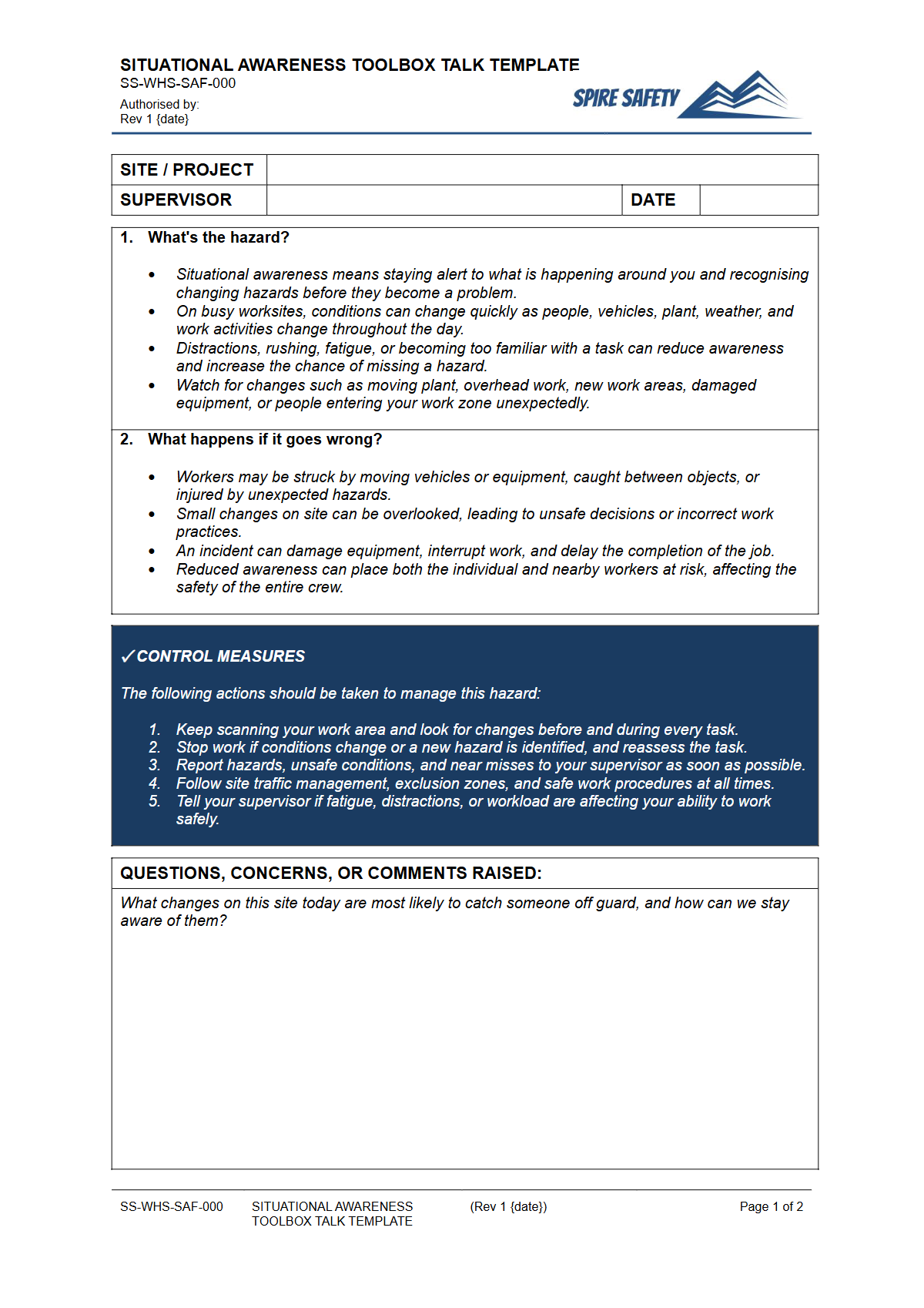
This free Situational Awareness Toolbox Talk Template is a structured starting point for discussing the critical safety concept of situational awareness in your workplace. Recognising and understanding the elements in your environment, comprehending their meaning, and projecting their future status are fundamental to preventing incidents and maintaining a safe working environment.
This template provides a framework to help workers understand the importance of being alert to their surroundings, recognising potential hazards, and anticipating changes that could impact their safety or the safety of others.
By regularly discussing situational awareness through toolbox talks, organisations can foster a proactive safety culture where every worker contributes to identifying and mitigating risks. This document is aligned with Australian WHS practice and encourages open dialogue about how individual and team awareness impacts overall workplace safety.
Video walkthrough
How to use this Toolbox Talk
Our Situational Awareness Toolbox Talk Template is provided in an editable DOCX format, making it easy for you to tailor it to your specific workplace context, industry, and the particular hazards your team faces. It also includes a PDF version for quick reference or distribution. To use this template effectively:
- Download the DOCX file and open it in your preferred word processor.
- Review the content and customise all sections marked with bracketed prompts (e.g., [Insert Company Name], [Specific Workplace Hazard]).
- Add real-world examples from your workplace or industry to make the discussion relevant and impactful.
- Prepare any visual aids, equipment, or scenarios that might help illustrate the concepts during the talk.
- Encourage questions and active participation from your team to ensure understanding and engagement.
- Document attendance and follow up on any actions identified during the discussion.
Remember, this template is a guide. It absolutely must be customised to your workplace's specific risks, procedures, and conditions.
As the employer, you are responsible for ensuring the content is accurate and directly applicable to your operations before presenting it to your workers.
When to use it
A Situational Awareness Toolbox Talk can be highly effective when delivered in various scenarios to reinforce safety principles:
- Before commencing work on a new project or task, especially one with unfamiliar elements or heightened risks.
- Regularly, as part of your routine safety briefings, to maintain a consistent focus on vigilance.
- Following an incident or near-miss where a lack of situational awareness was identified as a contributing factor.
- When there are changes in work procedures, equipment, or the work environment that require workers to adapt their awareness.
- As part of induction training for new employees to establish a strong safety foundation from day one.
- During periods of high workload or stress, when situational awareness can naturally diminish, to remind workers of its importance.
Who should use it
This Situational Awareness Toolbox Talk is an invaluable resource for anyone responsible for leading team discussions on WHS and fostering a strong safety culture. This includes:
- Supervisors, team leaders, and foremen who conduct daily or weekly safety briefings.
- WHS officers and safety managers implementing broader WHS programs and looking to enhance their WHS management systems.
- Project managers overseeing teams in various operational settings.
- Anyone facilitating training sessions that involve operational safety.
- Small business owners keen to improve safety communication and hazard identification within their teams.
It's a foundational element for ensuring that all workers, from new hires to seasoned professionals, consistently recognise and respond to potential hazards. For more resources like this, explore our free WHS resources library or consider WHS consulting for tailored guidance.
Common mistakes
Common mistakes to avoid
- Not customising the template to specific workplace hazards and tasks.
- Delivering the talk as a lecture rather than an interactive discussion.
- Failing to follow up on identified actions or concerns raised during the talk.
- Not documenting the session and attendance for WHS records.
Legal references
Legal considerations
The following legal requirements may be relevant to this type of work.
- Work Health and Safety Act (Harmonised) — Provides the primary duties for protecting workers and other people from work health and safety risks.
- Work Health and Safety Regulations (Harmonised) — Sets out requirements supporting the management of workplace hazards and risks.
The following codes may be relevant to this type of work.
- Managing WHS Risks Code of Practice — Provides practical guidance on identifying hazards, assessing risks and applying effective controls.
- Work Health and Safety Consultation, Cooperation and Coordination Code of Practice — Provides practical guidance on consulting workers and coordinating with other duty holders.
- Managing the Work Environment and Facilities Code of Practice — Provides practical guidance on safe work environments, workplace facilities and related controls.
Did you know
Impact of Fatigue
Fatigue significantly impairs situational awareness, leading to slower reaction times and reduced ability to perceive hazards. Adequate rest is a critical safety control.
Human Error Link
Approximately 80% of human errors in high-risk industries are linked to failures in situational awareness. Enhancing it can drastically reduce operational incidents.
FAQ
Frequently asked questions
01What specifically is meant by situational awareness in a workplace setting?
02How can I make this Situational Awareness Toolbox Talk engaging for my team?
03Why is regular training on situational awareness important?
04Can this template be adapted for different industries?
Share this resource
Situational Awareness Toolbox Talk Template
Browse Categories
How To Use It
- 1Download and open in Word or PDF.
- 2Replace the placeholders with your business details.
- 3Get it reviewed by a WHS specialist before rollout.
Need it customised?
Our WHS consultants can adapt this template to your site, run a gap analysis, or audit what you already have in place.
Book a Free Consultation WHS consulting servicesor call 1300 156 382
Related templates
- Slips Trips and Falls Toolbox Talk Template
- SS-WHS-SAF-000 Complacency and Routine Task Risk Toolbox Talk Template
- SS-WHS-SAF-000 Hand and Finger Injury Prevention Toolbox Talk Template
- Steel Erection Safety Toolbox Talk Template
- Stormwater and Waterway Protection Toolbox Talk Template
- Struck By Caught Between Hazards Toolbox Talk Template