
Slips Trips and Falls Toolbox Talk Template
Download your free Slips, Trips & Falls Toolbox Talk Template to engage your team on common workplace hazards. Customise easily for your WHS needs.
Slips Trips and Falls Toolbox Talk Template
DOCX • 140 KB + PDF
Updated Oct 2026
No signup required
Purpose of this document
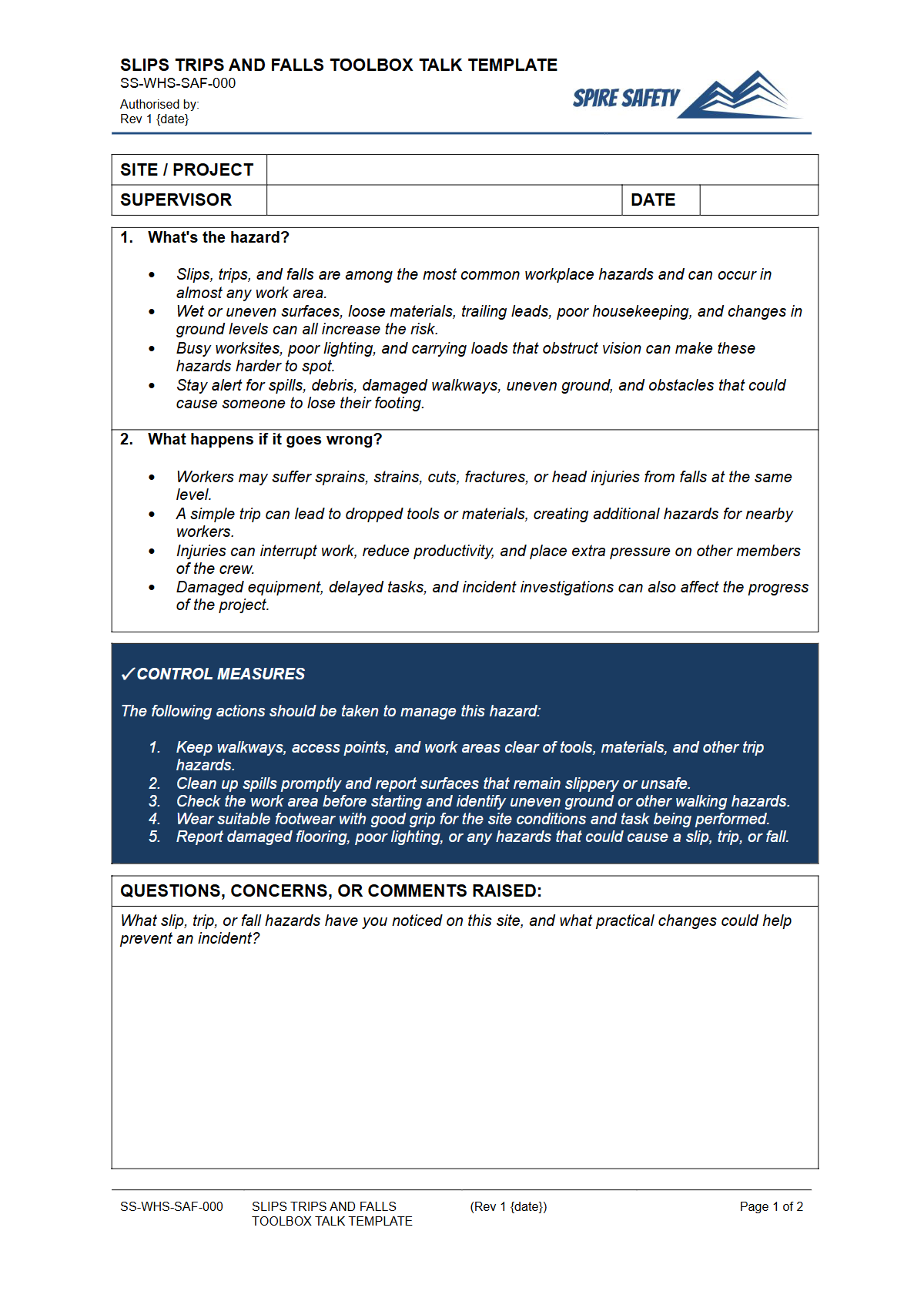
This Slips, Trips & Falls Toolbox Talk Template provides a structured starting point for conducting essential workplace safety discussions in Australia. Slips, trips, and falls are among the most common causes of workplace injuries, ranging from minor sprains to serious fractures and head trauma.
This template is designed to help organisations facilitate regular conversations with their workers about identifying, assessing, and controlling these pervasive risks.
By utilising this template, businesses can foster a proactive safety culture, ensuring that all personnel recognise potential hazards in their work environment and understand their roles in managing them. It’s a tool for continuous improvement, promoting awareness and practical risk mitigation strategies aligned with Australian WHS practice.
Regular toolbox talks, especially on fundamental topics like slips, trips, and falls, are crucial for maintaining a safe and healthy workplace and demonstrating an ongoing commitment to worker consultation and safety education.
Video walkthrough
How to use this Toolbox Talk
This Slips, Trips & Falls Toolbox Talk Template is provided in DOCX format (with a PDF version for reference) to allow for easy customisation. To effectively use this resource, we recommend the following steps:
- Download and Review: Obtain the DOCX file and review its contents thoroughly.
- Customise to Your Workplace: This template is a general guide. It must be customised to your specific workplace conditions, tasks, and identified hazards. Include examples of slip, trip, and fall hazards relevant to your site (e.g., specific walkways, machinery, floor types, environmental conditions).
- Add Company-Specific Information: Incorporate your company's logo, WHS policies, incident reporting procedures, and any unique control measures in place.
- Prepare the Discussion: Before conducting the toolbox talk, familiarise yourself with the content. Gather any visual aids such as photos of workplace hazards, relevant incident reports, or examples of effective control measures.
- Engage Workers: During the talk, encourage open discussion, questions, and worker input. Their practical experience is invaluable in identifying risks and developing effective solutions.
- Document Attendance and Outcomes: Record who attended, key discussion points, actions agreed upon, and who is responsible for follow-up. This documentation is vital for demonstrating due diligence and continuous improvement of your WHS management systems.
- Follow-Up: Ensure that all actions identified during the toolbox talk are completed and reviewed for effectiveness.
When to use it
This Slips, Trips & Falls Toolbox Talk Template is ideal for a variety of situations to reinforce safety awareness and practices:
- Regular Scheduled Toolbox Talks: Integrate it into your routine WHS meetings, such as weekly or monthly safety briefings.
- New Worker Induction: Use it as part of the onboarding process for new employees to familiarise them with common workplace hazards and your organisation's approach to managing them.
- Following an Incident: Conduct a specific toolbox talk after a slip, trip, or fall incident (or near-miss) to discuss lessons learned and reinforce preventative measures.
- Changes in the Work Environment: Introduce this discussion when there are changes to workplace layout, equipment, or processes that might introduce new slip, trip, or fall hazards.
- Seasonal Changes: Discuss during periods where environmental factors (e.g., wet weather, leaf litter, ice) might increase these risks.
- Refresher Training: Periodically use it as a refresher for all workers to maintain high levels of awareness and vigilance.
Who should use it
This Slips, Trips & Falls Toolbox Talk Template is a valuable resource for anyone responsible for WHS within an Australian organisation. This includes:
- Site Managers and Supervisors: Those directly overseeing work activities are critical in delivering these talks and monitoring adherence to safety protocols.
- WHS Officers and Coordinators: Professionals tasked with developing and implementing WHS programs will find this template useful for their broader safety initiatives. For more comprehensive support, consider our WHS consulting services.
- Team Leaders: Individuals who lead small teams can use this template to engage their direct reports in focused safety discussions.
- Safety Committees: Members of WHS committees can adapt and present this material to wider groups, ensuring collective responsibility and involvement in safety.
- Anyone with WHS Responsibilities: Any person who has a duty to ensure the health and safety of workers within their area of control can utilise this template as part of their due diligence.
Common mistakes
Common mistakes to avoid
- Not customising the template to specific workplace hazards and conditions.
- Failing to encourage active worker participation and feedback during the talk.
- Neglecting to document discussions, attendees, and agreed-upon actions.
- Not following up on identified actions or reviewing the effectiveness of control measures.
Legal references
Legal considerations
The following legal requirements may be relevant to this type of work.
- Work Health and Safety Act (Harmonised) — Provides the primary duties for protecting workers and other people from work health and safety risks.
- Work Health and Safety Regulations (Harmonised) — Sets out requirements supporting the management of workplace hazards and risks.
The following codes may be relevant to this type of work.
- Managing WHS Risks Code of Practice — Provides practical guidance on identifying hazards, assessing risks and applying effective controls.
- Work Health and Safety Consultation, Cooperation and Coordination Code of Practice — Provides practical guidance on consulting workers and coordinating with other duty holders.
- Managing the Work Environment and Facilities Code of Practice — Provides practical guidance on safe work environments, workplace facilities and related controls.
Did you know
Impact of Slips, Trips, and Falls
Slips, trips, and falls are consistently among the leading causes of workplace injuries in Australia, often resulting in significant lost time and productivity for businesses. Many of these incidents are preventable with proper hazard identification and control.
Preventative Power of Housekeeping
Good housekeeping is one of the simplest yet most effective control measures against slips, trips, and falls. Keeping workspaces tidy, clear of obstructions, and free from spills can drastically reduce risk.
FAQ
Frequently asked questions
01What is a 'Toolbox Talk' and why are they important?
02How often should we conduct Slips, Trips & Falls Toolbox Talks?
03Can this template help with WHS compliance?
04What are the common causes of slips, trips, and falls in the workplace?
Share this resource
Slips Trips and Falls Toolbox Talk Template
Browse Categories
How To Use It
- 1Download and open in Word or PDF.
- 2Replace the placeholders with your business details.
- 3Get it reviewed by a WHS specialist before rollout.
Need it customised?
Our WHS consultants can adapt this template to your site, run a gap analysis, or audit what you already have in place.
Book a Free Consultation WHS consulting servicesor call 1300 156 382
Related templates
- SS-WHS-SAF-000 Complacency and Routine Task Risk Toolbox Talk Template
- SS-WHS-SAF-000 Hand and Finger Injury Prevention Toolbox Talk Template
- Steel Erection Safety Toolbox Talk Template
- Stormwater and Waterway Protection Toolbox Talk Template
- Struck By Caught Between Hazards Toolbox Talk Template
- Sun Safety and Skin Cancer Prevention Toolbox Talk Template