
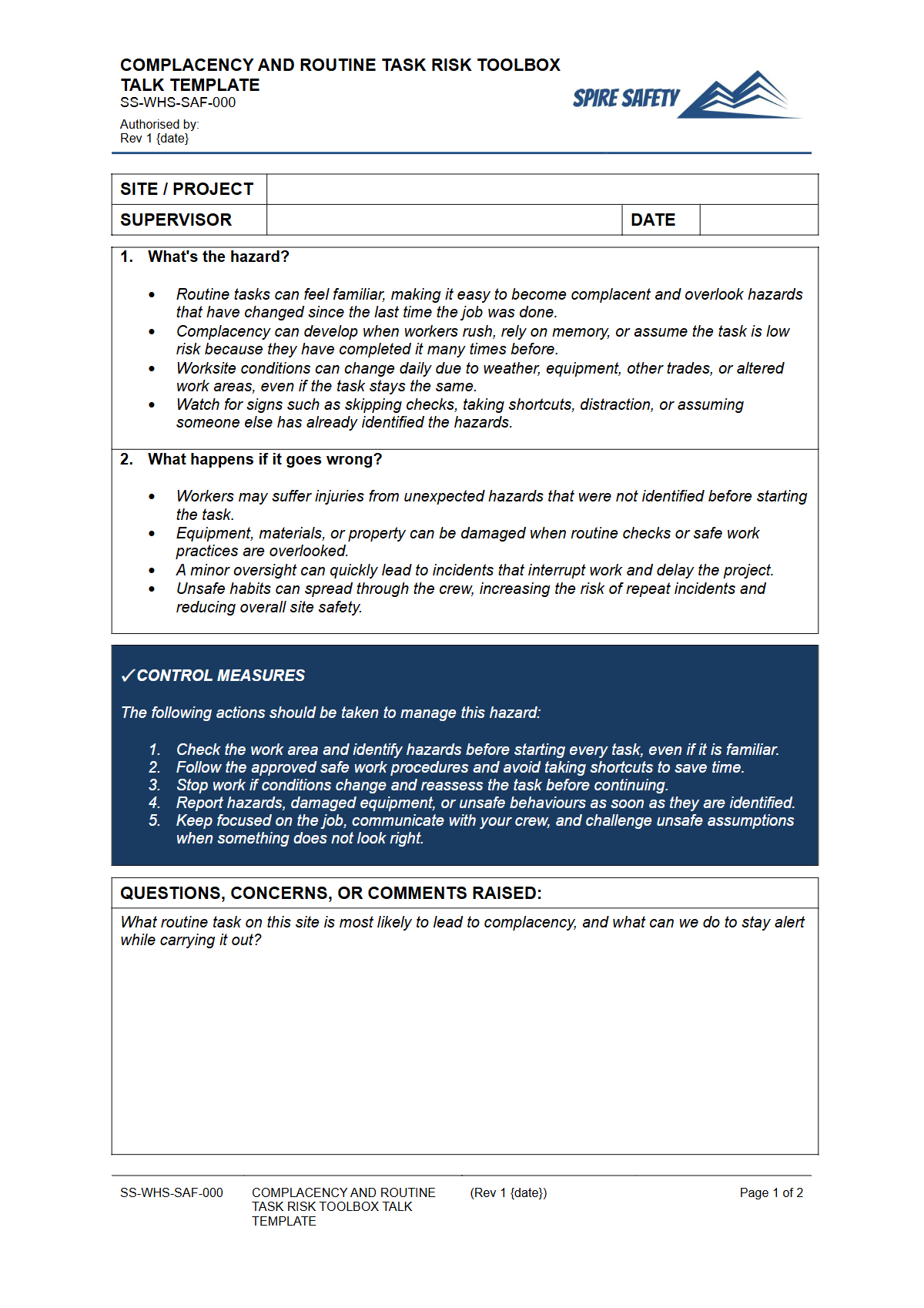
SS-WHS-SAF-000 Complacency and Routine Task Risk Toolbox Talk Template
Download this free Toolbox Talk template on complacency and routine task risk. A structured starting point for critical safety discussions. Get yours now!
SS-WHS-SAF-000 Complacency and Routine Task Risk Toolbox Talk Template
DOCX • 141 KB + PDF
Updated Oct 2026
No signup required
Purpose of this document
This free WHS resource, the SS-WHS-SAF-000 Complacency and Routine Task Risk Toolbox Talk Template, provides a structured framework for facilitating discussions about two common, yet often overlooked, workplace hazards: complacency and the risks associated with routine tasks. Over time, familiarity with tasks can lead to a reduction in attention to detail, a weakening of our perception of risk, and an increased likelihood of incidents.
This template is designed to help organisations raise awareness among workers about these dangers, encouraging a proactive approach to safety, even in the most familiar settings.
By using this Complacency and Routine Task Risk Toolbox Talk, you can help workers recognise the subtle signs of complacency and identify potential risks in their daily operations. The aim is to foster a culture where workers remain vigilant, continuously assess their environment, and never assume that 'because it’s always been done this way,' it’s inherently safe.
It serves as a reminder that safety is an ongoing commitment, regardless of how often a task is performed.
Video walkthrough
How to use this Toolbox Talk
This SS-WHS-SAF-000 Complacency and Routine Task Risk Toolbox Talk Template is provided as a downloadable DOCX file, with a PDF version for easy reference. Please note: This template must be customised to your specific workplace, tasks, and worker profiles. While it offers a valuable foundational structure, effective safety communication requires tailoring the content to directly address the unique hazards and operational context of your business.
Consider adding real-world examples from your workplace, encouraging open discussion, and documenting attendance and key takeaways.
Before conducting the Toolbox Talk, review the template thoroughly. Adapt the discussion points to reflect specific routine tasks performed by your team and any instances where complacency could lead to an incident.
Encourage participants to share their own experiences and observations. The goal is an interactive session that promotes genuine engagement and a deeper understanding of these risks, rather than a mere lecture. Effective use of this template contributes to a stronger safety culture, complementing your existing WHS management systems.
When to use it
The Complacency and Routine Task Risk Toolbox Talk is particularly valuable during times when:
- There's a perceived increase in minor incidents or near misses related to routine tasks.
- New workers are joining teams performing highly repetitive work.
- Following any incident investigation where complacency or a lack of attention to routine tasks was identified as a contributing factor.
- As part of regular safety meetings to reinforce core safety messages and maintain vigilance.
- During periods of high workload or stress, where attention to detail might naturally wane.
Who should use it
This Toolbox Talk template is intended for anyone responsible for conducting workplace health and safety discussions with their teams. This includes:
- Team Leaders and Supervisors
- Foremen and Site Managers
- Safety Officers and Coordinators
- Project Managers
- Anyone in a leadership role with direct reports performing work tasks.
While comprehensive WHS consulting can further enhance your safety framework, this template empowers internal leaders to drive daily safety awareness.
Common mistakes
Common mistakes to avoid
- Treating Toolbox Talks as a tick-box exercise rather than a genuine discussion.
- Failing to customise the generic template to specific workplace tasks and risks.
- Not documenting attendance or key takeaways from the discussion.
- Overlooking the psychological aspects of complacency, assuming workers are deliberately careless.
Legal references
Legal considerations
The following legal requirements may be relevant to this type of work.
- Work Health and Safety Act (Harmonised) — Provides the primary duties for protecting workers and other people from work health and safety risks.
- Work Health and Safety Regulations (Harmonised) — Sets out requirements supporting the management of workplace hazards and risks.
The following codes may be relevant to this type of work.
- Managing WHS Risks Code of Practice — Provides practical guidance on identifying hazards, assessing risks and applying effective controls.
- Work Health and Safety Consultation, Cooperation and Coordination Code of Practice — Provides practical guidance on consulting workers and coordinating with other duty holders.
- Managing the Work Environment and Facilities Code of Practice — Provides practical guidance on safe work environments, workplace facilities and related controls.
Did you know
Impact of Habituation
Our brains are wired to create habits for routine tasks, which conserves mental energy but can also bypass critical thought processes necessary for safety, leading to a phenomenon known as 'habituation to risk'.
The 'Swiss Cheese Model'
Complacency can be seen as weakening a 'slice of cheese' in the Swiss Cheese Model of accident causation, making it easier for multiple failures to align and lead to an incident, even when other safety barriers are in place.
FAQ
Frequently asked questions
01What is complacency in a WHS context?
02How do routine tasks increase risk?
03What are some practical strategies to combat complacency?
04Does this template cover all WHS regulations?
Share this resource
SS-WHS-SAF-000 Complacency and Routine Task Risk Toolbox Talk Template
Browse Categories
How To Use It
- 1Download and open in Word or PDF.
- 2Replace the placeholders with your business details.
- 3Get it reviewed by a WHS specialist before rollout.
Need it customised?
Our WHS consultants can adapt this template to your site, run a gap analysis, or audit what you already have in place.
Book a Free Consultation WHS consulting servicesor call 1300 156 382
Related templates
- SS-WHS-SAF-000 Hand and Finger Injury Prevention Toolbox Talk Template
- Steel Erection Safety Toolbox Talk Template
- Stormwater and Waterway Protection Toolbox Talk Template
- Struck By Caught Between Hazards Toolbox Talk Template
- Sun Safety and Skin Cancer Prevention Toolbox Talk Template
- Tiling Safety Toolbox Talk Template