
SS-WHS-SAF-000 Hand and Finger Injury Prevention Toolbox Talk Template
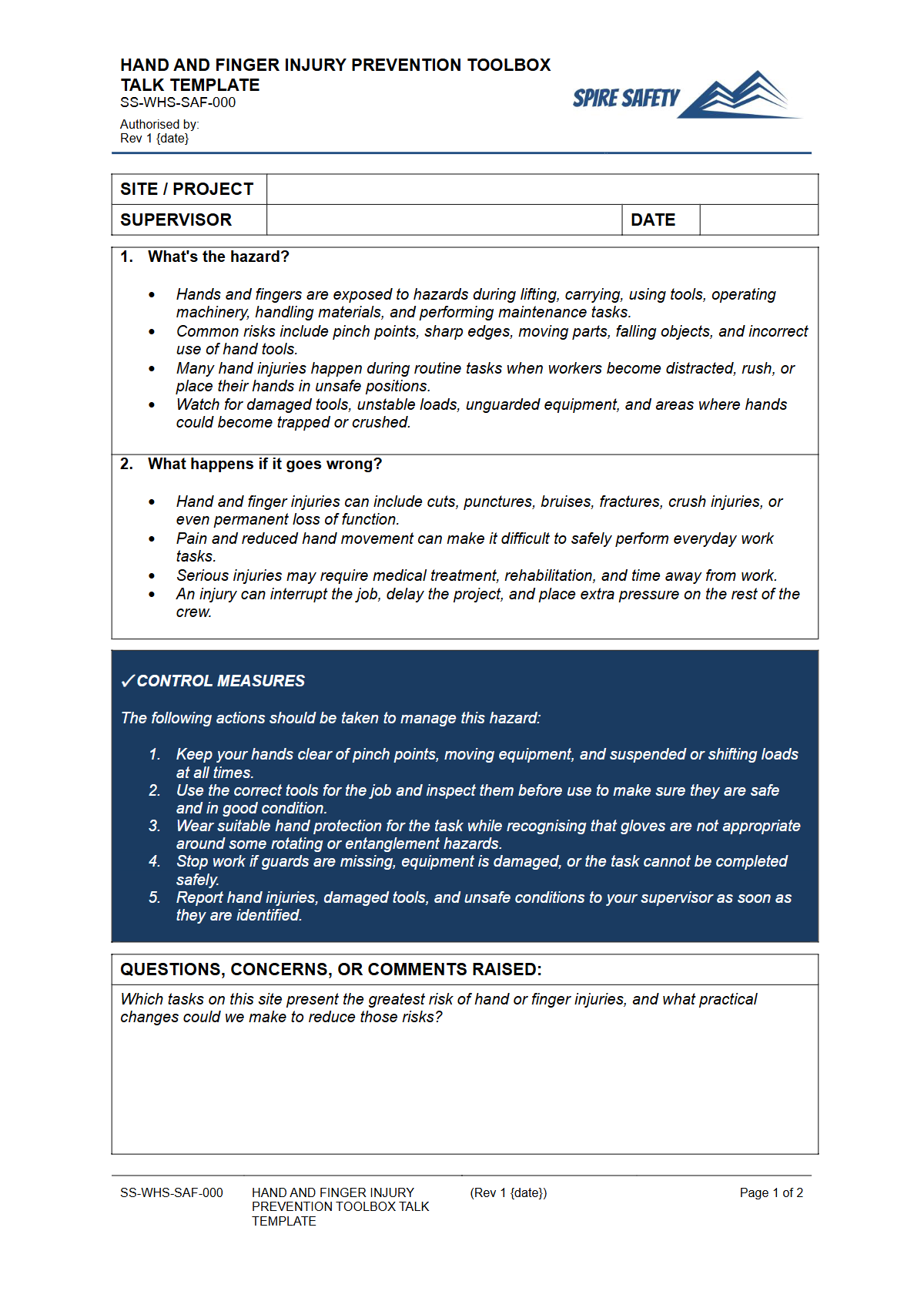
Download this free Hand and Finger Injury Prevention Toolbox Talk Template (SS-WHS-SAF-000) for a structured approach to workplace safety discussions.
SS-WHS-SAF-000 Hand and Finger Injury Prevention Toolbox Talk Template
DOCX • 139 KB + PDF
Updated Oct 2026
No signup required
Purpose of this document
The SS-WHS-SAF-000 Hand and Finger Injury Prevention Toolbox Talk Template provides a structured framework for conducting essential workplace safety discussions. This resource is designed to help organisations consistently address common hand and finger injury risks, a prevalent concern across many Australian industries. Utilising this Hand and Finger Injury Prevention Toolbox Talk Template ensures key safety messages are communicated effectively, promoting a safer working environment. It serves as a foundational tool for WHS managers, supervisors, and team leaders to facilitate regular, focused discussions about hazards and preventative measures during toolbox talks. By consistently reviewing and reinforcing safe work practices, organisations can significantly reduce the incidence of preventable injuries.
This template is aligned with Australian WHS practice, offering a practical way to integrate safety discussions into daily operations. It’s a crucial component for any WHS management system, supporting the ongoing education and awareness of all workers regarding critical safety practices.
Video walkthrough
How to use this Toolbox Talk
This Hand and Finger Injury Prevention Toolbox Talk Template is provided in an editable DOCX format, allowing for straightforward customisation to suit your specific workplace hazards and operational procedures. To effectively use this template:
- Download the DOCX file.
- Review the content, identifying sections that require modification or additional detail relevant to your site.
- Clearly define specific hand and finger injury risks present in your workplace (e.g., machinery pinch points, sharp objects, chemical exposure, repetitive tasks).
- Outline the control measures already in place and any new or reinforced actions required.
- Add details about your specific Personal Protective Equipment (PPE) requirements related to hand safety.
- Incorporate real-world examples or incidents from your workplace, if appropriate and de-identified, to make the discussion more tangible.
- Plan for engagement: encourage workers to share their experiences, ask questions, and contribute to identifying effective solutions.
- Always ensure the 'must be customised to your workplace' note remains clearly visible if you adapt the template for broader use; remember, compliance with WHS legislation depends on how you adapt and apply it to your specific context.
- Present the toolbox talk clearly and concisely, encouraging open dialogue.
- Document attendance and key discussion points for future reference and WHS record-keeping.
When to use it
This Toolbox Talk template is ideal for regular safety briefings, particularly:
- Before commencing tasks identified as having a high risk of hand or finger injuries.
- As part of routine weekly or monthly safety meetings.
- Following any incident or near-miss involving hand or finger injuries to reinforce preventative measures.
- When new equipment, processes, or substances are introduced that could impact hand safety.
- For induction training of new workers or contractors.
- As a refresher during periods of heightened activity or when injury rates show an upward trend.
Who should use it
The SS-WHS-SAF-000 Hand and Finger Injury Prevention Toolbox Talk Template is an invaluable resource for:
- WHS Managers and Coordinators responsible for overseeing safety programs.
- Supervisors and Team Leaders who conduct daily or weekly briefings with their teams.
- Site Managers responsible for overall workplace safety and operational efficiency.
- Project Managers overseeing temporary work sites or specific projects with manual tasks.
- Anyone facilitating safety education and risk management within an Australian organisation.
By effectively utilising tools like this, organisations can move towards achieving ISO 45001 certification, demonstrating a commitment to world-class occupational health and safety standards. For more useful documents, explore our free WHS resources library.
Common mistakes
Common mistakes to avoid
- Not customising the template to specific workplace hazards and tasks.
- Delivering the Toolbox Talk as a lecture rather than an interactive discussion.
- Failing to document attendance and key points discussed.
- Not following up on actions or suggestions raised during the talk.
Legal references
Legal considerations
The following legal requirements may be relevant to this type of work.
- Work Health and Safety Act (Harmonised) — Provides the primary duties for protecting workers and other people from work health and safety risks.
- Work Health and Safety Regulations (Harmonised) — Sets out requirements supporting the management of workplace hazards and risks.
The following codes may be relevant to this type of work.
- Managing WHS Risks Code of Practice — Provides practical guidance on identifying hazards, assessing risks and applying effective controls.
- Work Health and Safety Consultation, Cooperation and Coordination Code of Practice — Provides practical guidance on consulting workers and coordinating with other duty holders.
- Managing the Work Environment and Facilities Code of Practice — Provides practical guidance on safe work environments, workplace facilities and related controls.
Did you know
Impact of Hand Injuries
Hand and finger injuries are among the most frequently reported incidents in many Australian workplaces, often leading to significant downtime and rehabilitation periods.
Prevention through Planning
Effective planning and consistent communication through tools like this Hand and Finger Injury Prevention Toolbox Talk Template can significantly reduce the risk and severity of these common injuries.
FAQ
Frequently asked questions
01What is a Toolbox Talk?
02Why are hand and finger injuries so common in Australian workplaces?
03How can I make the Toolbox Talk more engaging for my team?
04Are Toolbox Talks legally required in Australia?
Share this resource
SS-WHS-SAF-000 Hand and Finger Injury Prevention Toolbox Talk Template
Browse Categories
How To Use It
- 1Download and open in Word or PDF.
- 2Replace the placeholders with your business details.
- 3Get it reviewed by a WHS specialist before rollout.
Need it customised?
Our WHS consultants can adapt this template to your site, run a gap analysis, or audit what you already have in place.
Book a Free Consultation WHS consulting servicesor call 1300 156 382