
Towing and Load Securing Toolbox Talk Template
Improve workplace safety with our free Towing and Load Securing Toolbox Talk Template.
Towing and Load Securing Toolbox Talk Template
DOCX • 138 KB + PDF
Updated Oct 2026
No signup required
Purpose of this document
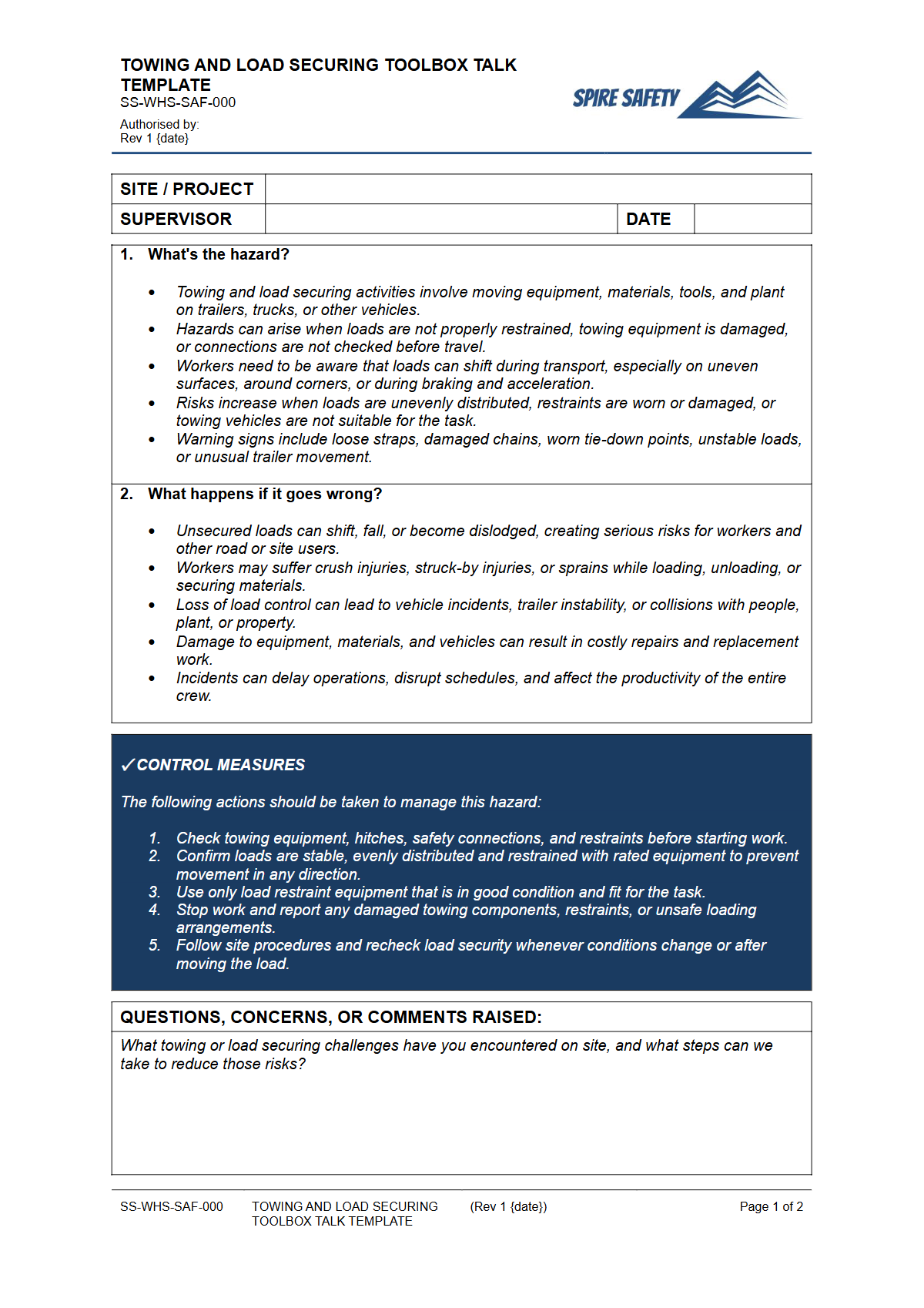
This Towing and Load Securing Toolbox Talk Template provides a structured framework for conducting essential safety discussions in your workplace. This template is designed to help facilitate conversations about critical aspects of safe towing practices, including vehicle inspection, coupling procedures, load distribution, securing methods, and hazard identification related to towing operations. It aims to reinforce safe work practices and prevent incidents involving towed plant, equipment, or materials.
Using this template supports a proactive approach to risk management, aligning with principles of effective WHS management systems by promoting regular safety communication and hazard awareness among workers involved in towing and load securing tasks.
Video walkthrough
How to use this Toolbox Talk
Download this free template in DOCX or PDF format. The DOCX version is fully editable, allowing you to tailor the content to your specific workplace operations, types of vehicles, plant, and common loads. It includes sections for discussion points, hazard identification, control measures, and worker sign-offs. Remember, this template is a starting point; it must be customised to your workplace’s specific risks, procedures, and equipment. Supplement discussions with practical demonstrations where appropriate, and encourage active participation from all attendees. Consider integrating this toolbox talk into your broader WHS consulting strategy.
When to use it
This Towing and Load Securing Toolbox Talk Template is suitable for regular safety meetings, particularly before commencing new projects involving towing, when new equipment or vehicles are introduced, or after any near-misses or incidents related to towing and load securing. It’s also valuable for new employee inductions or as a refresher for experienced workers. Incorporate it into your routine WHS schedule to maintain a high level of safety awareness and competence.
Who should use it
This template is ideal for WHS officers, supervisors, team leaders, and managers responsible for overseeing operations that involve towing and load securing. It is also highly beneficial for all workers involved in operating vehicles with trailers, transporting equipment, or manual handling of loads requiring securing. Essentially, any personnel whose role includes, or interacts with, towing operations will benefit from the discussions facilitated by this template.
FAQs
Common mistakes
Common mistakes to avoid
- Not checking vehicle and trailer coupling mechanisms (e.g., tow ball, pintle hook) before every tow.
- Underestimating load weight or miscalculating tongue weight, leading to instability.
- Using worn, damaged, or incorrect load securing equipment (e.g., ropes instead of rated straps).
- Failing to conduct a final walk-around check of the load and securing methods before departure.
Legal references
Legal considerations
The following legal requirements may be relevant to this type of work.
- Work Health and Safety Act (Harmonised) — Provides the primary duties for protecting workers and other people from work health and safety risks.
- Work Health and Safety Regulations (Harmonised) — Sets out requirements supporting the management of workplace hazards and risks.
The following codes may be relevant to this type of work.
- Managing WHS Risks Code of Practice — Provides practical guidance on identifying hazards, assessing risks and applying effective controls.
- Work Health and Safety Consultation, Cooperation and Coordination Code of Practice — Provides practical guidance on consulting workers and coordinating with other duty holders.
- Managing the Work Environment and Facilities Code of Practice — Provides practical guidance on safe work environments, workplace facilities and related controls.
Did you know
Road Rules Exception
Did you know that Australian road rules generally exempt workplace exemptions for certain vehicle standards when operating exclusively on private property, but WHS obligations for safe vehicle and load operation still apply rigorously?
Load Shift Statistics
Improperly secured loads are a significant cause of road incidents and workplace injuries, with many incidents occurring due to sudden braking causing load shifts, highlighting the importance of correct securing methods.
FAQ
Frequently asked questions
01What is a Toolbox Talk?
02How often should I conduct Toolbox Talks on towing and load securing?
03Can this template replace formal training?
04Where can I find more free WHS resources?
Share this resource
Towing and Load Securing Toolbox Talk Template
Browse Categories
How To Use It
- 1Download and open in Word or PDF.
- 2Replace the placeholders with your business details.
- 3Get it reviewed by a WHS specialist before rollout.
Need it customised?
Our WHS consultants can adapt this template to your site, run a gap analysis, or audit what you already have in place.
Book a Free Consultation WHS consulting servicesor call 1300 156 382
Related templates
- Traffic Management Toolbox Talk Template
- Trolleys and Stock Handling Toolbox Talk Template
- Underground Services Awareness Toolbox Talk Template
- Vibration - Hand Arm and Whole Body Toolbox Talk Template
- Visitor Safety Responsibilities Toolbox Talk Template
- Waste Management and Recycling Toolbox Talk Template