
Waste Management and Recycling Toolbox Talk Template
Download our free Waste Management and Recycling Toolbox Talk Template. A structured starting point for your team discussions on WHS risks and controls.
Waste Management and Recycling Toolbox Talk Template
DOCX • 137 KB + PDF
Updated Oct 2026
No signup required
Purpose of this document
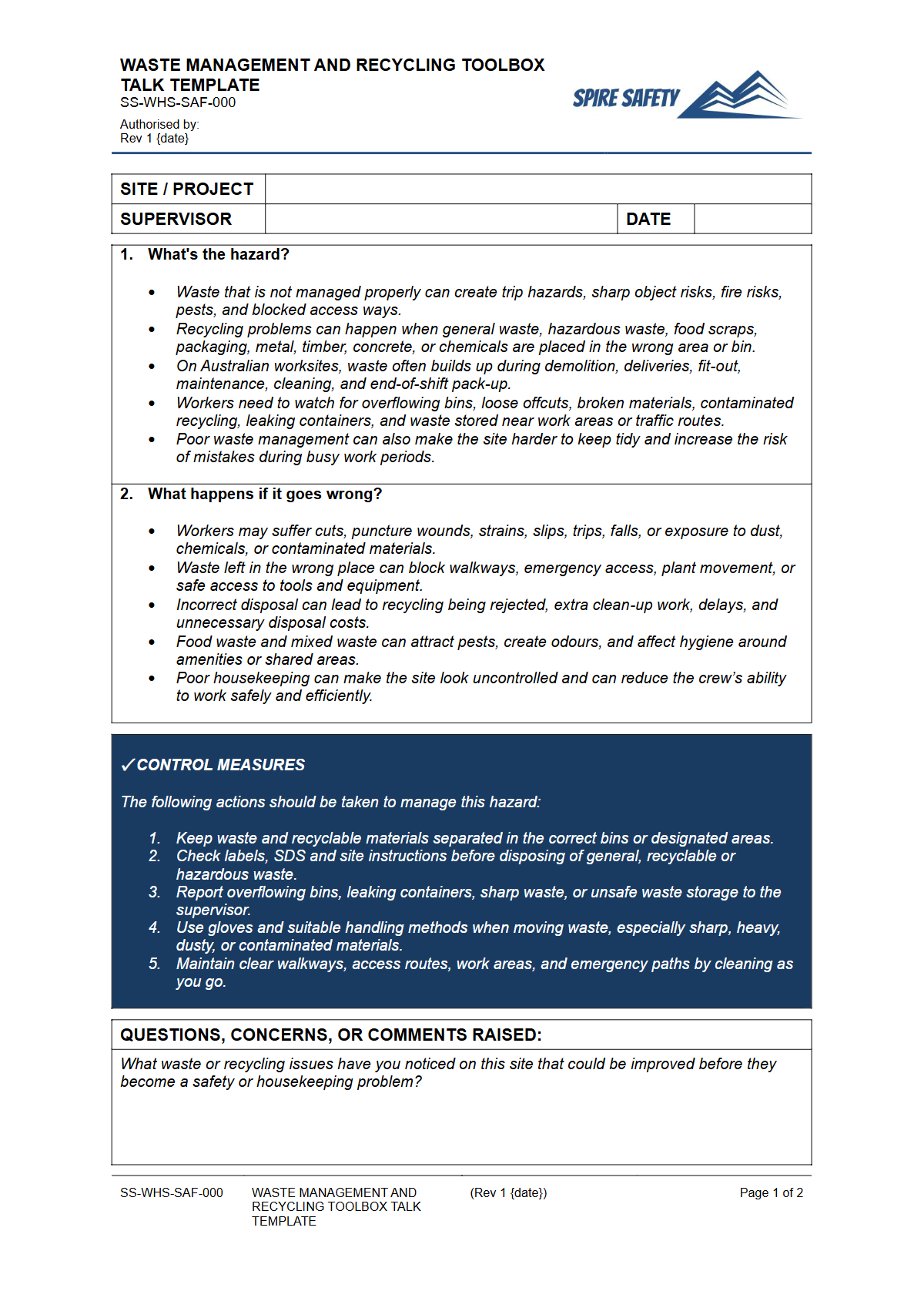
This free WHS resource provides a structured template for conducting a Waste Management and Recycling Toolbox Talk. Waste management and recycling activities, while essential, can introduce various workplace health and safety (WHS) hazards. These can range from manual handling injuries, exposure to hazardous chemicals, cuts from sharp objects, and risks associated with plant and equipment. This template is designed to help organisations facilitate discussions with their workers, ensuring everyone understands the potential risks involved and the control measures in place to mitigate them. By regularly discussing these topics, workplaces can proactively manage safety, fostering a culture of hazard identification and risk reduction. It serves as a foundational tool for promoting safe work practices within waste handling operations, aligned with Australian WHS practice.
Video walkthrough
How to use this Toolbox Talk
Our Waste Management and Recycling Toolbox Talk Template is provided in both DOCX and PDF formats for flexibility. The DOCX version is fully editable, allowing you to tailor the content to the specific hazards, risks, and control measures relevant to your workplace's waste management processes. It includes sections for outlining key discussion points, safety procedures, and an attendance sign-off sheet. Prior to conducting the toolbox talk, review the template thoroughly and customise it with examples pertinent to your operations. This might involve detailing types of waste handled, specific recycling equipment used, or unique site-specific considerations. Remember to incorporate any incidents or near misses related to waste management that have occurred in your workplace to highlight lessons learned. After customisation, present the information clearly and encourage active participation from your team. This template is a starting point; it must be customised to your workplace's specific hazards, risks, and control measures to be effective and relevant.
When to use it
This Waste Management and Recycling Toolbox Talk Template should be used regularly to maintain awareness and reinforce safe work practices. Key times to utilise this resource include:
Induction of new workers: To introduce them to safe waste management and recycling procedures from day one.
Prior to commencing new projects or tasks: Especially when new types of waste are introduced, or new recycling processes are implemented.
Following an incident or near-miss: To review contributing factors and reinforce preventative measures.
During routine safety meetings: As part of an ongoing WHS program to refresh worker knowledge and address emerging concerns.
After a change in procedures or equipment: To ensure all workers are aware of updated methods or new plant associated with waste handling.
Annually or semi-annually: As a scheduled review of WHS protocols related to waste management and recycling.
Regular application of this and other WHS management systems elements helps to embed safety into daily operations.
Who should use it
This resource is primarily intended for individuals responsible for WHS management and supervision within any Australian workplace where waste is generated, handled, stored, or recycled. This includes:
WHS Managers and Coordinators: To develop and implement consistent safety messaging.
Supervisors and Team Leaders: To facilitate direct discussions with their teams on a regular basis.
Site Managers: To ensure overall compliance and a safe working environment.
Business Owners and Directors: To understand their obligations and provide resources for effective WHS.
WHS Committees and Health and Safety Representatives (HSRs): To contribute to safety dialogue and represent worker concerns.
Ultimately, while designed for those leading the talks, the content is for all workers involved in waste management and recycling. Developing clear and effective communication and training materials is a core component of WHS consulting.
Common mistakes
Common mistakes to avoid
- Not customising the template to specific workplace hazards and controls.
- Failing to encourage worker participation and feedback during the talk.
- Not documenting attendance or topics discussed for record-keeping.
- Treating Toolbox Talks as a formality rather than an interactive safety discussion.
Legal references
Legal considerations
The following legal requirements may be relevant to this type of work.
- Work Health and Safety Act (Harmonised) — Provides the primary duties for protecting workers and other people from work health and safety risks.
- Work Health and Safety Regulations (Harmonised) — Sets out requirements supporting the management of workplace hazards and risks.
The following codes may be relevant to this type of work.
- Managing WHS Risks Code of Practice — Provides practical guidance on identifying hazards, assessing risks and applying effective controls.
- Work Health and Safety Consultation, Cooperation and Coordination Code of Practice — Provides practical guidance on consulting workers and coordinating with other duty holders.
- Managing the Work Environment and Facilities Code of Practice — Provides practical guidance on safe work environments, workplace facilities and related controls.
Did you know
Waste creates psychosocial risks
Poor waste management can contribute to psychosocial risks, including stress and low morale, due to cluttered workspaces, unpleasant odours, and potential for injury, impacting worker wellbeing.
Manual handling is a key risk
Many injuries in waste management occur due to hazardous manual tasks like lifting, carrying, and emptying bins. Proper techniques and mechanical aids are essential to mitigate these risks.
FAQ
Frequently asked questions
01What is a Toolbox Talk?
02Why is regular waste management training important?
03Does this template cover all types of waste?
04How can I ensure my Toolbox Talks are effective?
Share this resource
Waste Management and Recycling Toolbox Talk Template
Browse Categories
How To Use It
- 1Download and open in Word or PDF.
- 2Replace the placeholders with your business details.
- 3Get it reviewed by a WHS specialist before rollout.
Need it customised?
Our WHS consultants can adapt this template to your site, run a gap analysis, or audit what you already have in place.
Book a Free Consultation WHS consulting servicesor call 1300 156 382