
Working at Night - Security and Safety Toolbox Talk Template
Download our free 'Working at Night - Security and Safety Toolbox Talk Template'. A structured starting point for your team's WHS discussions.
Working at Night - Security and Safety Toolbox Talk Template
DOCX • 138 KB + PDF
Updated Oct 2026
No signup required
Purpose of this document
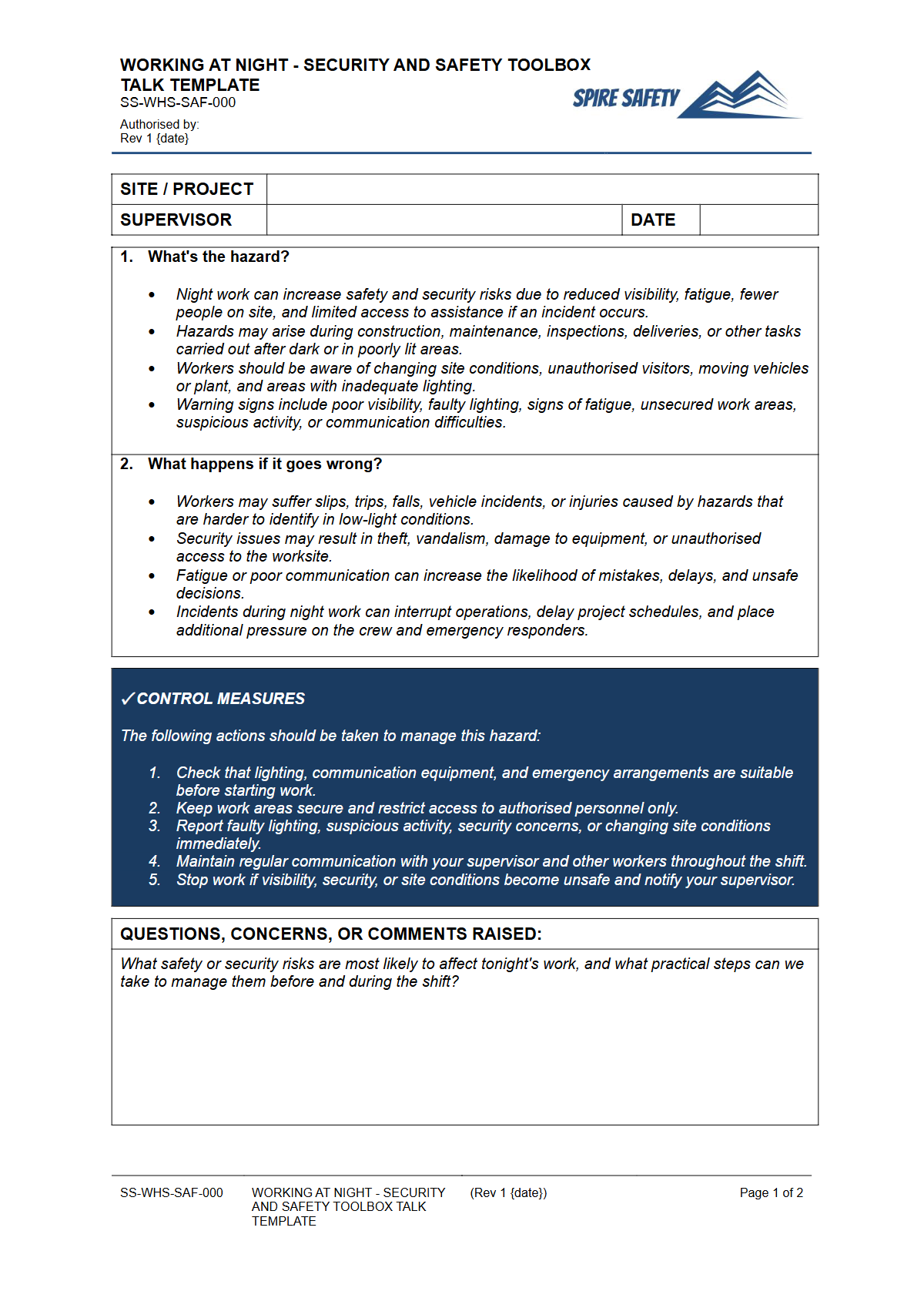
This Toolbox Talk template provides a foundational framework for discussing the unique safety and security considerations associated with working at night. It's designed to help Australian organisations facilitate meaningful conversations about the heightened risks, specific control measures, and essential procedures required to protect workers during night shifts.
By addressing topics such as reduced visibility, increased risk of incidents, mental alertness, fatigue management, and personal security, this template assists in fostering a proactive WHS culture.
The template encourages teams to identify and discuss potential hazards specific to their overnight operations, ranging from site security vulnerabilities to individual worker well-being. Using this resource helps ensure that all team members are aware of their responsibilities, understand emergency protocols, and know how to report incidents or concerns effectively.
It aligns with Australian WHS practice regarding risk identification and control measures, offering a practical tool for regular safety briefings.
Video walkthrough
How to use this Toolbox Talk
This document is provided as a downloadable DOCX template, ready for you to adapt and implement within your organisation. It serves as a discussion guide rather than a prescriptive checklist.
We recommend printing out copies or displaying it during your Toolbox Talk session. Encourage open dialogue, invite questions, and prompt team members to share their own experiences and insights related to working at night.
To get the most out of this template, leaders should familiarise themselves with its content beforehand and be prepared to facilitate an engaging and interactive session. Remember to document attendance and any key actions or discussions for your WHS records.
Critically, this template must be customised to your specific workplace, industry, and the unique conditions of your night work operations. I am unable to supports your compliance efforts with all WHS requirements if it is not tailored effectively.
When to use it
This 'Working at Night - Security and Safety Toolbox Talk' template is best used during regular pre-shift briefings for night crews, weekly safety meetings, or following any incident or near-miss that highlights risks associated with out-of-hours work. It's also suitable for induction training for new employees undertaking night shifts or as part of a review of existing WHS procedures when there are changes to operational contexts or equipment used after dark.
Regular use reinforces safety messaging and helps maintain a high level of awareness among workers.
Who should use it
This Toolbox Talk template is intended for WHS managers, supervisors, team leaders, and anyone responsible for overseeing workers performing duties during night hours in any Australian industry. It's also highly beneficial for WHS committees and worker representatives who play a role in identifying and addressing WHS concerns.
Ultimately, all workers engaged in night operations will benefit from participating in discussions facilitated by this template. Organisations focused on achieving robust WHS management systems will find this a valuable recurring discussion topic.
Common mistakes
Common mistakes to avoid
- Not customising the Toolbox Talk to specific site conditions and risks.
- Failing to engage all team members in discussion; only presenting information.
- Ignoring worker feedback or concerns raised during the talk.
- Not following up on actions or issues identified during the session.
Legal references
Legal considerations
The following legal requirements may be relevant to this type of work.
- Work Health and Safety Act (Harmonised) — Provides the primary duties for protecting workers and other people from work health and safety risks.
- Work Health and Safety Regulations (Harmonised) — Sets out requirements supporting the management of workplace hazards and risks.
The following codes may be relevant to this type of work.
- Managing WHS Risks Code of Practice — Provides practical guidance on identifying hazards, assessing risks and applying effective controls.
- Work Health and Safety Consultation, Cooperation and Coordination Code of Practice — Provides practical guidance on consulting workers and coordinating with other duty holders.
- Managing the Work Environment and Facilities Code of Practice — Provides practical guidance on safe work environments, workplace facilities and related controls.
Did you know
Circadian Rhythm Impact
Studies show that human performance naturally dips between 2:00 AM and 6:00 AM, making this period particularly critical for managing risks in night work.
Increased Accident Risk
Workers on night shifts are generally at a higher risk of accidents and injuries compared to those on day shifts, largely due to factors like fatigue and reduced visibility.
FAQ
Frequently asked questions
01What are the primary WHS challenges for night shift workers?
02How can organisations mitigate fatigue risks for night workers?
03What security measures should be considered for working at night?
04Is a Toolbox Talk sufficient for night shift safety training?
Share this resource
Working at Night - Security and Safety Toolbox Talk Template
Browse Categories
How To Use It
- 1Download and open in Word or PDF.
- 2Replace the placeholders with your business details.
- 3Get it reviewed by a WHS specialist before rollout.
Need it customised?
Our WHS consultants can adapt this template to your site, run a gap analysis, or audit what you already have in place.
Book a Free Consultation WHS consulting servicesor call 1300 156 382
Related templates
- Working in Cold Wet Conditions Toolbox Talk Template
- Working in Extreme Heat Toolbox Talk Template
- Working Near Live Traffic Toolbox Talk Template
- Working Near Overhead Powerlines Toolbox Talk Template
- Working Safely After Natural Disaster Toolbox Talk Template
- Working Safely Under Pressure Deadlines Toolbox Talk Template