
Working Near Overhead Powerlines Toolbox Talk Template
A free Working Near Overhead Powerlines Toolbox Talk Template to discuss risks and controls. Customise for your workplace needs today.
Working Near Overhead Powerlines Toolbox Talk Template
DOCX • 139 KB + PDF
Updated Oct 2026
No signup required
Purpose of this document
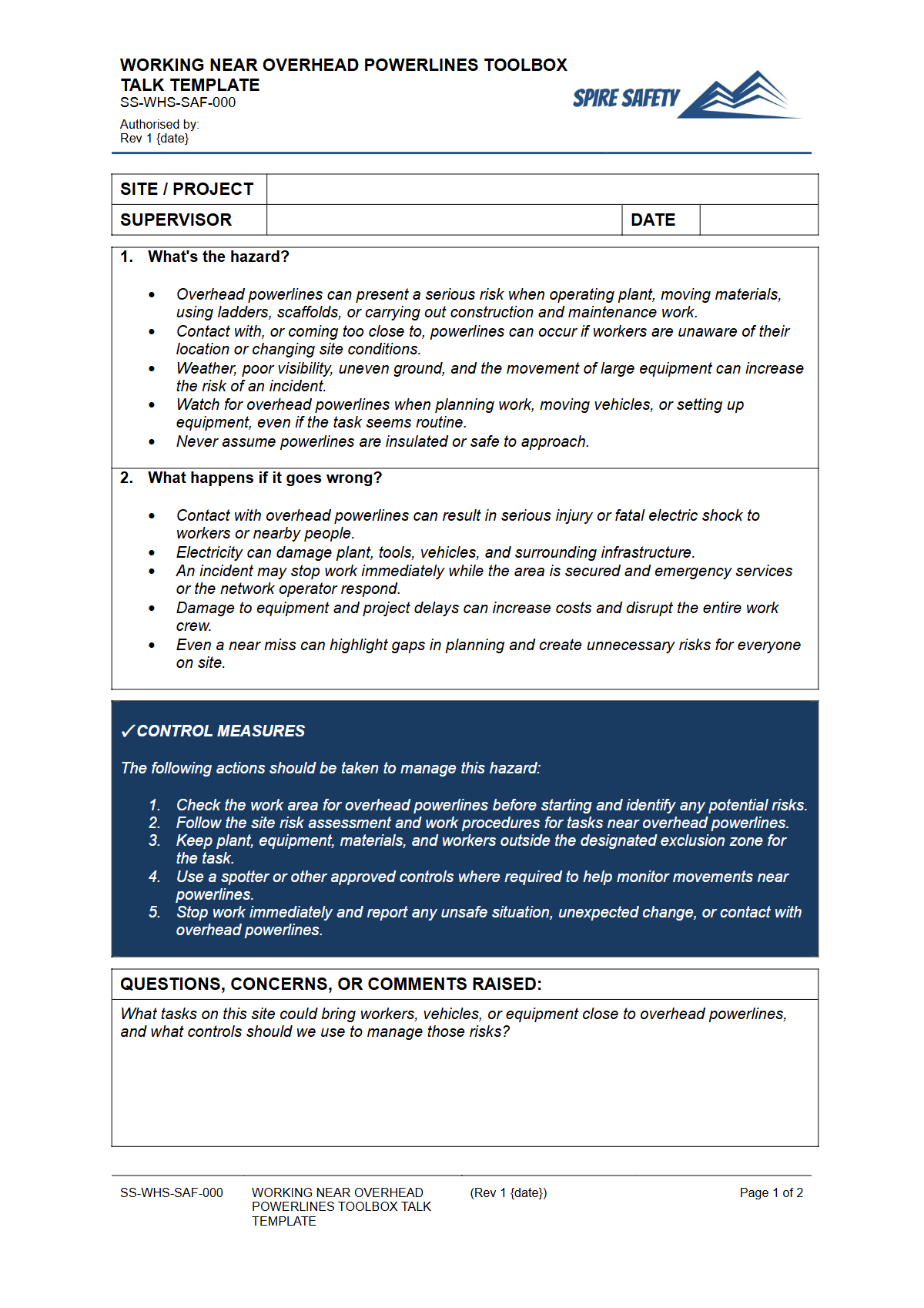
Our free Working Near Overhead Powerlines Toolbox Talk Template provides a structured framework for delivering essential safety discussions. This resource helps supervisors and team leaders facilitate conversations about the significant hazards associated with working near overhead powerlines, including the risks of electrocution, arcing, and contact.
It outlines key control measures and safe work practices to prevent incidents, promoting a proactive safety culture within your organisation. Using this template helps ensure that all workers understand their responsibilities and the critical precautions required when operations bring them into proximity with electrical infrastructure.
Video walkthrough
How to use this Toolbox Talk
Download this free Working Near Overhead Powerlines Toolbox Talk Template in DOCX format to begin. We’ve designed it to be a flexible foundation that you must customise to your specific workplace conditions, equipment, personnel, and operational procedures.
Before conducting the toolbox talk, review the content and adapt it to reflect the unique aspects of your work environment. Consider adding specific examples relevant to recent incidents (if any) or particular challenges your team faces.
Facilitate an open discussion, encouraging workers to ask questions and share their experiences and concerns. Document attendance and any key takeaways or actions points.
While this template is based on the model WHS framework, its effectiveness and alignment with Australian WHS practice depend entirely on how you customise and implement it within your specific context. For comprehensive guidance on risk management, consider our WHS consulting services.
When to use it
This Toolbox Talk is ideal for use before commencing work that involves or has the potential to involve activities near overhead powerlines. This includes tasks such as operating plant and equipment, scaffolding, erecting structures, or any elevated work.
It should also be used as part of routine safety meetings, following any changes in work procedures, equipment, or personnel, or after any near-miss incidents related to powerline proximity. Regular discussions with this framework reinforce safety protocols and keep the risks of working near overhead powerlines top of mind for all workers. It’s a vital component of any robust approach to WHS management systems.
Who should use it
This resource is primarily for supervisors, team leaders, project managers, and safety officers responsible for planning and overseeing work activities in proximity to overhead powerlines. It is also beneficial for WHS representatives who facilitate safety discussions and promote a safe working environment.
All workers who may be involved in or affected by such operations should participate in the toolbox talk itself. This ensures a consistent understanding of risks and safety procedures across the entire team, fostering shared responsibility for safety.
Common mistakes
Common mistakes to avoid
- Failing to conduct a thorough site-specific risk assessment before work begins.
- Not verifying exclusion zones with the electrical asset owner.
- Relying on visual estimation instead of using measuring devices for clearances.
- Inadequate communication between operators, spotters, and supervisors about powerline hazards.
Legal references
Legal considerations
The following legal requirements may be relevant to this type of work.
- Work Health and Safety Act (Harmonised) — Provides the primary duties for protecting workers and other people from work health and safety risks.
- Work Health and Safety Regulations (Harmonised) — Sets out requirements supporting the management of workplace hazards and risks.
The following codes may be relevant to this type of work.
- Managing WHS Risks Code of Practice — Provides practical guidance on identifying hazards, assessing risks and applying effective controls.
- Work Health and Safety Consultation, Cooperation and Coordination Code of Practice — Provides practical guidance on consulting workers and coordinating with other duty holders.
- Managing the Work Environment and Facilities Code of Practice — Provides practical guidance on safe work environments, workplace facilities and related controls.
Did you know
Understanding Exclusion Zones
Defined exclusion zones around overhead powerlines are legally mandated to prevent accidental contact. These distances vary based on voltage and local regulations, highlighting the importance of proper planning and assessment.
Hidden Dangers of Electricity
Electrical current from powerlines can arc or 'jump' to objects or people without direct contact, especially in damp conditions. Always assume powerlines are live and dangerous, even if there's no visible indication of current.
FAQ
Frequently asked questions
01What is a Toolbox Talk for Working Near Overhead Powerlines?
02Why is it important to use a Toolbox Talk for this topic?
03How often should we deliver a Toolbox Talk on Working Near Overhead Powerlines?
04Are there other free WHS resources available?
Share this resource
Working Near Overhead Powerlines Toolbox Talk Template
Browse Categories
How To Use It
- 1Download and open in Word or PDF.
- 2Replace the placeholders with your business details.
- 3Get it reviewed by a WHS specialist before rollout.
Need it customised?
Our WHS consultants can adapt this template to your site, run a gap analysis, or audit what you already have in place.
Book a Free Consultation WHS consulting servicesor call 1300 156 382
Related templates
- Working Safely After Natural Disaster Toolbox Talk Template
- Working Safely Under Pressure Deadlines Toolbox Talk Template
- Workplace Bullying and Harassment Toolbox Talk Template
- Aged Care Manual Handling Toolbox Talk Template
- Angle Grinder Safety Toolbox Talk Template
- Asbestos Awareness Toolbox Talk Template