
Working Safely Under Pressure Deadlines Toolbox Talk Template
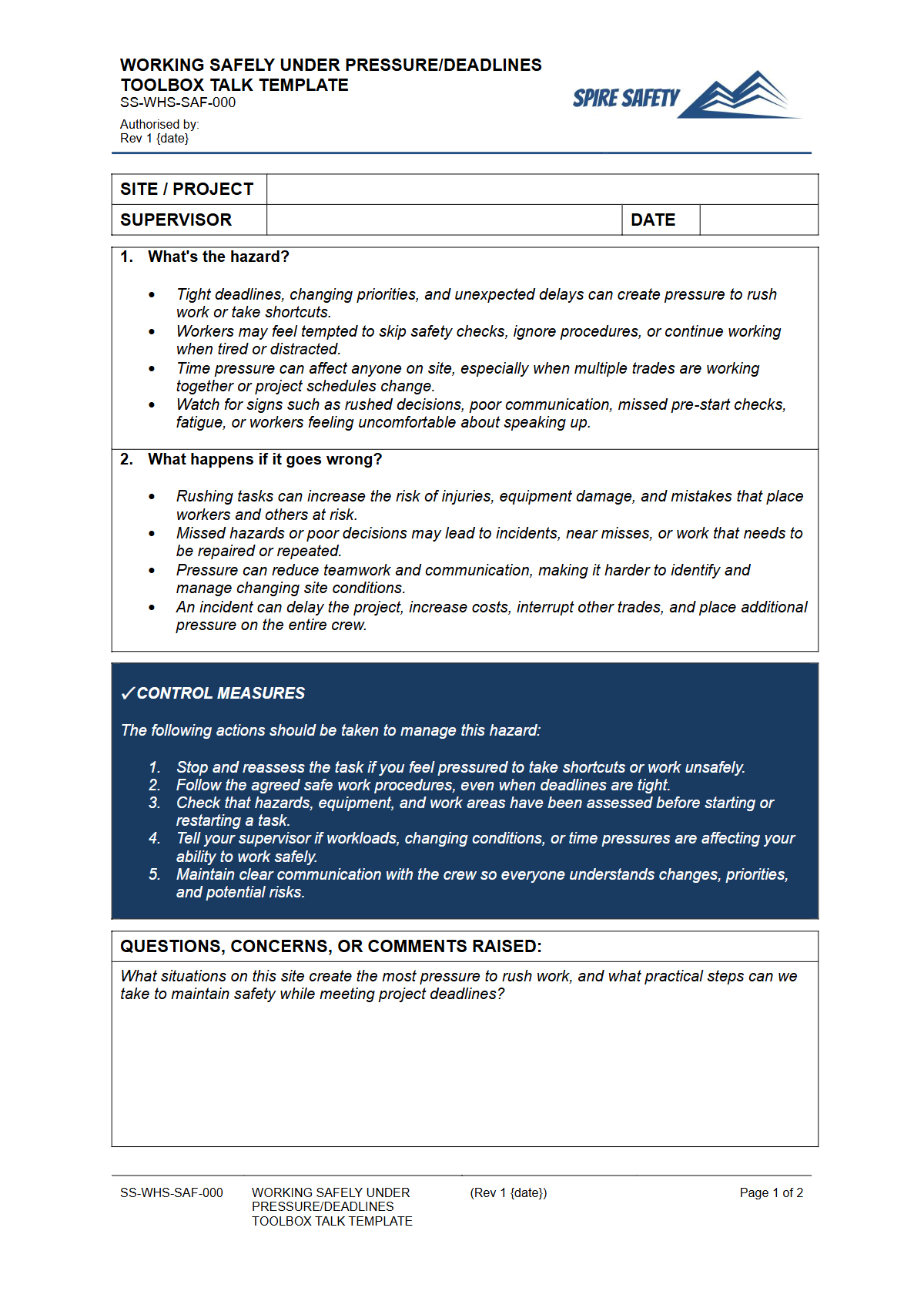
Download our free template for a Toolbox Talk on working safely under pressure deadlines. A structured starting point for your WHS discussions.
Working Safely Under Pressure Deadlines Toolbox Talk Template
DOCX • 141 KB + PDF
Updated Oct 2026
No signup required
Purpose of this document
This Toolbox Talk template provides a structured starting point for discussions with your team about managing work safely when facing pressure and tight deadlines. It aims to help organisations recognise and address the psychosocial hazards associated with high-pressure work environments, promoting proactive risk management and supporting worker wellbeing.
The resource facilitates conversations about identifying stressors, implementing control measures, and fostering a supportive work culture where safety is not compromised by time constraints.
By utilising this template, businesses can consistently communicate expectations regarding safe work practices, even when operational demands are high. It encourages an open dialogue between management and workers, which is crucial for identifying workplace-specific issues and developing effective, tailored solutions.
Video walkthrough
How to use this Toolbox Talk
Our Working Safely Under Pressure Deadlines Toolbox Talk template is designed to be a pragmatic tool for workplace safety discussions. Download the DOCX file, which allows for full customisation to reflect the specific operations, terminology, and risks present in your workplace.
Remember, this template must be customised to your workplace conditions, specific roles, and relevant hazards. Simply reading it aloud without adaptation will not be effective or satisfy your WHS obligations.
We recommend you:
- Review the entire document and adapt the language to suit your team's understanding and the industry context.
- Insert examples of deadlines and pressure points common in your specific work environment.
- Discuss potential physical and psychological impacts of working under pressure and existing control measures.
- Facilitate an open discussion, encouraging workers to share their experiences and contribute ideas for better risk management.
- Document attendance, discussion points, and any agreed actions for your WHS records.
- Consider integrating these discussions into your broader WHS management systems.
When to use it
This Toolbox Talk is particularly valuable during periods of high workload, before commencing projects with tight deadlines, or following incidents where pressure may have been a contributing factor. It's also suitable as part of an ongoing WHS training schedule focusing on psychosocial hazards.
Regular discussions about working safely under pressure deadlines help to embed a safety-first culture, ensuring that employees feel supported and equipped to manage their workload without compromising health and safety.
It can also be a proactive measure when introducing new projects, changes in work processes, or any shift that might increase demand on workers. Utilising it before issues arise helps to prevent the escalation of stress-related incidents and promotes a healthier work environment.
Who should use it
This template is primarily intended for persons conducting a business or undertaking (PCBUs), WHS managers, supervisors, team leaders, and anyone responsible for facilitating safety discussions with workers. It is also a valuable resource for WHS committees and worker representatives who play a role in identifying and addressing workplace risks.
The content is accessible and relevant for all workers, encouraging their active participation in discussions about managing workplace pressures. Spire Safety also offers WHS consulting services for organisations needing more in-depth support.
Common mistakes
Common mistakes to avoid
- Not customising the template to your specific workplace conditions and hazards.
- Delivering the Toolbox Talk as a lecture rather than an interactive discussion.
- Failing to document attendance and any actions agreed upon during the talk.
- Not following up on actions or concerns raised by workers during the session.
Legal references
Legal considerations
The following legal requirements may be relevant to this type of work.
- Work Health and Safety Act (Harmonised) — Provides the primary duties for protecting workers and other people from work health and safety risks.
- Work Health and Safety Regulations (Harmonised) — Sets out requirements supporting the management of workplace hazards and risks.
The following codes may be relevant to this type of work.
- Managing WHS Risks Code of Practice — Provides practical guidance on identifying hazards, assessing risks and applying effective controls.
- Work Health and Safety Consultation, Cooperation and Coordination Code of Practice — Provides practical guidance on consulting workers and coordinating with other duty holders.
- Managing the Work Environment and Facilities Code of Practice — Provides practical guidance on safe work environments, workplace facilities and related controls.
Did you know
Psychosocial Hazards Impact
According to Safe Work Australia, psychosocial hazards, including high job demands and low job control, are a leading cause of work-related stress and can significantly impact mental and physical health.
Benefits of Open Communication
Organisations that foster open communication about workplace pressures often see improved employee morale, reduced absenteeism, and a stronger safety culture, contributing to overall business resilience.
FAQ
Frequently asked questions
01What is a 'Toolbox Talk'?
02Why is working safely under pressure important?
03How often should we hold Toolbox Talks?
04Can this template help with WHS compliance?
Share this resource
Working Safely Under Pressure Deadlines Toolbox Talk Template
Browse Categories
How To Use It
- 1Download and open in Word or PDF.
- 2Replace the placeholders with your business details.
- 3Get it reviewed by a WHS specialist before rollout.
Need it customised?
Our WHS consultants can adapt this template to your site, run a gap analysis, or audit what you already have in place.
Book a Free Consultation WHS consulting servicesor call 1300 156 382