
Asbestos Awareness Toolbox Talk Template
Download our free Asbestos Awareness Toolbox Talk Template to educate your team on asbestos risks and safe work practices. Get your copy today!
Asbestos Awareness Toolbox Talk Template
DOCX • 141 KB + PDF
Updated Oct 2026
No signup required
Purpose of this document
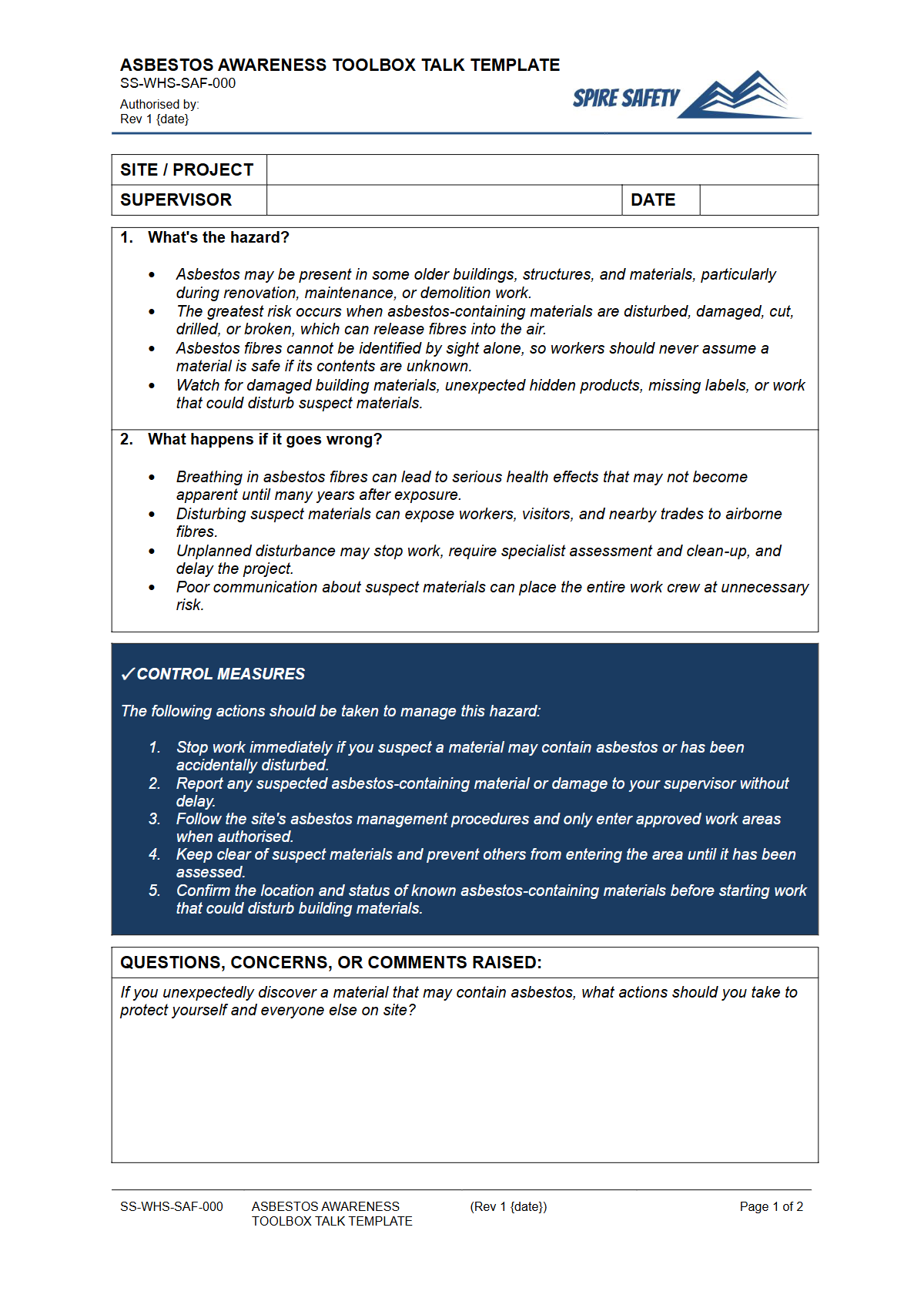
This Asbestos Awareness Toolbox Talk Template is designed to facilitate crucial discussions about the risks associated with asbestos-containing materials (ACMs) in the workplace. It provides a structured framework for educating workers, supervisors, and others about recognising potential asbestos hazards, understanding exposure risks, and implementing appropriate control measures. The template aims to promote a proactive approach to safety, ensuring that all personnel are aware of their responsibilities when working in environments where asbestos may be present. By utilising this resource, organisations can enhance their safety culture and contribute to the prevention of asbestos-related diseases.
Video walkthrough
How to use this Toolbox Talk
Our free Asbestos Awareness Toolbox Talk Template is provided in a customisable DOCX format, making it easy to adapt to your specific operational needs. Download the document and review its content, then tailor it to reflect the specific asbestos risks, control measures, and procedures relevant to your workplace. Remember, this is a starting point; it must be customised to your workplace, specific tasks, and the risks identified within your operational environment. Consider incorporating photos or site-specific examples where possible to make the information more relatable and impactful for your team.
During the session, encourage open discussion and questions to ensure that all participants fully understand the information presented. Document attendance and any actions or follow-up required. This template, aligned with Australian WHS practice, serves as a valuable tool within your broader WHS management systems to maintain a safe working environment and demonstrate a commitment to worker health and safety.
When to use it
This Asbestos Awareness Toolbox Talk Template is ideal for use during:
- Inductions for new employees or contractors who may encounter asbestos during their work.
- Regular safety meetings, particularly before commencing work at sites where asbestos is known or suspected to be present.
- Refresher training sessions to reinforce knowledge and keep asbestos awareness at the forefront of workers' minds.
- Following any changes to work procedures, legislation, or the discovery of new information regarding asbestos in your workplace.
- As part of continuous improvement initiatives in your organisation's WHS program.
Who should use it
This Toolbox Talk is suitable for a wide range of personnel including:
- WHS Managers and Officers responsible for delivering safety training.
- Supervisors and Team Leaders who need to brief their teams on specific job hazards.
- Workers across various industries, especially those in construction, demolition, maintenance, plumbing, electrical, and other trades where exposure to asbestos is a known risk.
- Contractors working on sites where asbestos may be encountered.
- Anyone involved in identifying, managing, or working near asbestos-containing materials.
Common mistakes
Common mistakes to avoid
- Failing to identify and register asbestos-containing materials in the workplace.
- Undertaking work that disturbs asbestos without proper training, controls, and licensing.
- Not providing adequate personal protective equipment (PPE) for asbestos-related tasks.
- Neglecting to consult with workers on asbestos management plans and procedures.
Legal references
Legal considerations
The following legal requirements may be relevant to this type of work.
- Work Health and Safety Act (Harmonised) — Provides the primary duties for protecting workers and other people from work health and safety risks.
- Work Health and Safety Regulations (Harmonised) — Sets out requirements supporting the management of workplace hazards and risks.
The following codes may be relevant to this type of work.
- Managing WHS Risks Code of Practice — Provides practical guidance on identifying hazards, assessing risks and applying effective controls.
- Work Health and Safety Consultation, Cooperation and Coordination Code of Practice — Provides practical guidance on consulting workers and coordinating with other duty holders.
- Managing the Work Environment and Facilities Code of Practice — Provides practical guidance on safe work environments, workplace facilities and related controls.
Did you know
Asbestos Ban in Australia
Australia banned the manufacture, use, and import of all asbestos-containing materials on 31 December 2003, but many older buildings and structures still contain asbestos.
Hidden Hazard
Asbestos fibres are microscopic and can be inhaled without being seen or smelt, making awareness and careful management crucial for prevention of serious health issues.
FAQ
Frequently asked questions
01What is the purpose of asbestos awareness training?
02Does this template guarantee WHS compliance for asbestos management?
03How often should asbestos awareness training be conducted?
04Where can I find more free WHS resources for my business?
Share this resource
Asbestos Awareness Toolbox Talk Template
Browse Categories
How To Use It
- 1Download and open in Word or PDF.
- 2Replace the placeholders with your business details.
- 3Get it reviewed by a WHS specialist before rollout.
Need it customised?
Our WHS consultants can adapt this template to your site, run a gap analysis, or audit what you already have in place.
Book a Free Consultation WHS consulting servicesor call 1300 156 382