
Compressed Air Safety Toolbox Talk Template
Download our Compressed Air Safety Toolbox Talk Template. A free, customisable resource to help manage risks associated with compressed air in your workplace.
Compressed Air Safety Toolbox Talk Template
DOCX • 141 KB + PDF
Updated Oct 2026
No signup required
Purpose of this document
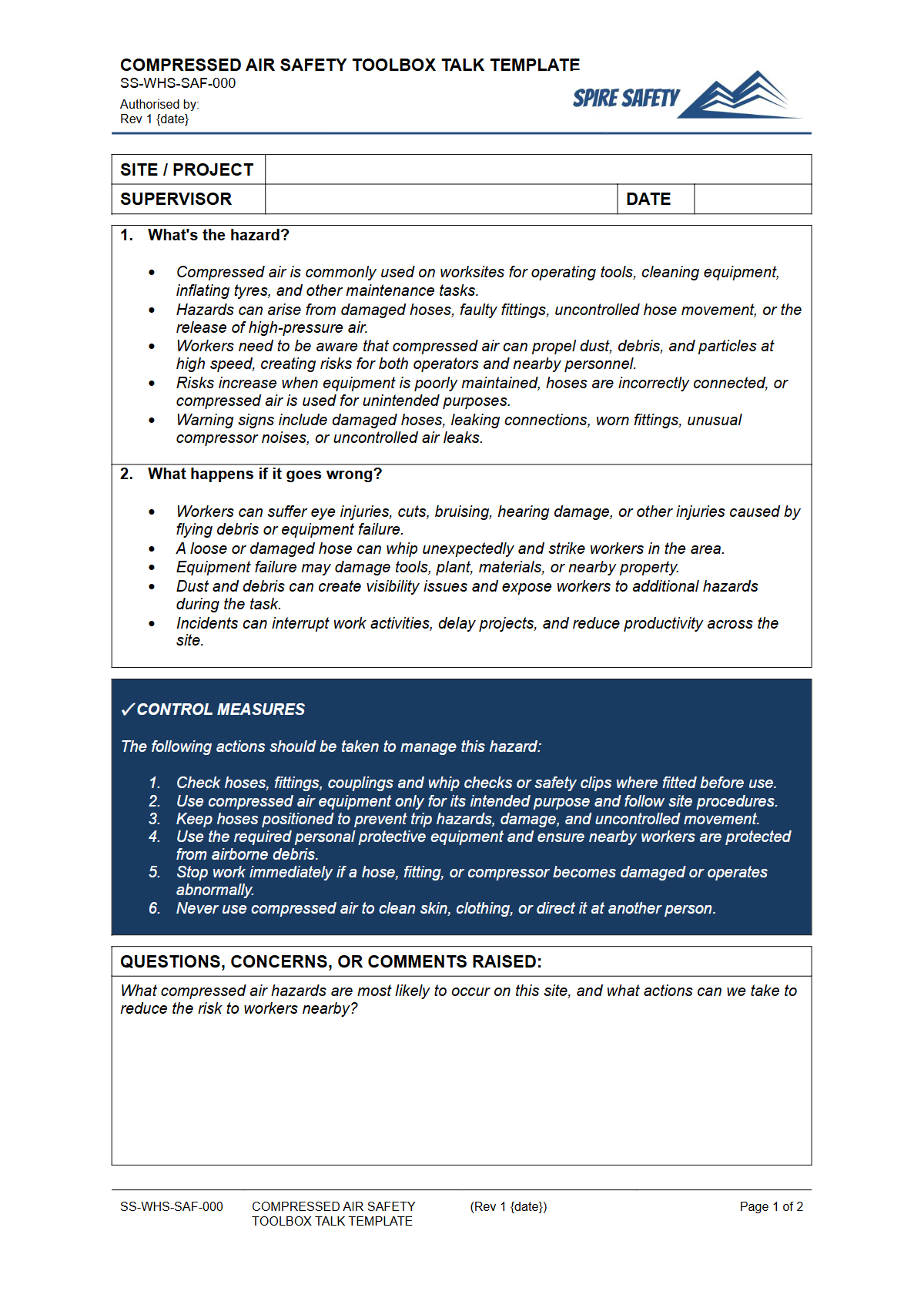
This Compressed Air Safety Toolbox Talk Template provides a structured framework for delivering essential safety information to your workers. Compressed air, while a versatile and powerful tool, poses significant hazards if not managed correctly. This template aims to facilitate discussions on safe operating procedures, potential risks, and control measures specific to compressed air systems and equipment.
Using this template will help your organisation reinforce critical safety behaviours, prevent incidents, and foster a proactive safety culture. It covers key aspects such as proper equipment inspection, safe handling practices, the dangers of misusing compressed air, and the importance of appropriate personal protective equipment (PPE).
Video walkthrough
How to use this Toolbox Talk Topic
This Toolbox Talk template is designed for managers, supervisors, and safety officers to deliver concise, impactful safety briefings. It's laid out in a clear, easy-to-follow format, encouraging interactive discussion rather than a one-way lecture. Before each session, review the content thoroughly and prepare to facilitate questions and share relevant workplace-specific examples.
Ensure you customise this template to your workplace's specific compressed air equipment, processes, and identified hazards. No two workplaces are identical, and effective safety discussions always reflect the unique risks present in your operational environment. Supplement the discussion with demonstrations where appropriate, such as showing the correct way to connect air hoses or inspect pressure gauges. Document attendance and any actions agreed upon during the talk, maintaining these records as part of your overall WHS management systems.
When to use it
This Compressed Air Safety Toolbox Talk Template should be used regularly as part of your ongoing safety program. Optimal timings include:
Before commencing work involving new or unfamiliar compressed air equipment.
As a refresher training session, particularly after any incidents or near misses involving compressed air.
During onboarding for new workers who will be using or working near compressed air systems.
When reviewing or updating your workplace's safe work procedures for compressed air.
As part of routine safety meetings to maintain a high level of hazard awareness.
Regular safety communication, like that facilitated by this template, is a cornerstone of effective hazard control and risk management.
Who should use it
This Compressed Air Safety Toolbox Talk Template is suitable for:
Managers and Supervisors: To lead safety discussions and ensure their teams are informed about compressed air hazards and controls.
Safety Officers and WHS Representatives: To integrate into broader WHS training programs and promote a safer working environment.
Workers: As a resource for understanding their responsibilities and contributing to a safer workplace when interacting with compressed air systems.
Anyone involved in operating, maintaining, or supervising tasks that utilise compressed air: This includes tradespeople, mechanics, production line workers, and maintenance personnel. By consistently delivering and participating in these talks, your organisation reinforces its commitment to safety and compliance with WHS regulations. For more free WHS resources, visit our free WHS resources library.
Common mistakes
Common mistakes to avoid
- Failing to inspect hoses and fittings for damage before use.
- Using compressed air for horseplay or cleaning skin/clothing.
- Operating pneumatic tools without proper guarding or instruction.
- Not wearing appropriate personal protective equipment (PPE) like eye and hearing protection.
- Leaving hoses under pressure when not in use.
Legal references
Legal considerations
The following legal requirements may be relevant to this type of work.
- Work Health and Safety Act (Harmonised) — Provides the primary duties for protecting workers and other people from work health and safety risks.
- Work Health and Safety Regulations (Harmonised) — Sets out requirements supporting the management of workplace hazards and risks.
The following codes may be relevant to this type of work.
- Managing WHS Risks Code of Practice — Provides practical guidance on identifying hazards, assessing risks and applying effective controls.
- Work Health and Safety Consultation, Cooperation and Coordination Code of Practice — Provides practical guidance on consulting workers and coordinating with other duty holders.
- Managing the Work Environment and Facilities Code of Practice — Provides practical guidance on safe work environments, workplace facilities and related controls.
Did you know
Invisible Danger
A compressed air stream as low as 10-15 psi can be strong enough to propel small particles at speeds capable of causing severe eye injuries or even forcing air into the body through an open wound or body orifice.
Noise Exposure
Continuous exposure to noise from compressed air exhausts or pneumatic tools can lead to permanent hearing damage if not adequately controlled with engineering measures and appropriate hearing protection.
FAQ
Frequently asked questions
01What are the main hazards of compressed air?
02How often should toolbox talks be conducted for compressed air safety?
03What PPE is required when working with compressed air?
04Can I use compressed air to clean clothing or skin?
Share this resource
Compressed Air Safety Toolbox Talk Template
Browse Categories
How To Use It
- 1Download and open in Word or PDF.
- 2Replace the placeholders with your business details.
- 3Get it reviewed by a WHS specialist before rollout.
Need it customised?
Our WHS consultants can adapt this template to your site, run a gap analysis, or audit what you already have in place.
Book a Free Consultation WHS consulting servicesor call 1300 156 382