
Contractor Safety Responsibilities Toolbox Talk Template
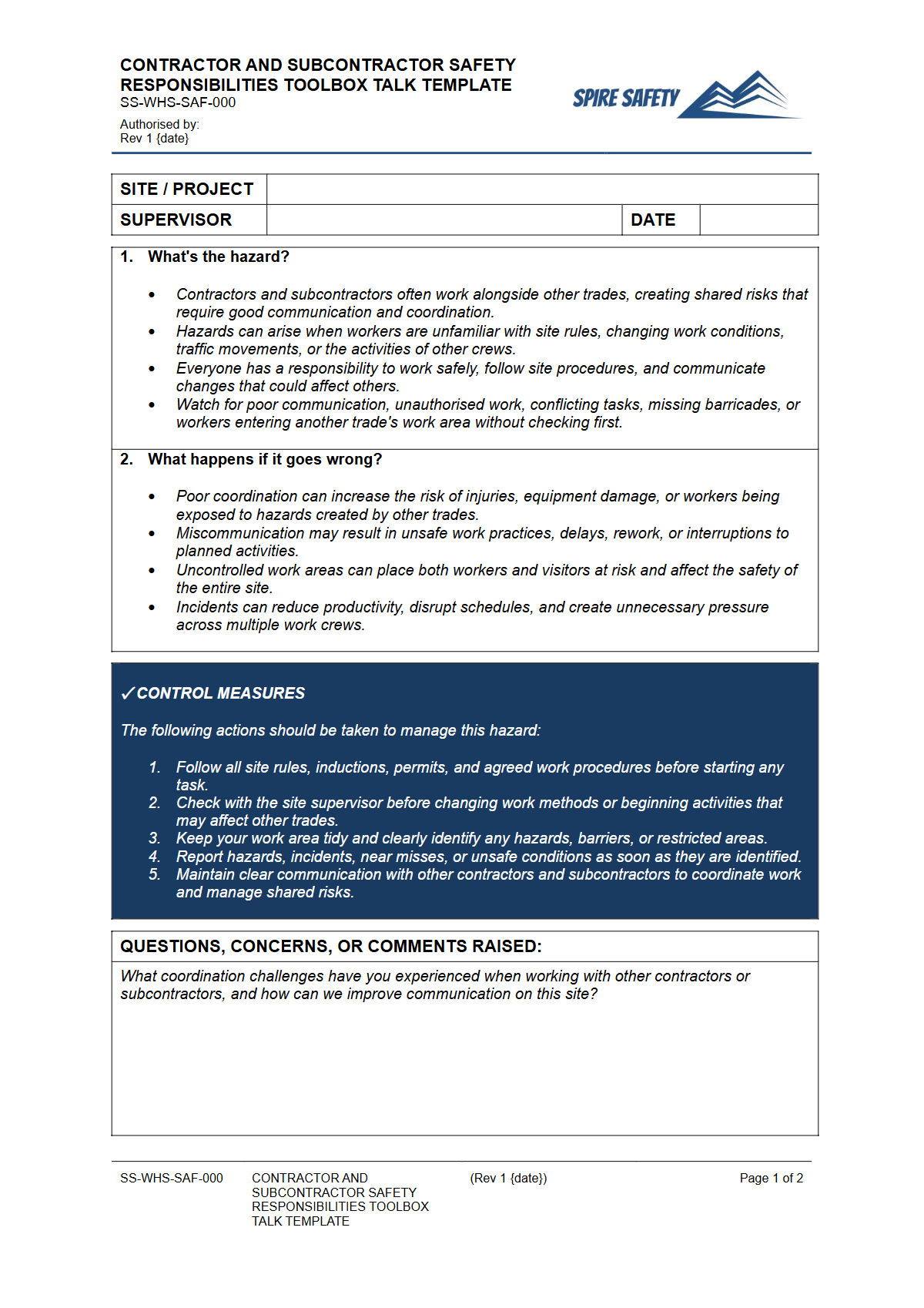
Understand and communicate contractor safety responsibilities with this free Contractor Safety Responsibilities Toolbox Talk Template.
Contractor Safety Responsibilities Toolbox Talk Template
DOCX • 141 KB + PDF
Updated Oct 2026
No signup required
Purpose of this document
This Contractor Safety Responsibilities Toolbox Talk Template provides a structured starting point for discussions on managing WHS risks associated with contractors. It’s designed to help Person Conducting a Business or Undertaking (PCBUs) and their workers understand the shared and individual responsibilities when engaging contractors, ensuring a safe working environment for everyone involved. This template focuses on key aspects relevant to Australian workplaces, aligning with general WHS principles.
Engaging contractors introduces different dynamics to workplace safety. This Toolbox Talk aims to facilitate open communication, clarify expectations, and promote a consistent approach to WHS management. It helps ensure that contractors recognise and fulfil their safety obligations, and that the PCBU provides the necessary information and controls to minimise risks. Regular discussions using resources like this template are crucial for maintaining vigilance and fostering a strong safety culture.
Video walkthrough
How to use this Toolbox Talk
This template is provided in a convenient DOCX format, making it easy to download and edit. To effectively use this Contractor Safety Responsibilities Toolbox Talk Template, you must customise it to your specific workplace, the nature of the work being carried out, and the type of contractors engaged. Consider the unique hazards and risks present in your operational environment and tailor the content accordingly. We recommend adding site-specific examples and recent incidents (if applicable) to make the discussion more relevant and engaging for your team.
Before conducting the Toolbox Talk, ensure you are familiar with its content and prepared to answer questions. Encourage open discussion and worker participation. Distribute copies, record attendance, and document any actions identified during the talk. This template is a foundational piece; its efficacy depends on thoughtful customisation and consistent application within your broader WHS management systems.
When to use it
This Contractor Safety Responsibilities Toolbox Talk Template is ideal for use during:
- Before a new contractor commences work on site.
- Induction processes for contractors and relevant internal staff.
- Regular WHS meetings or team briefings when contractor work is ongoing or planned.
- Following any incident or near-miss involving contractors, to reinforce expectations.
- As part of periodic reviews of your contractor management processes.
- When introducing new equipment, processes, or substances that contractors will interact with.
Using this Toolbox Talk proactively helps establish clear lines of responsibility and communication from the outset, reducing misunderstandings and enhancing safety outcomes.
Who should use it
- WHS Managers and Coordinators responsible for overseeing contractor engagement.
- Supervisors and Team Leaders managing teams who interact with contractors.
- Project Managers overseeing projects involving external contractors.
- PCBU representatives responsible for ensuring overall WHS compliance.
- Contractors themselves, as part of their induction or ongoing WHS refreshers.
- Anyone involved in the selection, engagement, or supervision of contractors, particularly in sectors like construction, manufacturing, or facilities management where contractor interaction is frequent.
For further assistance in developing robust contractor management frameworks or other WHS resources, explore our wider range of free WHS resources library or consider engaging our WHS consulting services.
Common mistakes
Common mistakes to avoid
- Not customising the Toolbox Talk to specific workplace risks or contractor tasks.
- Failing to document attendance and discussion points, including any follow-up actions.
- Not providing adequate opportunity for contractors and workers to ask questions or raise concerns.
- Assuming contractors are aware of site-specific WHS rules without explicit instruction.
Legal references
Legal considerations
The following legal requirements may be relevant to this type of work.
- Work Health and Safety Act (Harmonised) — Provides the primary duties for protecting workers and other people from work health and safety risks.
- Work Health and Safety Regulations (Harmonised) — Sets out requirements supporting the management of workplace hazards and risks.
The following codes may be relevant to this type of work.
- Managing WHS Risks Code of Practice — Provides practical guidance on identifying hazards, assessing risks and applying effective controls.
- Work Health and Safety Consultation, Cooperation and Coordination Code of Practice — Provides practical guidance on consulting workers and coordinating with other duty holders.
- Managing the Work Environment and Facilities Code of Practice — Provides practical guidance on safe work environments, workplace facilities and related controls.
Did you know
Shared Responsibility
In Australia, multiple PCBUs can have shared WHS duties concerning the same matter, including when engaging contractors. This means responsibilities can overlap and require collaboration.
High-Risk Work
Contractors performing high-risk work, such as in construction, often require specific WHS documentation like Safe Work Method Statements (SWMS) to outline how risks will be controlled. This template can help reinforce these requirements.
FAQ
Frequently asked questions
01What is a 'Toolbox Talk' in the WHS context?
02Why is it important to discuss contractor safety responsibilities?
03How often should contractor safety Toolbox Talks be conducted?
04Can this template be used for various types of contractors?
Share this resource
Contractor Safety Responsibilities Toolbox Talk Template
Browse Categories
How To Use It
- 1Download and open in Word or PDF.
- 2Replace the placeholders with your business details.
- 3Get it reviewed by a WHS specialist before rollout.
Need it customised?
Our WHS consultants can adapt this template to your site, run a gap analysis, or audit what you already have in place.
Book a Free Consultation WHS consulting servicesor call 1300 156 382