
CPR and AED Awareness Toolbox Talk Template
Download our free CPR and AED Awareness Toolbox Talk Template (DOCX/PDF) for Australian workplaces. A structured starting point for critical safety discussions.
CPR and AED Awareness Toolbox Talk Template
DOCX • 143 KB + PDF
Updated Oct 2026
No signup required
Purpose of this document
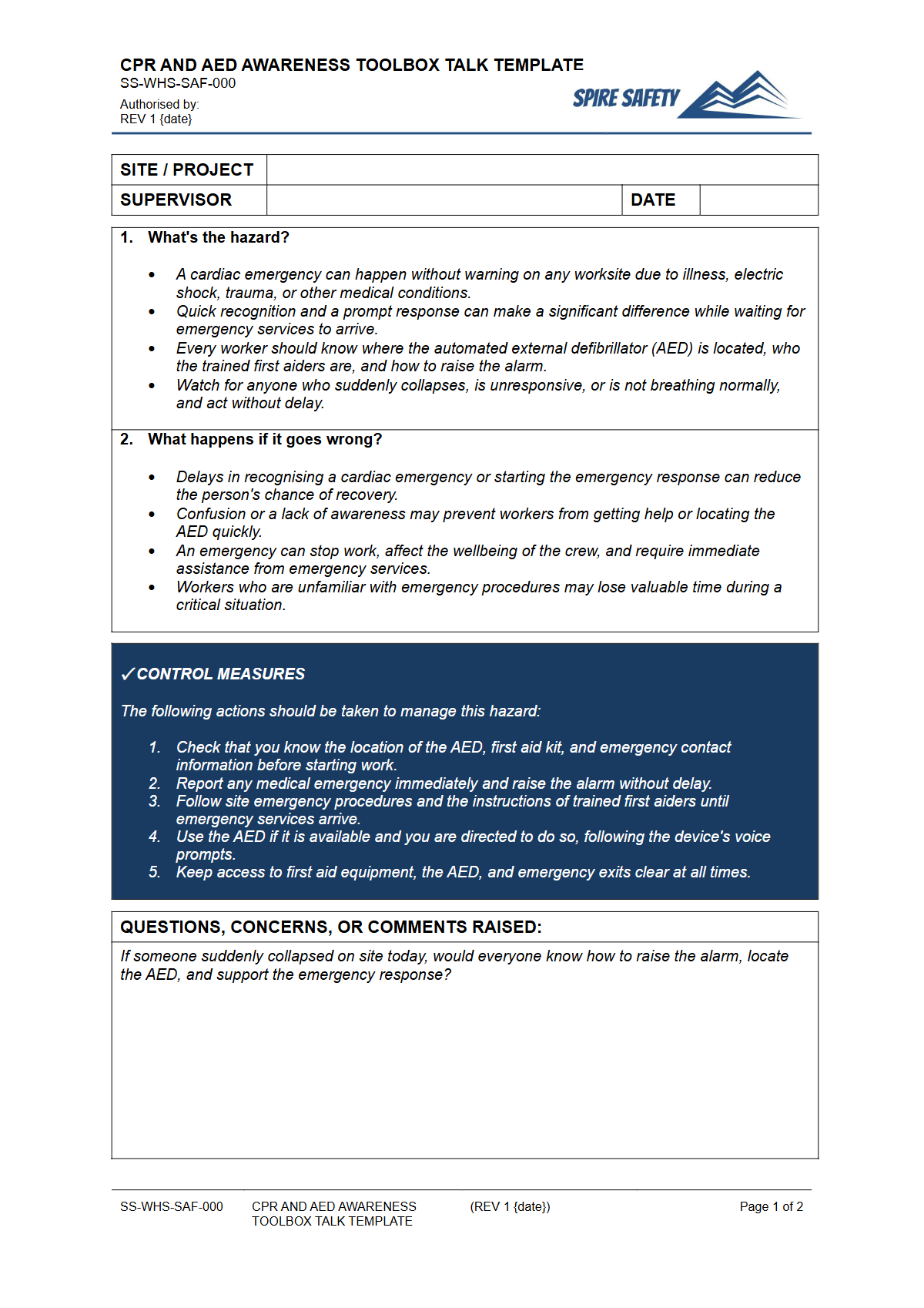
This free CPR and AED Awareness Toolbox Talk Template provides a structured framework for delivering essential safety information in Australian workplaces. Cardiopulmonary Resuscitation (CPR) and the use of Automated External Defibrillators (AEDs) are critical life-saving skills that can significantly improve outcomes in cardiac emergencies.
This template helps organisations conduct brief, focused discussions with their workers about recognising cardiac arrest, initiating CPR, and utilising readily available AEDs.
A well-prepared workforce, aware of fundamental emergency response procedures, is crucial for fostering a proactive safety culture. While this Toolbox Talk serves as an excellent starting point, it complements, rather than replaces, formal first aid and AED training.
It aims to reinforce knowledge, clarify procedures, and encourage open dialogue about emergency preparedness. This resource is aligned with Australian WHS practice, offering a practical tool for regular safety discussions, thereby enhancing worker confidence and contributing to overall workplace safety.
Video walkthrough
How to use this Toolbox Talk
This CPR and AED Awareness Toolbox Talk Template is provided in both DOCX and PDF formats, allowing for easy customisation and distribution. We recommend downloading the DOCX version to tailor the content specifically to your organisation’s unique context, including the precise location of AEDs, emergency contact details, and any site-specific protocols. Please note: this template must be customised to your workplace. We cannot ensure its suitability for your specific operational procedures without your input.
Before conducting the talk, familiarise yourself with the content and gather any relevant visual aids, such as an actual AED or a demonstration model. Encourage questions and active participation from your team.
Document attendance and key discussion points to maintain records of your safety training efforts. Regular discussions about critical safety topics like these are a cornerstone of effective WHS management systems.
When to use it
The CPR and AED Awareness Toolbox Talk Template is ideal for regular safety meetings, particularly:
- As part of an induction process for new workers, especially in high-risk environments.
- Following the installation of a new AED, or a change in its location within the workplace.
- After formal first aid or defibrillator training to reinforce key messages and practical steps.
- During annual safety reviews or as a refresher session to maintain a high level of preparedness.
- When reviewing emergency response plans or conducting emergency drills.
- In response to any workplace incident or near-miss where emergency first aid procedures were or could have been relevant.
Who should use it
This CPR and AED Awareness Toolbox Talk Template is designed for anyone responsible for WHS within an Australian organisation. This includes:
- WHS Managers and Coordinators.
- Supervisors and team leaders.
- Site managers and forepersons.
- Small business owners.
- First aid officers and emergency response team members.
- Anyone leading safety briefings or discussions within an organisation.
While the content is universally valuable, its effective delivery relies on individuals who can facilitate a conversation, answer basic questions, and encourage an open dialogue about emergency response. For more detailed guidance on WHS obligations, consider consulting with WHS consulting experts at Spire Safety, or explore our free WHS resources library for other useful templates and guides.
Common mistakes
Common mistakes to avoid
- Assuming someone else will act in an emergency.
- Not knowing the location of the nearest AED or emergency contacts.
- Failing to practise or refresh CPR skills regularly.
- Neglecting to customise templates for specific workplace hazards and procedures.
Legal references
Legal considerations
The following legal requirements may be relevant to this type of work.
- Work Health and Safety Act (Harmonised) — Provides the primary duties for protecting workers and other people from work health and safety risks.
- Work Health and Safety Regulations (Harmonised) — Sets out requirements supporting the management of workplace hazards and risks.
The following codes may be relevant to this type of work.
- Managing WHS Risks Code of Practice — Provides practical guidance on identifying hazards, assessing risks and applying effective controls.
- Work Health and Safety Consultation, Cooperation and Coordination Code of Practice — Provides practical guidance on consulting workers and coordinating with other duty holders.
- Managing the Work Environment and Facilities Code of Practice — Provides practical guidance on safe work environments, workplace facilities and related controls.
Did you know
AEDs can save lives
For every minute defibrillation is delayed, the chance of survival from sudden cardiac arrest decreases by about 10%. Access to and correct use of an AED can be a life-saving intervention.
Chain of Survival
The 'Chain of Survival' for cardiac arrest includes early recognition, early CPR, early defibrillation, and early advanced medical care. Each link is vital for a positive outcome.
FAQ
Frequently asked questions
01What is a Toolbox Talk?
02Why is CPR and AED awareness important in the workplace?
03Does this template replace formal first aid training?
04How often should CPR and AED awareness be discussed?
Share this resource
CPR and AED Awareness Toolbox Talk Template
Browse Categories
How To Use It
- 1Download and open in Word or PDF.
- 2Replace the placeholders with your business details.
- 3Get it reviewed by a WHS specialist before rollout.
Need it customised?
Our WHS consultants can adapt this template to your site, run a gap analysis, or audit what you already have in place.
Book a Free Consultation WHS consulting servicesor call 1300 156 382