
Customer Aggression and Personal Safety Toolbox Talk Template
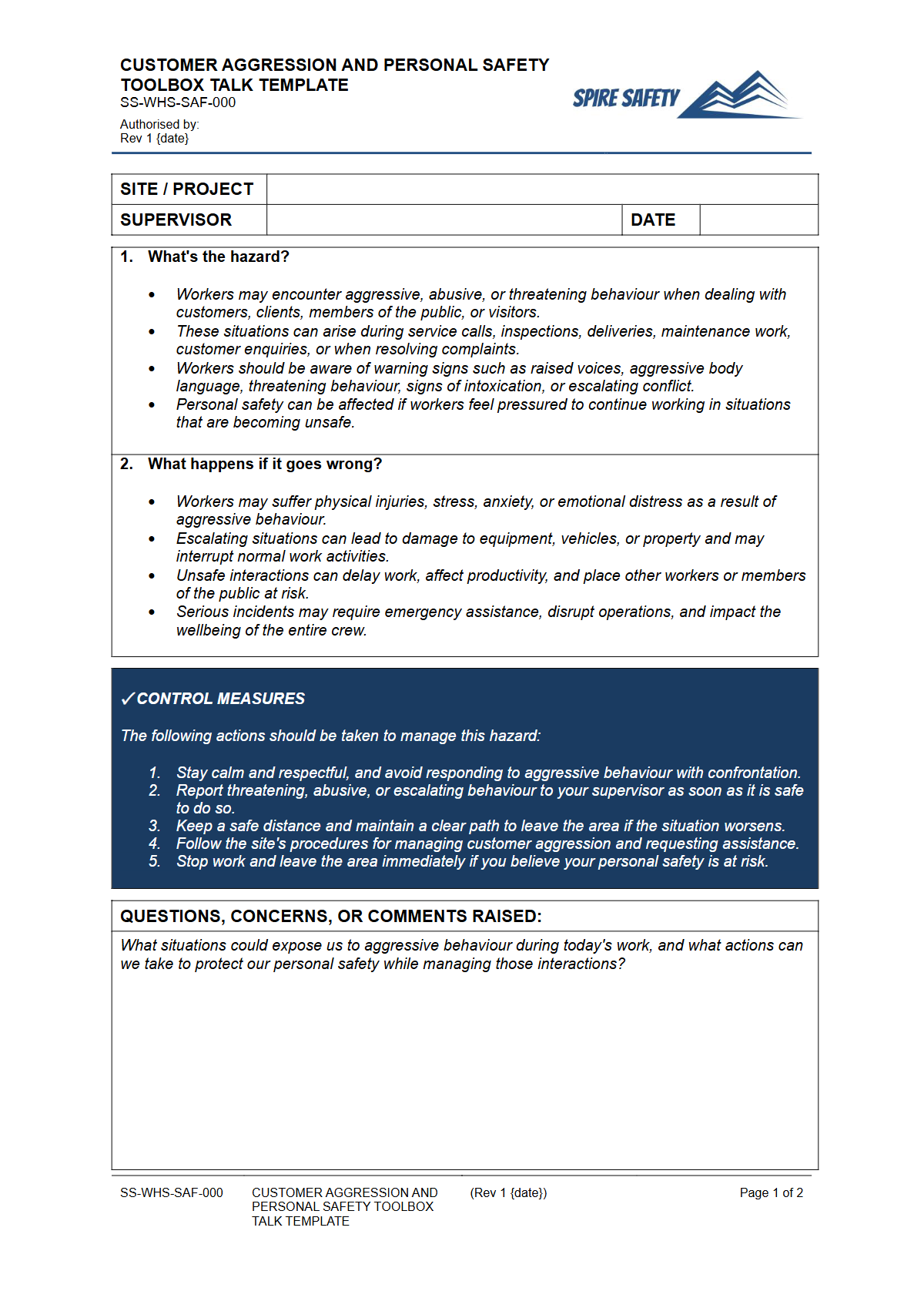
Addressing customer aggression at work? Download our free Customer Aggression and Personal Safety Toolbox Talk Template to empower your team.
Customer Aggression and Personal Safety Toolbox Talk Template
DOCX • 138 KB + PDF
Updated Oct 2026
No signup required
Purpose of this document
Our free Customer Aggression and Personal Safety Toolbox Talk Template is designed to help Australian workplaces address the risks associated with customer aggression. This template provides a structured starting point for discussions about identifying, assessing, and controlling hazards related to aggressive customer behaviour. It aims to foster a proactive safety culture by encouraging open communication about personal safety and the importance of effective response strategies. Recognising that every workplace environment is unique, this resource offers a flexible framework that businesses can adapt to their specific operational contexts and risk profiles.
Video walkthrough
How to use this Toolbox Talk
This Customer Aggression and Personal Safety Toolbox Talk Template is provided in an editable format (DOCX) to allow for complete customisation. It is crucial that you adapt this document to reflect the specific hazards, control measures, and procedures of your workplace. We recommend reviewing all sections, inserting relevant examples from your own operations, and ensuring that your team understands how to apply the information in their daily roles. Integrate this toolbox talk into your regular safety meetings to maintain awareness and encourage ongoing dialogue about personal safety. For comprehensive support in developing tailored WHS solutions, consider our WHS consulting services.
When to use it
This Toolbox Talk on Customer Aggression and Personal Safety is ideal for induction training for new employees, regular refresher sessions for all staff, or immediately following any incident involving challenging customer behaviour. It’s also beneficial to schedule these discussions when there are changes to roles, processes, or customer interaction points that might introduce new risks. Proactive use helps embed a culture of safety, while reactive application can serve as a critical learning opportunity post-incident.
Who should use it
Managers, supervisors, WHS officers, and team leaders responsible for the safety and well-being of their staff should utilise this template. It is particularly relevant for organisations where employees regularly interact with customers, clients, or the public, such as retail, healthcare, hospitality, service industries, and public-facing roles. The content aims to equip all workers with the knowledge and strategies to manage aggressive encounters safely and effectively, contributing to more robust WHS management systems.
Common mistakes
Common mistakes to avoid
- Not customising the template to specific workplace risks and scenarios.
- Failing to discuss specific warning signs and de-escalation techniques relevant to your industry.
- Not providing practical training or role-playing exercises alongside the discussion.
- Neglecting to follow up on identified improvements or review control measures regularly.
Legal references
Legal considerations
The following legal requirements may be relevant to this type of work.
- Work Health and Safety Act (Harmonised) — Provides the primary duties for protecting workers and other people from work health and safety risks.
- Work Health and Safety Regulations (Harmonised) — Sets out requirements supporting the management of workplace hazards and risks.
The following codes may be relevant to this type of work.
- Managing WHS Risks Code of Practice — Provides practical guidance on identifying hazards, assessing risks and applying effective controls.
- Work Health and Safety Consultation, Cooperation and Coordination Code of Practice — Provides practical guidance on consulting workers and coordinating with other duty holders.
- Managing the Work Environment and Facilities Code of Practice — Provides practical guidance on safe work environments, workplace facilities and related controls.
Did you know
Impact of Aggression
Work-related aggression and violence are significant contributors to psychological injury claims in Australia, highlighting the need for effective prevention and response strategies.
Proactive vs. Reactive
Proactive measures, like regular toolbox talks and training, are far more effective in reducing incidents of customer aggression than solely reacting after an event occurs.
FAQ
Frequently asked questions
01What is considered customer aggression in a WHS context?
02How often should we deliver a toolbox talk on customer aggression?
03Does this template ensure WHS compliance regarding customer aggression?
04Where can I find more free WHS resources like this one?
Share this resource
Customer Aggression and Personal Safety Toolbox Talk Template
Browse Categories
How To Use It
- 1Download and open in Word or PDF.
- 2Replace the placeholders with your business details.
- 3Get it reviewed by a WHS specialist before rollout.
Need it customised?
Our WHS consultants can adapt this template to your site, run a gap analysis, or audit what you already have in place.
Book a Free Consultation WHS consulting servicesor call 1300 156 382